


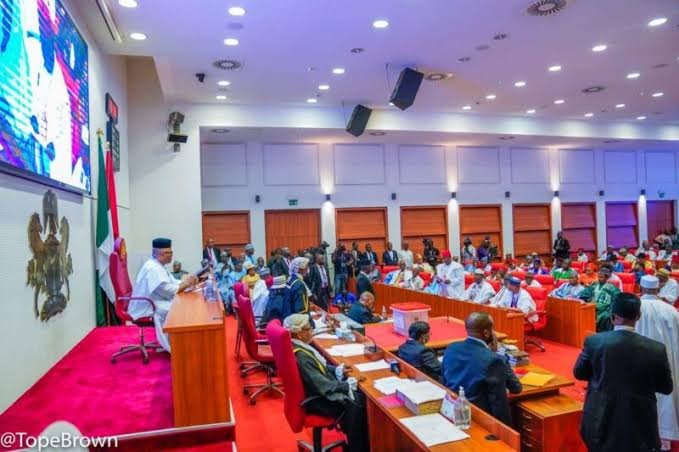
The Senate has declared the escalating lead poisoning crisis in Ogijo, a crowded community linking Lagos and Ogun States, a national emergency. Lawmakers issued the warning on Thursday after reviewing fresh evidence that confirmed widespread and dangerous contamination from years of unregulated battery-recycling activities.
Senators said the toxic exposure has now grown into a severe public health disaster. They warned that thousands of residents, especially children, mothers and factory workers, face deadly long-term health risks. They blamed the situation on used lead-acid battery smelters that operated for years with little oversight.
The motion, sponsored by Senator Mukhail Adetokunbo Abiru of Lagos East and Senator Gbenga Daniel of Ogun East, detailed the shocking environmental damage. They said communities have inhaled poisonous fumes and dust for years without meaningful government intervention.
Senator Abiru described Ogijo as the site of an “environmental catastrophe of global significance.” He cited investigations that uncovered contamination levels up to 186 times above global safety limits. He added that residents suffer persistent headaches, seizures, abdominal pain, memory loss and declining cognitive ability. These symptoms match chronic lead exposure.

He also referenced findings by The Examination and The New York Times. Both investigations confirmed the poisoning through blood tests and soil analysis.
In a disturbing revelation, Abiru disclosed that processed lead from Ogijo entered global supply chains. According to him, the toxic metal reached foreign automobile manufacturers while local children breathed poisonous smoke.
“Children are dying slowly,” he warned. “Families have lived under poisonous smoke for years. This demands urgent federal intervention.”
Abiru acknowledged the shutdown of seven factories and the temporary suspension of lead-ingot exports by the Minister of State for Labour, Nkeiruka Onyejeocha. However, he insisted that enforcement remains weak and dangerous exposure continues. He noted that many affected families still live near highly contaminated sites.
The Senate praised Lagos and Ogun State Governments for early interventions. Yet lawmakers stressed that the Constitution requires the government to protect life and guarantee a safe environment. They said children in Ogijo cannot be sacrificed for industrial profit.
Senators across party lines backed the motion. They said the Ogijo tragedy must become a turning point for environmental justice and public health protection in Nigeria. They demanded strict regulation, stronger accountability and an end to hazardous industrial practices that endanger poor communities.
The Senate then issued far-reaching directives. It ordered the NCDC to deploy emergency medical teams for free toxicology screening, blood-lead testing and long-term treatment. It also demanded a full environmental cleanup of contaminated soil, water, air and household dust by the Ministry of Environment and NESREA.
It further mandated strict nationwide enforcement of safety standards for battery recyclers. It instructed NEMA to provide relief materials, clean water and temporary relocation for families in heavily polluted zones.
The Senate also directed multiple ministers to appear for a national briefing. It ordered the creation of a National Lead Poisoning Response Office under NEMA.
Finally, the Senate tasked the Committee on Legislative Compliance with ensuring full implementation within six weeks.
Lawmakers concluded that Ogijo must be restored and that Nigeria must never again allow unregulated industries to destroy vulnerable communities.




