



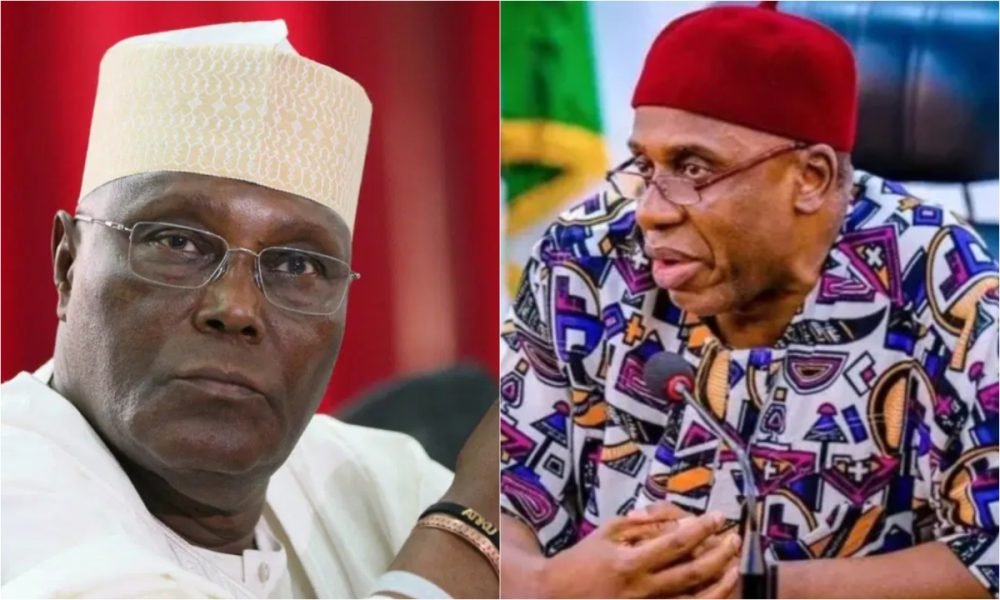
Nigeria’s already fragile democratic landscape has been thrown into renewed turmoil following grave allegations of an alleged plot to arrest, intimidate, and politically neutralize some of the country’s most prominent opposition figures. The alarm was raised by public affairs analyst and civic activist, Adekunle Adebayo, who warned that powerful forces within the state may be orchestrating a calculated clampdown aimed at silencing dissent and engineering a de facto one-party system under the guise of law enforcement and national security.
In a strongly worded statement obtained by DDM NEWS, Adebayo alleged that former Vice President Atiku Abubakar, former Rivers State Governor and ex-Minister of Transportation Rotimi Chibuike Amaechi, and former Kaduna State Governor Nasir Ahmad el-Rufai have been “marked” for arrest in what he described as a dangerous escalation of political repression in Africa’s most populous democracy. According to him, the alleged plan is not isolated or accidental but rather part of a broader, coordinated strategy to intimidate opposition voices, weaken pluralism, and consolidate power in the hands of the ruling establishment.
Adebayo’s claims, though yet to be officially confirmed by security agencies, have triggered intense debate across political, civil society, and diplomatic circles, reviving painful memories of Nigeria’s authoritarian past and raising questions about the direction of governance under the current political order.
A Pattern of Intimidation?
At the heart of Adebayo’s warning is the assertion that the alleged plot follows a worrying pattern that has been unfolding quietly but steadily across the political space. He pointed to the reported arrests, interrogations, and detentions of high-profile political actors in recent months, including former Sokoto State Governor Aminu Waziri Tambuwal, former Anambra State Governor and ex-Minister of Labour Chris Ngige, and former Attorney General of the Federation Abubakar Malami.

While government officials have consistently framed such actions as routine anti-corruption or security-related measures, critics argue that the timing, selectivity, and intensity of these actions suggest political motivations rather than impartial law enforcement. Adebayo contended that the alleged targeting of opposition figures reflects a deliberate strategy to cow political rivals into silence, weaken alternative power centers, and send a chilling message to anyone contemplating resistance to the ruling order.
“This is not about fighting corruption or enforcing the law,” Adebayo stated in his submission to DDM NEWS. “This is about using the instruments of the state to intimidate political opponents and frighten citizens into submission. When the law is applied selectively, democracy becomes a hollow shell.”
The Names on the List
According to Adebayo, the list of those allegedly being targeted goes beyond Atiku, Amaechi, and el-Rufai. He claimed that other influential political figures and former public office holders, including Isa Ali Pantami, Rauf Aregbesola, Kashim Ibrahim Imam, and several unnamed opposition strategists, are also under scrutiny and may face arrest, harassment, or prolonged investigations designed to weaken their political relevance.
The diversity of the alleged targets—spanning different regions, parties, and ideological backgrounds—has only deepened concerns that the campaign is less about accountability and more about eliminating perceived threats to the ruling political structure. Observers note that many of the named individuals are either vocal critics of the current administration or potential power brokers ahead of future electoral contests.
Atiku Abubakar, in particular, remains one of the most formidable opposition figures in the country, having contested multiple presidential elections and maintained a nationwide political network. Rotimi Amaechi, despite his past affiliation with the ruling party, has increasingly positioned himself as a critic of the political status quo, while Nasir el-Rufai has not hidden his discontent with certain policy directions and internal party dynamics. Their combined influence, analysts argue, makes them prime targets in any attempt to reshape the political battlefield ahead of future elections.
Constitutional Red Lines
Adebayo’s warning went beyond naming alleged targets; it also raised profound constitutional questions. He argued that any attempt to arrest or detain individuals based on political affiliation or opposition activity would constitute a blatant violation of the 1999 Constitution of the Federal Republic of Nigeria (as amended).
He cited provisions guaranteeing personal liberty, freedom of association and expression, equality before the law, and the independence of the judiciary, stressing that these rights are not optional privileges granted at the discretion of those in power but fundamental pillars of democratic governance.
“Selective application of law enforcement based on political affiliation is incompatible with constitutional democracy,” Adebayo warned. “Once the state begins to weaponize its coercive apparatus against political opponents, the line between democracy and authoritarianism is crossed.”
Legal experts who spoke to DDM NEWS echoed these concerns, noting that the legitimacy of any arrest depends not only on the existence of allegations but also on due process, transparency, and the absence of political interference. They cautioned that even the perception of politically motivated arrests can erode public trust in institutions, weaken the rule of law, and fuel instability.
One-Party State by Stealth?
Perhaps the most alarming aspect of Adebayo’s claims is his assertion that Nigeria is drifting toward a de facto one-party state, not through constitutional amendments or overt bans on opposition parties, but through a subtler, more insidious process of intimidation, selective justice, and political suffocation.
According to him, democratic institutions may continue to exist in form—elections will be held, courts will sit, and parties will operate—but their substance will be hollowed out if opposition figures are systematically harassed, arrested, or forced into political irrelevance.
This warning resonates with broader concerns raised by civil society organizations in recent years about shrinking civic space, increasing pressure on the media, and the use of security agencies to police dissent. Nigeria’s history, marked by long periods of military rule, makes these fears particularly potent.
“Democracy does not die overnight,” a senior civil society leader told DDM NEWS. “It dies slowly, through a thousand small cuts—intimidation here, selective prosecution there—until one day citizens wake up and realize that the institutions they relied on no longer protect them.”
Government Silence and Public Anxiety
As of the time of filing this report, neither the presidency nor relevant security agencies have issued an official response to Adebayo’s allegations. The silence has only fueled speculation and anxiety, with political actors across party lines calling for clarity and reassurance.
Some ruling party supporters have dismissed the claims as alarmist, arguing that no one is above the law and that investigations into former officials should not be politicized. However, critics counter that accountability must be even-handed and transparent, warning that justice perceived as partisan quickly loses legitimacy.
On social media and in political forums, Nigerians have expressed a mixture of skepticism, fear, and anger. Many recall past episodes where opposition figures were targeted under the guise of national security, only for charges to be dropped quietly once political objectives had been achieved.
International Implications
Adebayo also urged the international community to pay close attention to unfolding events, warning that Nigeria’s democratic health has implications far beyond its borders. As Africa’s largest economy and most populous nation, Nigeria is often seen as a bellwether for democratic governance on the continent.
Diplomats and international partners, he argued, should not wait until the situation deteriorates further before raising concerns. History, he noted, has shown that early warning signs of democratic erosion are often ignored until it is too late.
Foreign observers contacted by DDM NEWS declined to comment on specific allegations but emphasized the importance of rule of law, political pluralism, and respect for human rights in sustaining stable partnerships with Nigeria.
A Call to Vigilance
In his concluding remarks, Adebayo called on Nigerians from all walks of life—politicians, civil society actors, professionals, religious leaders, and ordinary citizens—to remain vigilant and resist any attempt to normalize political repression. He stressed that the defense of democracy is not the responsibility of opposition figures alone but a collective duty owed to future generations.
“Nigeria risks sliding into a system where democratic institutions exist only in form, while political power is consolidated through coercion and selective justice,” he warned. “If we fail to speak out now, we may soon find that the space to do so has disappeared.”
As the nation watches and waits, the allegations raised by Adekunle Adebayo have added a new layer of tension to Nigeria’s political atmosphere. Whether they will prompt transparency and reassurance from authorities or deepen mistrust and polarization remains to be seen. What is clear, however, is that the stakes are high. In a country still struggling to entrench democratic norms after decades of authoritarian rule, even the perception of politically motivated arrests can have far-reaching consequences.




