



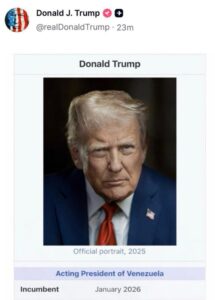
In a development that has sent shockwaves through global political circles and ignited fierce debate over international norms, US President Donald J. Trump has publicly styled himself as the “Acting President of Venezuela,” a self-styled title he shared in an unusually provocative post on his social media platform, Truth Social, on January 12, 2026. The image accompanying his message, resembling a digitally altered Wikipedia profile, listed him not only as the 45th and 47th President of the United States but also declared him the “Acting President of Venezuela, Incumbent January 2026.” This spectacular claim, while lacking any official legal basis or international recognition, immediately captivated global attention and thrust the tense situation in Venezuela into a new, controversial spotlight.
The context for this bold declaration lies in a series of dramatic events that have unfolded in recent weeks. On January 3, 2026, the United States carried out what it described as a “large-scale” military operation in Venezuela’s capital, Caracas, during which Venezuelan President Nicolás Maduro and his wife, Cilia Flores, were reportedly apprehended and transported to New York to face federal charges, including narco-terrorism conspiracy accusations. This unprecedented action marked a significant escalation in bilateral tensions and raised questions about sovereignty, regional stability, and the limits of US intervention abroad.
Almost immediately after Maduro’s removal, Venezuela’s Supreme Tribunal of Justice moved to maintain governmental continuity by ordering Vice President and Oil Minister Delcy Rodríguez to assume the role of acting president in accordance with the country’s constitutional succession mechanism. Rodríguez was formally sworn in on January 5, 2026, with the support of elements of the Venezuelan military and state institutions, even as diplomatic pressure mounted from outside powers.

Yet the Trump administration’s posture toward Venezuela has been anything but conventional. In his Truth Social post, Trump framed the US role as one of temporary stewardship, asserting that Washington would “run Venezuela until such time as we can do a safe, proper and judicious transition.” The post suggested that the United States would oversee crucial aspects of Venezuela’s governance, especially its vast oil resources, which Trump claimed would be harnessed and sold at market value to benefit both Venezuelans and Americans under US direction. Energy Secretary Chris Wright was named as the official tasked with implementing this plan, with oil to be transported via storage ships to US ports for distribution.
The optics of Trump’s self-designation as an acting foreign head of state have fueled intense debate. Critics argue the claim is symbolic at best, and legally meaningless at worst. There is no official record in Venezuelan law, US law, or international institutions recognizing Trump as Venezuela’s legitimate leader, and his so-called title does not appear in any credible public record outside of the social media post itself. Observers note that such a claim raises critical questions about respect for national sovereignty, the limits of executive authority, and the potential for diplomatic fallout.
Nonetheless, Trump’s declaration appears to form part of a broader strategy that the White House describes as seeking a “judicious transition” for Venezuela. The United States has linked its engagement with the Venezuelan situation to securing access to significant quantities of Venezuelan oil—between 30 and 50 million barrels of what Trump described as “high-quality, sanctioned oil”—which US officials say will be sold at market prices with proceeds under American oversight. Trump’s comments also included warnings to regional actors such as Cuba, where he hinted at a dramatic shift in longstanding oil supply dynamics, further intensifying geopolitical tensions.
The reaction on the world stage has been swift and varied. Some international figures and governments have expressed alarm at what they describe as a blatant overreach of power, underscoring that the norms of international relations and sovereignty remain central to diplomatic stability. Others have dismissed Trump’s post as political theatre or commentary rather than an assertion of formal authority, pointing out that interim leadership in Venezuela remains recognized domestically under Rodríguez’s presidency.
At home, Trump’s messaging has ignited fierce discussion among supporters and critics alike. Supporters see it as an assertive move in a broader campaign to reassert US influence, while critics warn that conflating social media pronouncements with governance undermines diplomatic credibility and risks destabilising not only Venezuela but the broader region.




