


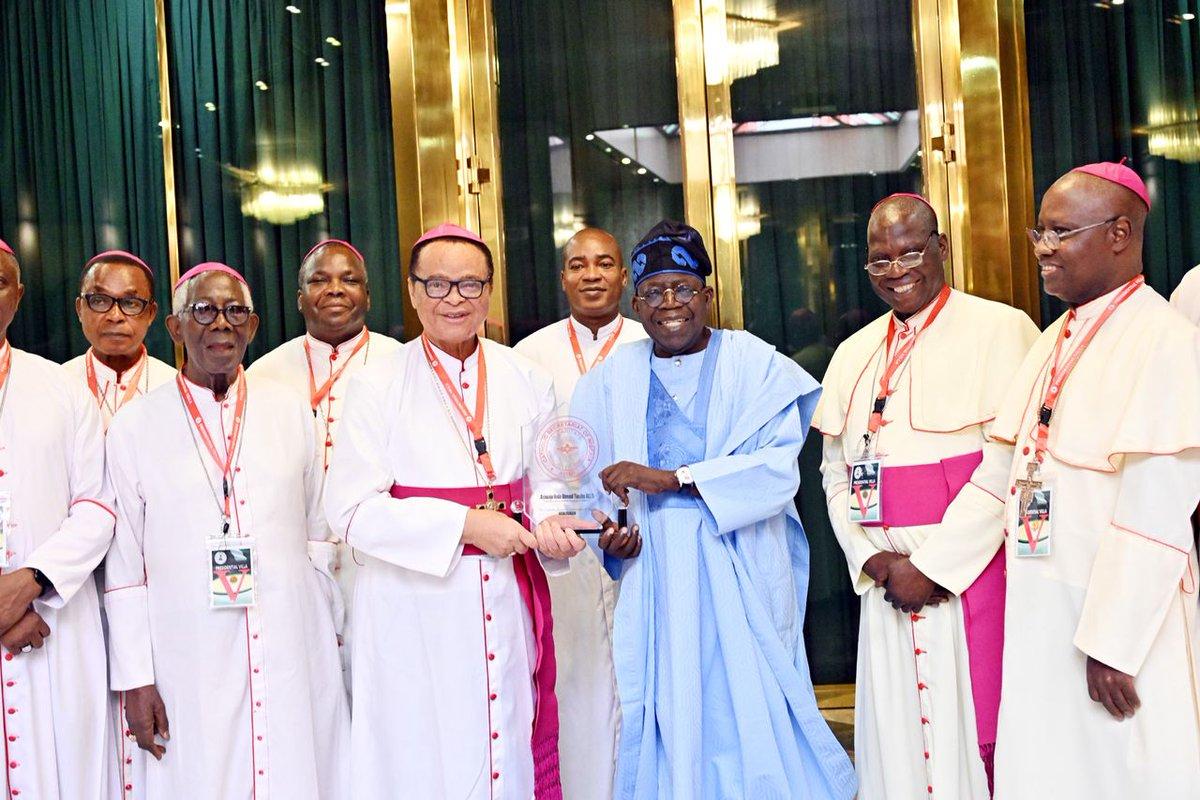
A wave of reactions has followed reports that Catholic bishops recently met with Nigeria’s president, Bola Ahmed Tinubu, with many Nigerians praising the religious leaders for reportedly speaking candidly about the country’s current challenges.
The conversation gained traction after a social media user shared her thoughts on the meeting, stating that the bishops told the president “the current reality in the country that many don’t want to hear.” Her reaction quickly resonated with others online, sparking a broader discussion about the role of religious leaders in national discourse.
For many Nigerians, the reported engagement represents a rare moment where influential figures are perceived to be voicing the concerns of ordinary citizens directly to those in power. At a time when economic hardship, inflation, and cost of living pressures remain pressing issues, the expectation for honest advocacy has grown stronger.
Supporters of the bishops’ move argue that religious leaders hold a unique position in society—one that goes beyond spiritual guidance. With millions of followers across churches and mosques, they are often seen as moral voices capable of holding leaders accountable and speaking truth to power without political bias.

“This is what we want from our pastors, imams, and other religious leaders,” the woman wrote, echoing a sentiment shared by many who believe that silence or neutrality in difficult times can be interpreted as indifference.
The reaction also highlights a deeper concern among citizens: the feeling that everyday struggles are not always fully acknowledged by those in authority. Rising living costs, unemployment, and general economic strain have left many Nigerians frustrated, with increasing calls for transparency, empathy, and decisive action from leadership.
While details of what was discussed during the meeting have not been fully disclosed, the symbolic importance of such an interaction has not been lost on the public. For some, it represents a step toward bridging the gap between government and the people, especially when intermediaries like religious leaders convey unfiltered realities.
However, not everyone is entirely convinced. Some critics argue that beyond meetings and statements, what truly matters is whether such engagements lead to tangible policy changes and improvements in people’s lives. They caution against over-celebrating symbolic gestures without measurable outcomes.
Others have also pointed out that religious leaders themselves must remain consistent in their advocacy, ensuring that they speak out not only during high-profile meetings but also within their communities and platforms on a regular basis.
Still, the overwhelming sentiment online leans toward appreciation for what many see as courage and responsibility. In a country where religion plays a central role in daily life, the expectation for faith leaders to engage with social and political issues continues to grow.
The discussion has also reignited conversations about the intersection of religion and governance in Nigeria. While the country operates as a secular state, religious institutions remain deeply influential, often shaping public opinion and, indirectly, policy direction.
As reactions continue to pour in, one thing is clear: Nigerians are increasingly looking to all sectors of society not just politicians to play a role in addressing the nation’s challenges. Whether through advocacy, dialogue, or direct action, the demand for accountability and empathy is louder than ever.
In the end, the bishops’ reported message and the public’s response to it underscores a shared reality: many Nigerians are seeking to be heard, understood, and represented in conversations that affect their daily lives.




