


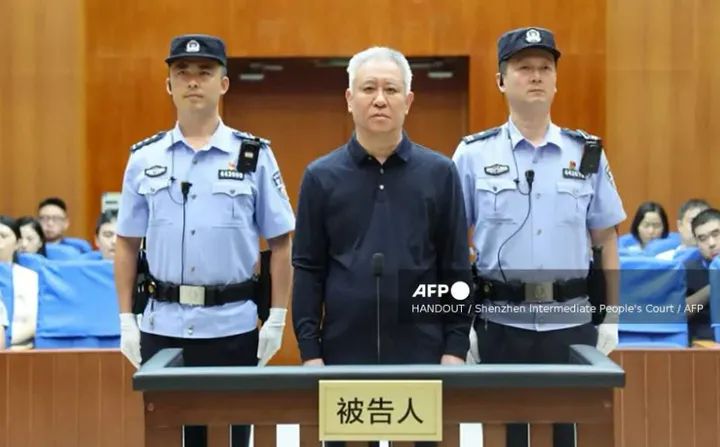
SHENZHEN, CHINA — China has sentenced Evergrande founder Hui Ka Yan, also known as Xu Jiayin, to life imprisonment after finding him guilty of large-scale financial crimes linked to the collapse of the property giant.
The 67-year-old former property tycoon was sentenced by the Shenzhen Intermediate People’s Court on Thursday after pleading guilty to multiple charges, including fundraising fraud, illegal absorption of public deposits, misuse of funds, securities-related offences and bribery. The court also ordered the confiscation of all his personal property.
Evergrande Group and its property subsidiary were separately handed massive fines. Evergrande was fined 8.82 billion yuan, while Evergrande Real Estate was ordered to pay another 7 billion yuan. Together, the penalties amount to 15.82 billion yuan, equivalent to more than US$2 billion.
The court said the offences were committed between 2016 and 2021, when Evergrande allegedly engaged in persistent and large-scale financial fraud. Authorities accused the company and Hui of inflating assets, concealing liabilities, illegally absorbing public deposits and committing fundraising fraud.

The court described the amount involved as extraordinarily large and said the offences caused extremely serious harm to society and severely disrupted China’s economic order.
Hui’s conviction represents a dramatic end to the career of a businessman who once ranked among China’s wealthiest people. He founded Evergrande in 1996 and transformed it into one of China’s biggest property developers during the country’s extraordinary real estate boom.
At its height, Evergrande expanded far beyond residential property, investing in electric vehicles, football and other businesses. Hui’s personal fortune reached tens of billions of dollars, and the company became a symbol of China’s rapid property-led economic expansion.
That growth was heavily dependent on borrowing, however. Evergrande accumulated enormous liabilities while relying on property sales and continued access to financing to sustain its expansion.
The company’s financial problems became increasingly visible as China’s property market weakened and regulators introduced measures designed to limit excessive borrowing by developers.
Evergrande eventually defaulted on its overseas debt in 2021, becoming one of the most prominent casualties of China’s property-sector crisis. The company had more than $300 billion in liabilities, making its collapse one of the largest corporate debt failures in history.
The consequences extended well beyond the company itself. Evergrande’s financial troubles affected homebuyers, investors, suppliers, employees and creditors, while unfinished housing projects became a highly visible symbol of China’s property crisis.
The company’s collapse also contributed to broader concerns about China’s real estate sector, which had played a major role in the country’s economy for decades.
In 2024, a Hong Kong court ordered Evergrande to be liquidated after efforts to restructure its enormous debt burden failed. The liquidation process has since focused on recovering assets and distributing proceeds among creditors.
Hui’s legal troubles began earlier. Chinese authorities detained him in 2023 as investigations into Evergrande’s financial activities intensified. In April 2026, he pleaded guilty during his trial and expressed remorse before the court.
The charges against him were not limited to the financial fraud that helped bring down Evergrande. Prosecutors also accused him of offences involving illegal fundraising, public deposits, loans, securities and bribery.
The court’s decision to impose a life sentence demonstrates the seriousness with which Chinese authorities have treated the financial misconduct surrounding the property giant.
Hui’s punishment also comes with the confiscation of his personal assets, while authorities will continue efforts to recover illegal gains and address outstanding financial losses.
Several other Evergrande executives and individuals connected to the company were also sentenced. Reuters reported that five senior executives received prison terms ranging from six to 18 years, while more than 50 people were sentenced in connection with the broader case.
The case has therefore become more than the downfall of a single billionaire. It reflects China’s wider attempt to address financial misconduct and the consequences of excessive leverage in the property sector.
For years, Evergrande’s aggressive expansion helped make Hui one of the country’s most powerful businessmen. Its spectacular collapse, however, exposed the risks associated with rapid growth financed by enormous debt.
Hui’s life sentence now marks the final and most dramatic chapter in the downfall of the once-powerful property empire, while Evergrande’s enormous fines underscore the financial consequences of the practices that contributed to its collapse.




