


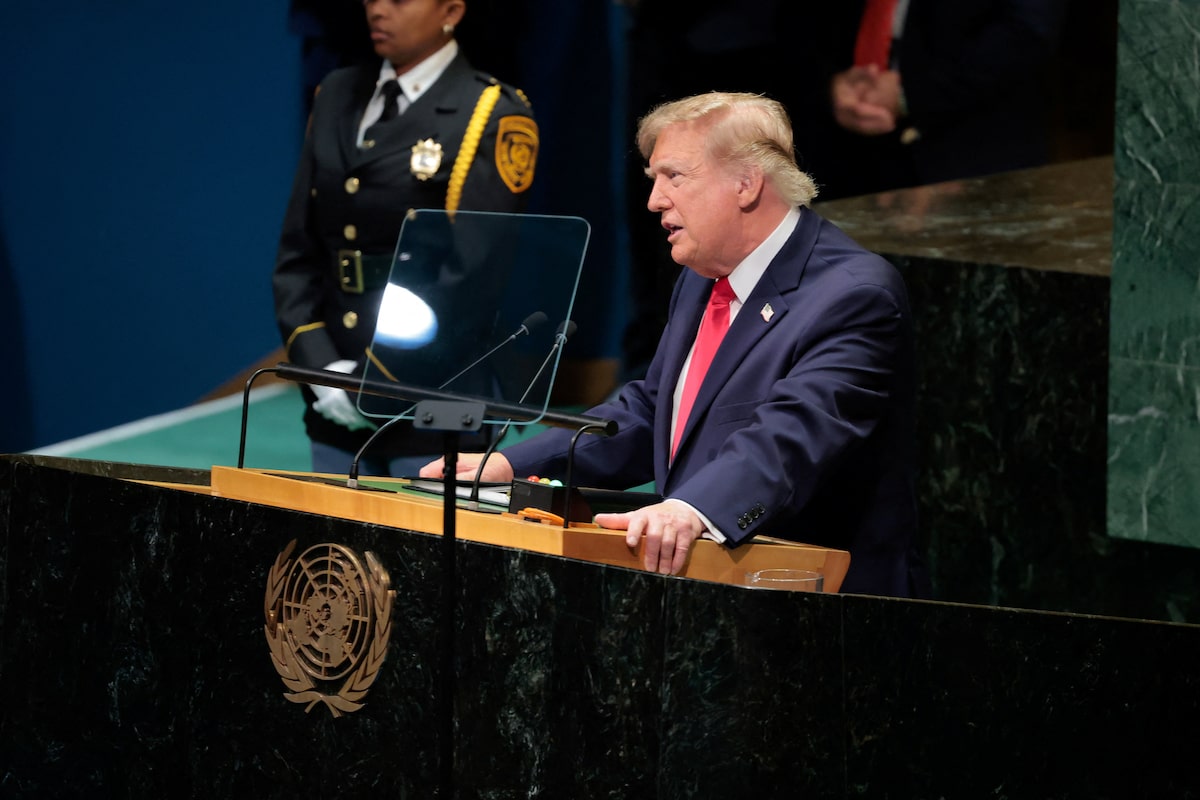
United States President Donald Trump has warned that the United States could “annihilate the Islamic Republic” if Iran fails to reach a deal to end the war, as he defended the conflict during his address to the United Nations General Assembly on Tuesday.
Trump said the war had prevented Iran from obtaining a nuclear weapon and urged other countries to join the US in economically isolating Tehran to force it to the negotiating table.
“I have a big decision to make. Will a deal be made with Iran that lets them rebuild and create a far greater country than it ever was before?” Trump said.
“Or do I annihilate the Islamic Republic and do it quickly, never giving them a chance to kill and destroy people and countries again?”

Trump, however, said he expected an agreement to be reached shortly after the November 3 US midterm elections.
“I believe we’ll make a deal right after the election,” he said, suggesting that Iranian authorities were waiting to see how his administration performs in the elections.
The speech marked the latest justification by Trump for the US-Israeli war against Iran, which began in February.
The US President has previously cited Iran’s nuclear programme, its support for regional proxy groups and the prospect of regime change among the reasons for the strikes.
Iran has consistently denied seeking to develop nuclear weapons.
The conflict has also contributed to higher global fuel prices and become a political issue ahead of the US congressional midterm elections.
Trump to meet world leaders
Trump’s UN speech opened a day of high-level diplomatic engagements, with the US President scheduled to meet more than a dozen world leaders as wars in the Middle East and Ukraine continue to shape his foreign policy agenda.
He was expected to hold bilateral or group meetings with at least 11 world leaders on Tuesday.
Those scheduled to meet Trump included British Prime Minister Andy Burnham, Ukrainian President Volodymyr Zelenskiy, Venezuela’s interim leader Delcy Rodriguez, Danish Prime Minister Mette Frederiksen and Greenland Prime Minister Jens-Frederik Nielsen.
Trump was also due to meet representatives of the United Arab Emirates, Saudi Arabia, Oman, Bahrain, Kuwait and Qatar.
He had met French President Emmanuel Macron on Monday, with additional meetings possible during the day.
A major engagement would involve Gulf leaders, many of whom are concerned about the activities of the Houthis, Iran-backed militants in Yemen who have threatened shipping through the strategic Bab el-Mandab Strait.
Trump was also expected to meet Rodriguez, who rose to power following the removal of Venezuelan President Nicolas Maduro by US forces in January. Maduro was taken to New York to face drug-trafficking charges.
Trump’s allies have said Washington is working with Rodriguez to open Venezuela’s oil sector to US investment, while some Democrats and Republicans have called for greater pressure for fresh elections.
Trump was also expected to use his UN address to criticise the organisation and defend his administration’s efforts to limit what it considers interference with US sovereignty.
A White House official, speaking on condition of anonymity, said Trump would highlight his administration’s opposition to international bodies advancing what it views as a left-wing agenda.
Trump caused controversy during last year’s UN speech, when he sharply criticised other countries over issues including climate policy and migration.
On Tuesday, anti-Iranian government demonstrators gathered outside the UN headquarters, with some holding signs calling for freedom and democracy and opposing what they described as dictatorship.
Trump’s schedule also included a meeting with the leaders of Denmark and Greenland over an agreement aimed at increasing US military presence in Greenland while limiting that of geopolitical rivals.
Danish and Greenlandic officials hope the agreement will ease tensions following Trump’s previous comments about potentially taking control of Greenland by force.




