


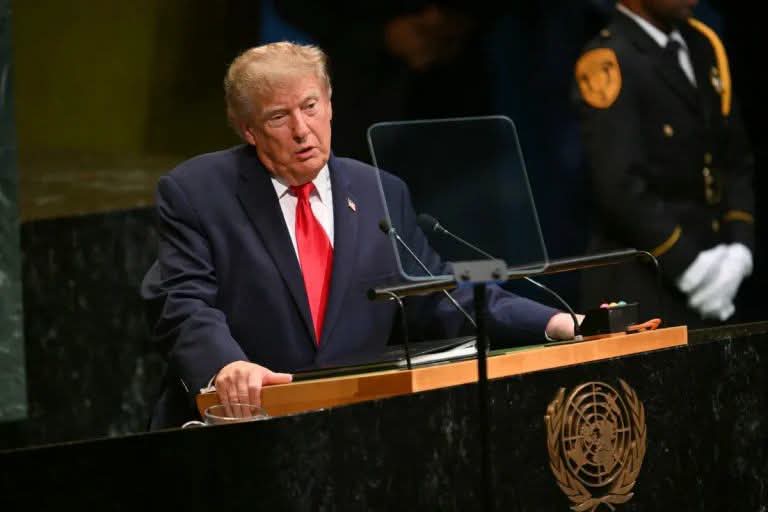
NEW YORK, UNITED STATES — US President Donald Trump told the United Nations General Assembly on Tuesday that he had to choose whether to “annihilate” Iran if it fails to make a deal to end the Middle East war, delivering a stark ultimatum to Tehran in his address to world leaders.
Speaking at the 81st session of the UN General Assembly, Trump said he was faced with two options: negotiate a deal with Iran or drive the country “into hell.” He said he preferred a diplomatic solution but warned that the United States would not hesitate to act decisively if Iran continued to pursue what he described as destabilising activities in the region.
“We have a choice. We can make a deal, or we can drive them into hell. I prefer a deal. I have always preferred a deal. But if they force our hand, we will do what we have to do,” Trump told the assembly.
The US president’s remarks came amid ongoing tensions between Washington and Tehran over Iran’s nuclear programme and its support for militant groups in the Middle East. Trump has repeatedly threatened military action against Iran, and his administration has imposed crippling sanctions on the country.

Trump accused Iran of being the world’s leading state sponsor of terrorism and said its nuclear ambitions posed a threat to global peace and security. He called on the international community to join the United States in pressuring Tehran to abandon its nuclear programme and to end its support for militant groups.
“Iran cannot be allowed to have a nuclear weapon. That is non-negotiable. The entire civilised world must stand together to ensure that Iran never acquires nuclear weapons,” he said.
The US president also criticised the UN for what he described as its failure to address the threat posed by Iran. He accused the organisation of being ineffective and of spending too much time on procedural matters rather than addressing the urgent security challenges facing the world.
“The United Nations was founded to prevent war and to promote peace. But too often, it has become a forum for talk rather than action. We need to change that. We need to make the UN relevant again,” he said.
Trump’s speech drew mixed reactions from world leaders. Some delegates welcomed his tough stance on Iran, while others expressed concern that his rhetoric could escalate tensions and undermine diplomatic efforts. French President Emmanuel Macron, who spoke after Trump, called for dialogue and diplomacy, stressing that military action should be a last resort.
“Iran must respect its international obligations. But we must also give diplomacy a chance. The only way to achieve a lasting solution is through negotiations, not through threats,” Macron said.
Iran’s Foreign Minister, who was not present during Trump’s speech, later dismissed the US president’s remarks as “provocative and irresponsible.” He said Iran was committed to the peaceful use of nuclear energy and that it had no intention of developing nuclear weapons.
“Trump’s threats will not intimidate us. We will defend our sovereignty and our rights. The international community must reject his belligerent rhetoric,” the minister said.
The UN Secretary-General, António Guterres, urged restraint, noting that the situation in the Middle East was at a critical juncture. He called on all parties to exercise maximum restraint and to work towards a peaceful resolution of the conflict.
“I urge all parties to step back from the brink. The consequences of a wider conflict would be catastrophic for the region and for the world,” Guterres said.
Trump’s address was the highlight of the first day of the UN General Assembly, which is bringing together world leaders to discuss pressing global issues, including the war in the Middle East, climate change, and sustainable development. The US president’s speech underscored the deepening divide between Washington and Tehran and the challenges facing the international community in addressing the crisis. As the assembly continues, all eyes will be on how Iran and other key players respond to Trump’s ultimatum.




