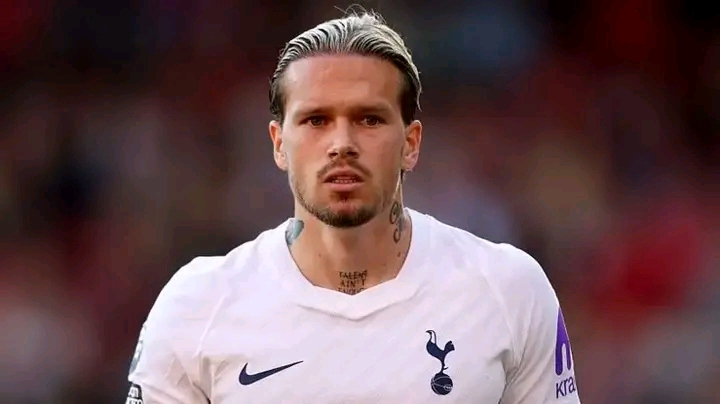
Tottenham Hotspur winger Mykhailo Mudryk has accused the Ukraine national team setup of creating the circumstances that led to his failed drug test, making fresh allegations about the handling of medication during international camps and the support he received after his suspension.
The 25-year-old made the claims in an interview with Ukrainian YouTube channel Guest of Gordon, where he spoke publicly about the doping controversy that kept him away from competitive football from late 2024 until July 2026.
Mudryk tested positive for meldonium, a prohibited substance, following an out-of-competition sample collected on October 22, 2024. The finding was communicated to him by the Football Association on December 4 that year, leading to a provisional suspension.
The former Chelsea forward insists he had never heard of meldonium before the test and believes the substance entered his system while he was representing Ukraine.
Asked who he held responsible for the situation, Mudryk pointed directly to the national team environment.
“The environment, the situation in the Ukrainian national team. It should never have existed,” he said.
He argued that his visits to Ukraine during the relevant period were connected to international football commitments, making the national team camp the place where he believed he could have been exposed to the substance.
Mudryk also questioned the system used to administer medication to players during national team gatherings. He alleged that a team nutritionist regularly distributed pills to players before matches, with members of the squad expected to take what was provided.
According to the winger, the arrangements lacked the level of supervision he was accustomed to at club level. He suggested that the absence of adequate safeguards created an environment in which players could unknowingly take substances that might put their careers at risk.
When asked whether he directly blamed the Ukraine national team, Mudryk answered: “Yes, exactly.”
His allegations extend to the Ukrainian Association of Football (UAF), which he accused of failing to provide sufficient support during the investigation and disciplinary proceedings.
Mudryk specifically criticised UAF president Andriy Shevchenko, claiming that he received little assistance from the football administrator during one of the most difficult periods of his career. He also accused the association of being responsible for leaks surrounding the case and suggested that its handling of the situation contributed to delays in his return.
The allegations are significant because the case involved more than a year and a half away from competitive football, substantial legal costs and uncertainty over whether the winger would be able to resume his career.
Mudryk revealed that he spent millions of pounds on legal representation, individual coaching, pitch rentals and private physiotherapy while serving his suspension. Unable to rely on the normal arrangements available to him at Chelsea, he said he had to make alternative provisions to maintain his fitness and prepare for a possible return.
He also described the emotional impact of discovering the positive test, saying the news came as a devastating shock.
“It was a bolt from the blue. I couldn’t believe it was true,” he said.
The winger compared the experience to falling from a skyscraper, explaining that the psychological consequences were severe. He admitted that he cried and turned to alcohol after the suspension was imposed, although he maintained that he never abandoned his ambition to return to professional football.
Mudryk’s case began attracting widespread attention in December 2024 after Chelsea confirmed that the Football Association had informed the club of an adverse finding in a routine urine test supplied by the player. At the time, he denied knowingly taking any prohibited substance and said he was working with his representatives to establish how the result had occurred.
In May 2025, the FA formally charged him with anti-doping rule violations. An independent regulatory commission subsequently considered the case at a hearing held between January 7 and 9, 2026, before finding that he had committed the violations and imposing a four-year period of ineligibility.
Mudryk challenged the decision at the Court of Arbitration for Sport (CAS). However, the proceedings were eventually resolved through an agreement involving the FA and the World Anti-Doping Agency (WADA) on July 30, 2026.
Under the agreement, Mudryk accepted that he had committed the anti-doping violations and agreed to a period of ineligibility equivalent to the time he had already served. He was consequently declared eligible to return to competition with immediate effect.
The FA also disclosed an important development concerning the scientific assessment of meldonium. Changes to WADA’s technical guidelines meant that a sample containing the same concentration of the substance would not have been reported as an adverse finding if it had been collected under the revised standards. The changes were not retroactive and did not erase the violations accepted by Mudryk.
After his suspension ended, the Ukrainian winger returned to action during Chelsea’s pre-season tour of Asia before completing a season-long loan move to Tottenham on transfer deadline day. The transfer reunited him with Roberto De Zerbi, his former manager at Shakhtar Donetsk.
However, his comeback has not been entirely smooth. An ankle injury sustained in training has limited his opportunities at Tottenham, leaving him with another challenge as he attempts to rebuild his career after the lengthy absence.
Meanwhile, Mudryk’s latest comments have placed the Ukraine national team administration and the UAF under renewed scrutiny. His account raises questions about medication management, player welfare and the responsibility of national football associations to protect athletes from potential anti-doping violations.
Nevertheless, his allegations remain his own account of events. The positive test and subsequent anti-doping violations were formally established through the disciplinary process, but the circumstances in which the meldonium entered his system have not been independently established.
The BBC has contacted the Ukrainian Association of Football for comment. A UAF spokesperson previously told BBC Sport that the association was in close contact with Mudryk’s lawyers but had not received communication from the FA about the case.
For Mudryk, the focus is now on returning to regular football and rebuilding the reputation and career that were interrupted by the suspension. But his decision to publicly blame the Ukraine national team has opened a new chapter in a controversy that is unlikely to disappear until the questions surrounding the alleged exposure are properly addressed.