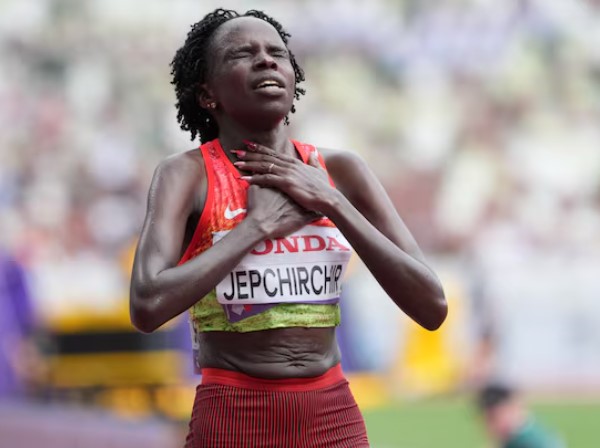
Reigning world marathon champion Peres Jepchirchir has been handed a three-year suspension following a doping violation involving the prohibited substance erythropoietin (EPO), bringing a major setback to the career of one of Kenya’s most successful long-distance runners.
The 33-year-old, who also won Olympic gold at the Tokyo 2020 Games in 2021, was provisionally suspended by the Athletics Integrity Unit (AIU) in October after an out-of-competition drug test returned a positive result for EPO.
The sample was collected in Kenya before Jepchirchir competed in the Sydney Marathon on 30 August 2026. The test result was reported as an adverse finding on 17 September, leading to an investigation by the athletics authorities.
According to DDM News, the suspension is a significant development in international athletics, considering Jepchirchir’s achievements and reputation in women’s long-distance running.
Despite denying the use of EPO, the Kenyan athlete signed an admission of violations form and accepted the disqualification of all her competitive results recorded since 17 July 2026.
The three-year suspension means she will be unable to compete professionally during the ban period, dealing a serious blow to her athletics career.
EPO is a natural hormone mainly produced by the kidneys. It stimulates the production of red blood cells, which transport oxygen from the lungs to different parts of the body, including the muscles.
When artificially introduced into the body, EPO can increase the number of red blood cells, potentially improving an athlete’s endurance and physical performance. This makes it particularly attractive to endurance athletes, including marathon runners.
However, its misuse is prohibited in professional sports because it can provide an unfair competitive advantage and create serious health risks, including blood clots, heart attacks and strokes.
Jepchirchir is among three prominent Kenyan athletes who have recently faced disciplinary action over doping-related offences.
Veronica Loleo has received a three-year suspension after admitting to using EPO, while Ronald Korir has been handed a six-year ban after failing to provide an acceptable explanation for abnormalities discovered in his Athlete Biological Passport.
The Athlete Biological Passport is a monitoring system used by anti-doping authorities to track changes in an athlete’s biological markers over time. Unusual changes can lead to further investigations into possible doping violations.
The latest cases have once again raised concerns about doping in Kenyan athletics, a country widely recognised for producing some of the world’s finest long-distance runners.
Reacting to the situation, Athletics Integrity Unit chief executive Brett Clothier acknowledged that Kenya had made considerable progress in fighting doping over the past five years. However, he warned that more work was needed to address the problem.
Clothier explained that the Kenyan government was aware of the situation and had promised to strengthen the Anti-Doping Agency of Kenya.
He also highlighted the need to take action against criminal networks believed to be involved in facilitating doping activities within the country.
The AIU chief executive added that discussions would take place with the Kenyan government in the coming months to examine the commitments and determine how further improvements could be achieved.
Before the controversy, Jepchirchir had enjoyed an outstanding career, winning several major international competitions.
Her achievements include victories at the New York City Marathon in 2021, the Boston Marathon in 2022 and the London Marathon in 2024.
She also secured Olympic gold at the Tokyo 2020 Games, which were held in 2021 following the postponement caused by the COVID-19 pandemic.
These achievements established her as one of the leading figures in women’s marathon running and helped strengthen Kenya’s position in international athletics.
However, the doping violation and subsequent suspension have now placed a major question mark over her recent career achievements.
DDM News reports that the case highlights the continued efforts of athletics authorities to protect the integrity of international competitions and ensure that athletes compete fairly.
With the AIU continuing its collaboration with Kenyan authorities, attention will now turn to the country’s efforts to strengthen its anti-doping system and prevent further violations.
For Jepchirchir, the three-year ban represents a difficult moment in a career that has been defined by major victories and international recognition.