Superhuman is expanding its Go assistant across work apps, with new connected agents, proactive features, and more context from email and documents.
Superhuman is expanding its Go assistant across more of its productivity tools, bringing AI agents into documents, email, browser workflows, and connected apps. The company, formerly known as Grammarly, says the updates will let Go use more work context and offer help without requiring users to switch to a separate chatbot. TechCrunch reported the rollout on November 19, including personalized suggestions, proactive assistance, and 20 new connected agents. The expansion reflects a broader industry push to make AI available inside everyday work tools.
Superhuman Go brings AI into daily work
Go is designed to appear in the places where users are already working, rather than only in a standalone chat window. Superhuman’s launch post says the assistant can work in documents, inboxes, browser tabs, workflows, and Slack. It also says users can create agents by describing a task, choosing a trigger, and connecting the relevant apps.
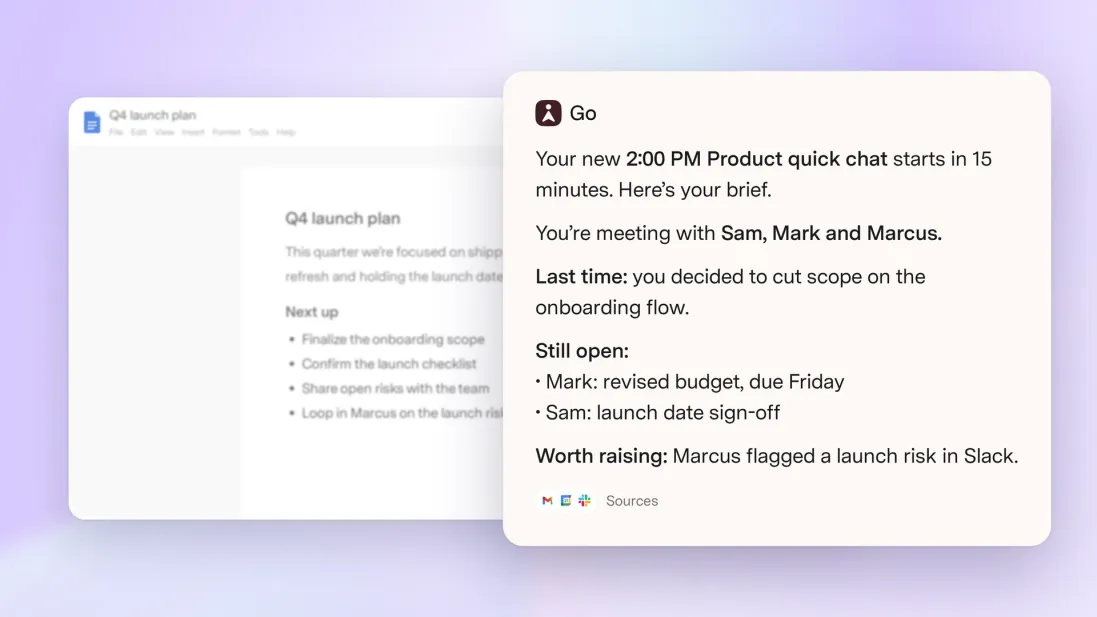
The updated assistant can work inline near the cursor and coordinate with other agents, according to TechCrunch. The company is also making Go more proactive. It can use calendar and email context, monitor relevant information, and draft responses, while learning a user’s writing style for email and documents.
Superhuman says Go can run in the background, search the web, ask follow-up questions, create shareable documents, and learn user preferences over time. These features could reduce the need to copy information between separate apps. However, the company’s announcements describe intended capabilities; they do not establish how well every feature performs for every user.
Connected agents expand Go’s reach
The rollout adds 20 connected agents through Superhuman’s Go software development kit, TechCrunch reported. The new integrations include DeepL, Legora, Amplitude, Databricks, and Blackboard. They expand the range of tasks Go can direct to third-party services, rather than limiting the assistant to Superhuman’s own tools.
Mail and meetings gain more context
Superhuman Mail is also changing. TechCrunch reported that Go is replacing Mail’s previous central AI tool and can search company knowledge bases and connected services. It can use that context to draft messages and organize inboxes across Google and Outlook accounts.
The company is extending its meeting features after acquiring Fathom, a meeting notetaker, in September, according to TechCrunch. It is rolling out collaborative notes that teams can share. Go can also take follow-up steps after a meeting, such as preparing an initial proposal draft, the report said.
These additions point to a wider role for the assistant: it can help before, during, and after routine work, not only answer a question typed into a prompt. Still, users will need to judge whether they want an assistant that uses information across multiple services. The rollout’s practical value will depend on its accuracy, integrations, and the controls available to users and organizations.
Superhuman’s plan to win assistant users
CEO Shishir Mehrotra told TechCrunch that Go has more than one million active users. He described the assistant as more work-focused than consumer AI tools, while saying it can also help with personal email and calendars.
“One of the reasons why these assistants have been popular is that they treat you as a whole person and recognize that we need to cover both extremes.” — Shishir Mehrotra, Superhuman CEO
Mehrotra said Go focuses on work but can also help with personal tasks, calendars, and email. That broader ambition puts Go in a crowded field of AI assistants. TechCrunch said Superhuman wants users to choose Go over offerings such as OpenAI’s Dots or Anthropic’s Claude Duet.
The company’s strategy is to combine its own productivity products with third-party agents and context drawn from connected apps. Superhuman has also faced criticism over some AI features, TechCrunch noted. As Go adds proactive and personalized functions, accuracy, privacy, and user control will matter alongside convenience.
Ultimately, Superhuman is pushing Go beyond a standalone assistant and into more parts of its productivity suite. The company says users can connect apps, create agents, and get help across documents, email, browsers, meetings, and workflows. Its reach will depend on adoption and how reliably the integrations work in practice. For now, the rollout signals Superhuman’s effort to make AI assistance part of everyday work.