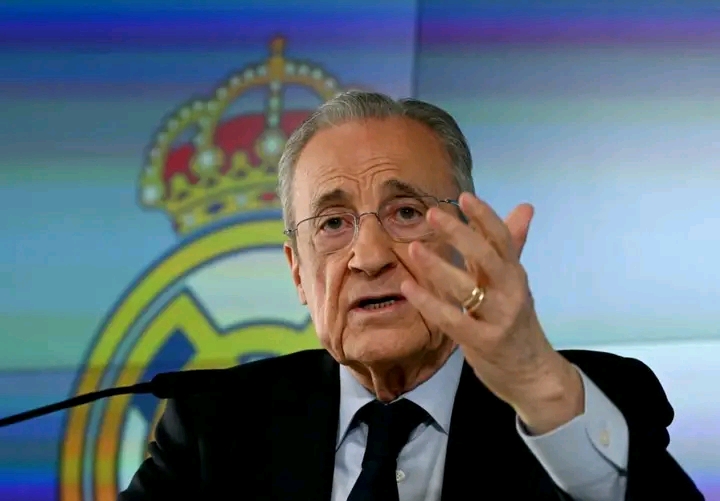
Real Madrid president Florentino Perez has firmly ruled out the possibility of the Spanish giants ever being sold, insisting that the club will remain under the ownership of its members while announcing plans to strengthen their rights and protect its long-term future.
Perez made the declaration on Saturday during the opening address at Real Madrid’s 2026 Ordinary General Assembly of Delegate Members, where he addressed concerns surrounding the club’s ownership structure and dismissed suggestions that external investors could eventually take control.
The 79-year-old president said misinformation had circulated during the club’s recent electoral campaign, with claims that his administration intended to sell Real Madrid or weaken the ownership rights of its members.
He, however, insisted that such suggestions were completely unfounded.
“Real Madrid is not for sale. It has never been considered for sale and it never will be,” Perez declared.
He further stressed that the club belonged to its members and would remain under their control, describing their ownership as one of the institution’s most important defining characteristics.
“The club belongs to and will always belong to its members, and even more so than it does today,” he added.
Real Madrid operates under a membership-based ownership structure, unlike several major European clubs controlled by private individuals, investment groups or corporate owners.
Its members, known as socios, hold the club’s ownership rights and participate in electing its president and representative bodies.
Perez explained that the club currently has approximately 100,000 members, warning that proposals to extend membership automatically to family members of existing members could significantly alter the ownership arrangement.
According to him, such a move could increase the membership population to between 300,000 and 400,000, potentially reducing the influence of the existing members.
He argued that the proposal could undermine the ownership structure that has protected Real Madrid’s independence for more than a century.
The president described members as more than just owners, saying they were also responsible for safeguarding the club’s history, identity and financial heritage for future generations.
“Members are not only the owners of Real Madrid; they are above all its guardians,” he said.
Perez also disclosed that his administration was working on reforms designed to reinforce members’ ownership rights and strengthen the club’s institutional structure.
He maintained that Real Madrid’s future should never depend entirely on the decisions of a particular president or board of directors but should remain protected through a collective ownership system.
The president also addressed plans for a new Madridista loyalty programme aimed at establishing a more direct relationship between the club and its millions of supporters worldwide.
The initiative is expected to recognise fans’ engagement with Real Madrid through activities such as watching matches, purchasing official merchandise, visiting the Santiago Bernabeu Stadium, following content on Real Madrid Play and participating in supporters’ club activities.
Perez explained that the programme would create additional commercial opportunities by allowing the club to connect directly with its global fanbase without intermediaries.
However, he was quick to clarify that the initiative would not affect the exclusive ownership rights enjoyed by existing members.
The announcement comes as Real Madrid continues to explore new commercial opportunities and strengthen its financial position while maintaining its traditional governance model.
During the assembly, Perez also highlighted the club’s achievements over the past 17 seasons, revealing that Real Madrid had won 59 major trophies across its football and basketball departments, including six European Cups in football.
He described the achievements as evidence of what the institution could accomplish through unity, ambition and long-term planning.
Real Madrid’s ownership structure remains unusual among Europe’s biggest football clubs, making the protection of its members’ rights a significant issue for the institution.
For Perez, preserving that tradition is central to ensuring the club’s independence and maintaining its position among the world’s most influential sporting institutions.
He concluded that the destiny of Real Madrid would continue to rest exclusively with its members, insisting that the club’s heritage must be protected for generations to come.