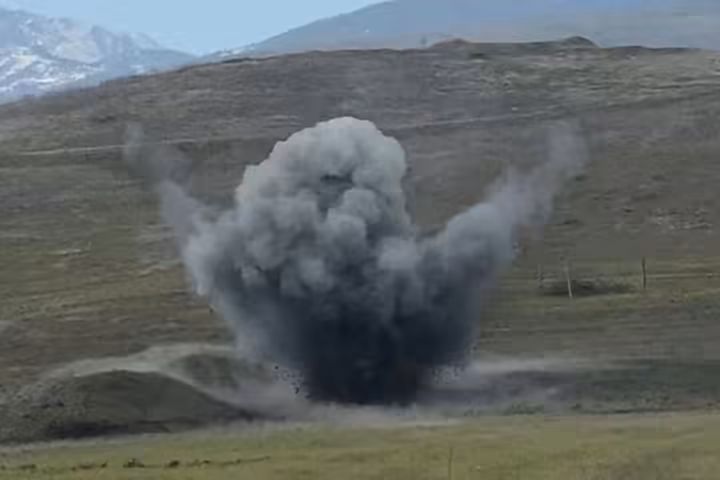
IDLIB, SYRIA — Four children have been killed and two others injured after a landmine exploded in northwestern Syria, highlighting the continuing danger posed by unexploded weapons left behind by more than a decade of armed conflict.
The explosion occurred on Sunday, November 22, 2026, in the village of Umm Khuzaym, in the Khan Sheikhoun countryside of southern Idlib province, according to reports by Syrian state media.
The Syrian Arab News Agency (SANA) reported that the children who died were between eight and 15 years old. The two injured victims were transferred to hospitals in Hama for medical treatment.
Syrian state television, Al-Ikhbariya, reported that the explosive device was believed to have been left behind during the rule of former President Bashar al-Assad, whose government was ousted in December 2024.
Authorities have not provided further details about how the children encountered the device or the precise circumstances surrounding the explosion. <Cite refs={[“turn889591search0″,”turn889591news4″,”turn889591search1”]}/>
The latest tragedy underscores the persistent threat posed by landmines, improvised explosive devices and unexploded ammunition scattered across Syria after more than 13 years of civil war.
Although the fall of Assad’s government brought a major political change, the physical dangers created by the conflict remain widespread. Explosive devices buried in agricultural fields, abandoned settlements, roadsides and former battle areas continue to threaten civilians attempting to return to normal life.
Children are particularly vulnerable because they may not recognise the appearance of unexploded weapons or understand the danger of approaching unfamiliar objects. In rural communities, where families depend on farming, grazing and outdoor activities, exposure to contaminated areas can have devastating consequences.
The incident in Idlib is part of a wider humanitarian crisis involving explosive remnants of war. According to figures cited by the United Nations Mine Action Service and other humanitarian organisations, 1,337 explosive-ordnance incidents were recorded across Syria between December 2024 and early September 2026. Those incidents resulted in 2,375 casualties, including more than 850 children. <Cite refs={[“turn889591news3″,”turn889591search2”]}/>
The HALO Trust, an international organisation involved in clearing landmines and other explosive remnants, has warned that these weapons continue to cause approximately one death or injury every six hours in Syria.
The scale of contamination has made the country one of the most dangerous places in the world for civilians exposed to explosive remnants. A preliminary report by the Landmine and Cluster Munition Monitor recorded approximately 1,600 people killed or injured by mines and explosive remnants in Syria during the previous year, placing the country among the world’s worst-affected locations. <Cite refs={[“turn889591news3″,”turn889591search1”]}/>
Human Rights Watch has also warned that explosive contamination remains a major obstacle to safe returns, reconstruction and economic recovery. The organisation has called on Syrian authorities and international partners to expand mine-survey operations, accelerate clearance programmes and provide assistance to survivors.
Clearing contaminated land, however, is a difficult and potentially dangerous process. Specialist teams must identify suspected devices, assess the risks and safely remove or destroy explosives. The extensive geographical spread of contamination means that the work requires sustained funding, technical expertise and cooperation between national authorities and humanitarian organisations.
Public education is also essential. Communities need clear warnings about suspected explosive devices, while children should be taught never to touch, move or approach unfamiliar objects that could contain explosives.
The latest deaths have renewed attention on the urgent need to protect civilians, particularly children, from weapons that continue to claim lives long after fighting has ended.
For families in Idlib, Sunday’s explosion represents another devastating reminder that the consequences of war do not disappear when the guns fall silent. Without accelerated clearance operations and stronger public safety measures, unexploded weapons will continue to threaten communities across Syria.