


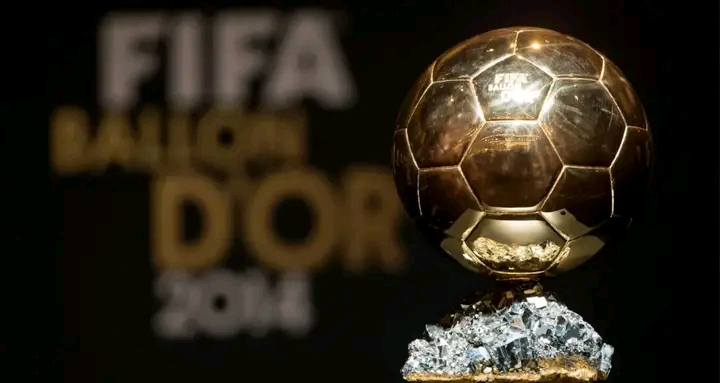
For nearly seven decades, the Ballon d’Or has stood as one of football’s most prestigious individual honours, celebrating players who have reached the highest level of excellence during a calendar year.
First awarded in 1956 by France Football, the prize has evolved significantly over the years. What began as an award primarily for European players eventually became a global recognition of football’s finest talents.
From Alfredo Di Stéfano and Johan Cruyff to Cristiano Ronaldo and Lionel Messi, the Ballon d’Or has been lifted by some of the greatest names the game has ever produced.

The 2025 edition added another name to that prestigious list, with Paris Saint-Germain forward Ousmane Dembélé claiming the men’s award after a remarkable campaign. France Football lists Dembélé as the 2025 winner.
Dembélé’s triumph came after an outstanding season with PSG, where his performances helped the French club enjoy a historic campaign. His victory also ended another chapter in the modern Ballon d’Or era dominated by Lionel Messi and Cristiano Ronaldo.
Here is the complete list of men’s Ballon d’Or winners from 1956 to 2025:
1956 – Stanley Matthews (England)
1957 – Alfredo Di Stéfano (Spain)
1958 – Raymond Kopa (France)
1959 – Alfredo Di Stéfano (Spain)
1960 – Luis Suárez (Spain)
1961 – Omar Sívori (Italy)
1962 – Josef Masopust (Czechoslovakia)
1963 – Lev Yashin (Soviet Union)
1964 – Denis Law (Scotland)
1965 – Eusébio (Portugal)
1966 – Bobby Charlton (England)
1967 – Flórián Albert (Hungary)
1968 – George Best (Northern Ireland)
1969 – Gianni Rivera (Italy)
1970 – Gerd Müller (West Germany)
1971 – Johan Cruyff (Netherlands)
1972 – Franz Beckenbauer (West Germany)
1973 – Johan Cruyff (Netherlands)
1974 – Johan Cruyff (Netherlands)
1975 – Oleg Blokhin (Soviet Union)
1976 – Franz Beckenbauer (West Germany)
1977 – Allan Simonsen (Denmark)
1978 – Kevin Keegan (England)
1979 – Kevin Keegan (England)
1980 – Karl-Heinz Rummenigge (West Germany)
1981 – Karl-Heinz Rummenigge (West Germany)
1982 – Paolo Rossi (Italy)
1983 – Michel Platini (France)
1984 – Michel Platini (France)
1985 – Michel Platini (France)
1986 – Igor Belanov (Soviet Union)
1987 – Ruud Gullit (Netherlands)
1988 – Marco van Basten (Netherlands)
1989 – Marco van Basten (Netherlands)
1990 – Lothar Matthäus (West Germany)
1991 – Jean-Pierre Papin (France)
1992 – Marco van Basten (Netherlands)
1993 – Roberto Baggio (Italy)
1994 – Hristo Stoichkov (Bulgaria)
1995 – George Weah (Liberia)
1996 – Matthias Sammer (Germany)
1997 – Ronaldo (Brazil)
1998 – Zinedine Zidane (France)
1999 – Rivaldo (Brazil)
2000 – Luís Figo (Portugal)
2001 – Michael Owen (England)
2002 – Ronaldo (Brazil)
2003 – Pavel Nedvěd (Czech Republic)
2004 – Andriy Shevchenko (Ukraine)
2005 – Ronaldinho (Brazil)
2006 – Fabio Cannavaro (Italy)
2007 – Kaká (Brazil)
2008 – Cristiano Ronaldo (Portugal)
2009 – Lionel Messi (Argentina)
2010 – Lionel Messi (Argentina)
2011 – Lionel Messi (Argentina)
2012 – Lionel Messi (Argentina)
2013 – Cristiano Ronaldo (Portugal)
2014 – Cristiano Ronaldo (Portugal)
2015 – Lionel Messi (Argentina)
2016 – Cristiano Ronaldo (Portugal)
2017 – Cristiano Ronaldo (Portugal)
2018 – Luka Modrić (Croatia)
2019 – Lionel Messi (Argentina)
2020 – No award
2021 – Lionel Messi (Argentina)
2022 – Karim Benzema (France)
2023 – Lionel Messi (Argentina)
2024 – Rodri (Spain)
2025 – Ousmane Dembélé (France).
One of the most remarkable periods in Ballon d’Or history came during the rivalry between Messi and Ronaldo. Between 2008 and 2017, the pair won the award nine times, with only Luka Modrić breaking their dominance in 2018.
Messi eventually extended his record to eight Ballon d’Or victories, while Ronaldo collected five. Their prolonged battle for individual supremacy became one of the defining stories of modern football.
The history of the award has also produced several memorable firsts. In 1963, Lev Yashin became the first and remains the only goalkeeper to win the men’s Ballon d’Or. In 1995, Liberia’s George Weah became the first African player to win the award, marking a historic moment for African football.
The award was not presented in 2020 because of the disruption caused by the COVID-19 pandemic, leaving that year without an official winner.
The Ballon d’Or has also expanded beyond its original format, with the introduction of the Women’s Ballon d’Or in 2018. Since then, stars such as Ada Hegerberg, Megan Rapinoe, Alexia Putellas and Aitana Bonmatí have joined the list of winners.
The 2025 ceremony added another significant chapter when Dembélé emerged as the latest men’s winner. His success demonstrates how the Ballon d’Or continues to move from one generation of football stars to another.
From Matthews in 1956 to Dembélé in 2025, the Ballon d’Or story is ultimately a story of football’s changing eras — from the legends of the black-and-white television age to today’s global superstars.
And with a new generation led by players such as Kylian Mbappé, Lamine Yamal, Erling Haaland and others emerging, the race for future Ballon d’Or glory is already taking shape.




