Nigerian music legend and activist Charly Boy has shared a hilarious encounter with former Anambra State governor and presidential candidate Peter Obi, leaving social media in stitches.
According to Charly Boy, Obi visited his home carrying a filled ‘Ghana Must Go’ bag, immediately sparking curiosity. “At first, I thought he was trying to bribe me,” Charly Boy recounted, reflecting on the moment he saw the iconic checkered bag. Known for holding everything from groceries to travel items, the bag initially gave him pause.
However, the suspense quickly turned into laughter. When he opened the bag, instead of money or fancy gifts, it contained garden eggs, a common local vegetable in Nigeria. Charly Boy couldn’t help but joke about the situation, calling the gesture unexpected yet amusing.
The story has since gone viral, with fans and social media users reacting with memes and playful commentary. Many praised Peter Obi for his humility, interpreting the gesture as a lighthearted, down-to-earth visit rather than anything political or material. Others couldn’t get over the absurdity of expecting a bribe and finding garden eggs instead.
Charly Boy’s anecdote not only showcases his signature humor but also highlights Peter Obi’s reputation for simplicity and approachability. In a world where encounters with public figures often come with high stakes or expectations, this surprise bag of garden eggs reminded everyone that sometimes, life — and politics — can be funny and humble.
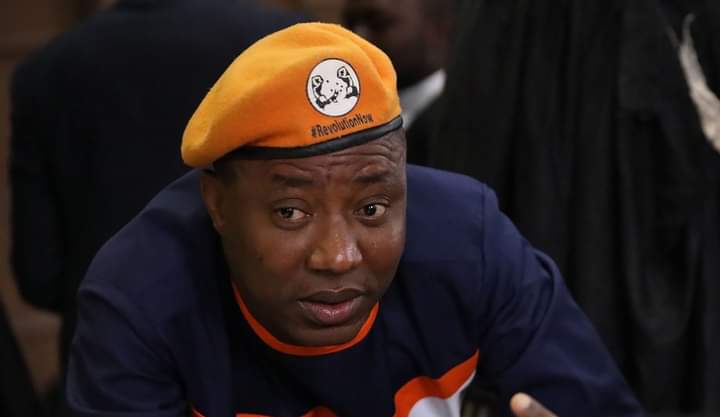
Convener of #RevolutionNow and Publisher of Sahara Reporters, Omoyele Sowore
Omoyele Sowore, former AAC presidential candidate, has joined #OccupyNASS protests in Abuja, warning security operatives against attacking peaceful demonstrators.
He said the fight for electoral reforms, particularly electronic processes, isn’t new and is a deliberate attempt to undermine credible elections.
“This is an exposition that already existed. It is not new. That is why it is a surprise to everyone that this provision was yanked away from the Electoral Act that Akpabio and his friends are trying to put in place,” he said.
According to the human rights activist, the ruling political class fears free and fair elections because they cannot win under transparent conditions.
“We know why they are doing it. These people cannot win in free and fair elections. But the people have a duty to demand processes that guarantee free, legal and transparent elections,” Sowore added.
While acknowledging debates around electronic transmission of results, Sowore said his preference goes beyond transmission.
“My preference is not even electronic transmission of results, because what gets transmitted at the end of the day is what has already been manipulated. I am more interested in electronic voting,” he said.
He stressed that whatever system Nigerians believe would protect the integrity of their votes must be defended and supported.
“Whatever people think in their minds that can protect the integrity of their votes, we must defend and support it,” he added.
Sowore warned security agencies that their constitutional role is to protect citizens, not to repress peaceful protests.
“It is their job to protect the country, not to attack peaceful protesters. I have warned them that if they try that, they are starting something they cannot predict how it will end,” he said.
Sowore insisted only radical change can resolve Nigeria’s political challenges, dismissing gradual reforms.
The activist sees the protests as a growing consciousness among Nigerians, urging collective action to reclaim democratic accountability.
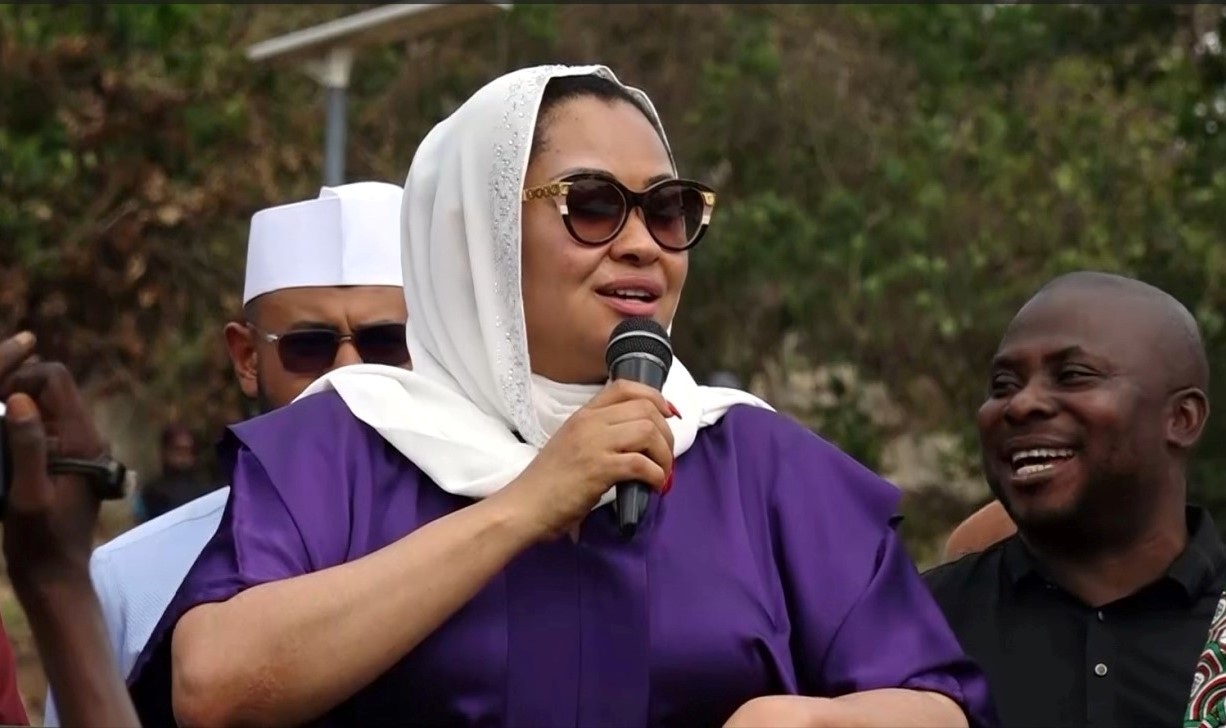
The Anambra State Government on Monday suspended the headteachers of nine public schools for two weeks following an inspection that revealed alarmingly low pupil turnout.
The announcement was made by the Chairman of the Anambra State Universal Basic Education Board (ASUBEB), Vera Nwadinobi, who led the visit to monitor school attendance and compliance with the state directive requiring all schools to open fully on Mondays.
While teachers were present in most schools, Nwadinobi expressed concern that student attendance was extremely poor. Some schools had no pupils at all, while others recorded as few as two to five students.
At Union Primary School, Ukpo, only three pupils were present, and Walter Eze Secondary School, Ukpo, had no students. Aguoji Primary School, Ifitedunu, had five pupils, while Hilltop Primary School, Ifitedunu, recorded three.
In Idemili North, Chukwurah Primary School, Abatete, and Umunebo Primary School, Nteje, had zero students. Other affected schools included Uzubi Primary School, Eziowelle, Union Primary School, Eziowelle, and Central School, Atani, in Ogbaru LGA.
Following the inspection, Nwadinobi stated that Governor Chukwuma C. Soludo approved the two-week suspension of the headteachers.
She said the suspended officers were directed to hand over immediately to the next most senior officials to ensure uninterrupted administration.
“This action underscores the state government’s zero tolerance for negligence and its firm commitment to restoring discipline, accountability, and full academic engagement in public schools,” Nwadinobi said.
The inspection follows an executive order issued on January 24 abolishing Monday closures linked to sit-at-home directives.
Earlier, ASUBEB had warned that teachers or non-teaching staff who fail to comply risk partial or total salary forfeiture, as stated in a letter dated January 22, signed by the board’s secretary, Loveline Mgbemena.
Former President Olusegun Obasanjo is reportedly supporting the presidential ambition of Labour Party (LP) 2023 candidate Peter Obi, amid growing discussions around a potential joint ticket with former Kano State Governor Rabiu Musa Kwankwaso ahead of the 2027 elections.
Sources say the push for an Obi–Kwankwaso alliance spans party lines, involving senior opposition politicians, power brokers, and retired military officers.
The idea, inspired by the 2023 election results in which both candidates had largely regional performances, is seen as a strategy to build a credible opposition capable of challenging the All Progressives Congress (APC).
Obasanjo’s media aide, Kehinde Akinyemi, confirmed the former president’s continued support for Obi but denied knowledge of any directive to ADC leaders regarding a joint ticket.
“I can confirm his support for Obi’s presidential ambition,” Akinyemi said, adding that he was unaware of any formal discussions with the ADC on the pairing.
Within the African Democratic Congress (ADC), the idea remains informal.
A senior party member told Daily Trust that while the Obi–Kwankwaso ticket is being debated in opposition circles, it has not been officially adopted as party policy.
“Many leaders believe that if Obi had run with Kwankwaso in 2023, they might have won. It’s being discussed, but it’s not a formal agenda within the ADC,” the source explained.
The source further noted that the ADC’s rising profile has attracted interest from various opposition factions, including segments of the Peoples Democratic Party (PDP).
“For Obi’s supporters to insist on ‘Obi or nothing,’ there must be behind-the-scenes assurances,” the insider said.
The source added that the party is keen to secure a consensus direction to avoid fragmentation post-primaries, positioning the ADC as a potential rallying point for opposition unity.
With strategic discussions ongoing and the influence of prominent Nigerians, many believe a joint Obi–Kwankwaso ticket could present a strong alternative to the APC, especially as Atiku Abubakar may continue to face internal challenges within the PDP.
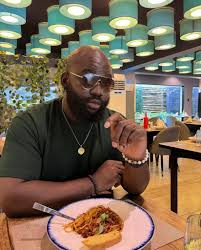
Social media is buzzing after content creator and food critic Peyemi made headlines with a bold statement about fellow celebrity Nancy Isime.
According to Peyemi, he recently heard that Nancy allegedly said she doesn’t like him. Instead of staying silent, he decided to make his feelings clear — and in classic Peyemi style, he didn’t hold back. He reportedly told fans, “I don’t give a f— about it.”
Fans were quick to react, with many jokingly questioning why Peyemi seems to be fighting with everyone lately. Memes, laughing emojis, and playful comments flooded timelines as people responded to his candidness. “Abeg he should rest,” wrote one fan, capturing the mixture of amusement and exasperation that many felt.
Peyemi has built his brand on fearless commentary, from critiquing restaurants to sharing strong opinions about celebrities. His blunt, unapologetic style has earned him a loyal following, but it also tends to stir drama intentionally or not.
While some fans are loving the entertainment, others wonder if he’s taking social media feuds too seriously. Regardless, Peyemi has made it clear that he isn’t losing sleep over who likes or dislikes him, and that includes high-profile stars like Nancy Isime.
The comment has sparked widespread conversation online, with the community now eagerly watching to see what he’ll say next. In the world of social media entertainment, one thing is certain: when Peyemi speaks, people listen and laugh along the way.
The Court of Appeal in Abuja on Monday upheld the suspension of Sen. Natasha Akpoti-Uduaghan saying that the Senate acted within its powers when it suspended her.
Mrs Akpoti- Uduaghan represents Kogi Central Senatorial District.
Delivering judgment in an appeal filed by Akpoti-Uduaghan challenging the judgment of the Federal High Court, the appeal court held that disciplinary action is correct according to the rules of the House.
In a unanimous decision by a three-member panel, it said that it was satisfied that neither the Appellant’s parliamentary privilege nor her constitutional rights were breached as a result of her suspension from the Senate.
Justice Abba Bello Mohammed, who read the judgment held that, from the provision of Section 66(4) of the Senate’s standing rules, the Senate has the power to invoke disciplinary action to ensure orderliness in the conduct of Senate’s proceedings.
The court however, vacated the contempt proceeding and N5 million fine that were awarded against Senator Akpoti-Uduaghan over the satirical apology she made to the Senate President, Godswill Akpabio.
The appellate court held that the Senate President was not wrong to have denied her, who was not on the official seat that was allotted to her during plenary on February 20, 2025, the opportunity to speak.
It held that the Senate President is empowered by the Rules to allocate seats to members, adding that lawmakers are only allowed to speak from seats allocated to them.
The appellate court held that, Akpoti-Uduaghan was wrong on the Feb. 20, 2025 incident when the Senate President allocated a new seat to her and refused to accept the order.
The court also said that the claim of Natasha that she was not given prior notice on the change of seat was unattainable because there was no provision for prior notification as she claimed.
The court also held that, the refusal of Sen. Akpoti-Uduaghan to appear before the Senate Committee on Ethics, Petition and Privileges did not help her matter.
It also dismissed her claims that her suspension was carried out in violation of an order by Justice Obiora Egwuatu .
It added that, since Justice Egwuatu recused himself and the matter started afresh by Justice Binta Nyako, the order of Justice Egwuatu waslonger subsisting.
The court however, faulted the contempt charge against Akpoti-Uduaghan and the N5 million fine imposed on her by Justice Binta Nyako.
The Police Command in Benue on Monday confirmed the kidnap of nine worshippers at Ojije in Utonkon, Ado Local Government Area of the state.
The command’s spokesperson, DSP Edet Udeme, told the News Agency of Nigeria, NAN, on the telephone in Makurdi that the victims were abducted at a night vigil.
Udeme said the victims were worshipping at St. John’s Catholic Church, Ojije, when the incident occurred.
She said the commissioner of police has deployed all the tactical teams in the state to the area to ensure their safe release.
Udeme further said that the command would continue to ensure that Benue residents were safe at all times.
Nollywood fans were left buzzing after what appeared to be a tense moment between Funke Akindele and Tobi Makinde at Timini Egbuson’s recent movie premiere. Observant viewers noted that the two stars, who share a long professional history, did not greet each other publicly, sparking questions about their relationship.
Funke Akindele, one of Nollywood’s most influential actresses, has been instrumental in Tobi Makinde’s rise to fame. Makinde gained widespread recognition through his work in Funke’s hit series Jenifa’s Diary, which helped him establish himself in the industry. Their mentor–mentee relationship has often been celebrated as a positive example of collaboration and professional support in Nollywood.
Despite this history, fans quickly speculated that something could be amiss. Clips from the premiere appeared to show that Funke and Tobi did not exchange greetings, and social media erupted with discussions about a possible rift.
Adding to the speculation is Funke’s absence from Tobi Makinde’s wedding, which many fans found notable given their past closeness. The absence fueled conversations online, leading some to wonder if there was tension between the two.
However, it is important to note that there is no official confirmation of a feud. Neither Funke Akindele nor Tobi Makinde has publicly addressed the rumors. In busy events like movie premieres, it is not uncommon for celebrities to miss moments with one another due to crowded spaces, hectic schedules, or overlapping social circles.
Social media reactions have been mixed. Supporters emphasize that Funke and Tobi are busy professionals, and missing a greeting does not necessarily indicate a conflict. Others, however, argue that given their shared history, the interaction or lack thereof could be significant.
At this point, the situation remains largely speculative. Clips and photos can often be misleading, and public appearances are rarely a definitive reflection of personal relationships. Until either party comments, fans should approach rumors with caution.
For now, the Nollywood community and fans alike will continue to watch closely, waiting for clarification from the stars themselves. One thing remains certain: even small gestures, or the lack thereof, can spark widespread conversation in today’s social media-driven entertainment world.
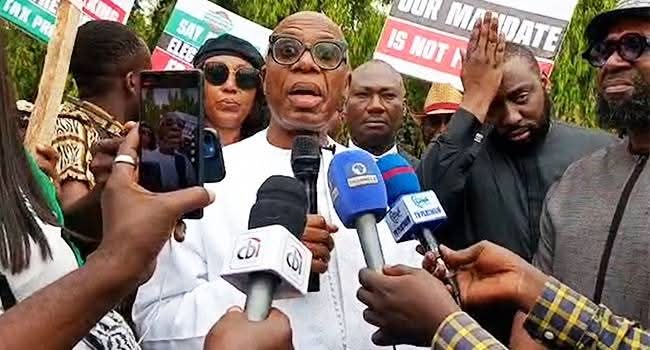
E-transmission of results: Amaechi, son join protest
Former Rivers State Governor Rotimi Amaechi has joined protests in Abuja against the Senate’s rejection of mandatory electronic transmission of election results.
Amaechi, accompanied by his son, a medical doctor, emphasized that leaders should lead from the front, especially on critical issues like electoral transparency.
He alleged the ruling All Progressives Congress (APC) opposes electronic transmission because it fears losing elections.
Amaechi questioned why the APC would fear electronic transmission, given its claimed dominance with 31 governors and prominent defectors from opposition parties.
“I believe that the opposition parties should come out—PDP, ADC, everybody should be out—to protest against the attempt of one party,” Amaechi said.
“If we come out, and they say the opposition has hijacked (the protest), what is APC doing? Are they not hijacking? What are they afraid of? I thought they said they have 31 governors. Tinubu is not Jonathan. The only way a good politician will know he has done well is by the people.”
The African Democratic Congress (ADC) has called on Nigerians to rise up and join the protests, arguing that all opposition parties should unite against the Senate’s decision.
However, the Senate is set to hold an emergency plenary session today, amid heightened security and public pressure.
Civil society groups and opposition parties have vowed to continue protests until the decision is reversed.
Six governorship aspirants from Benue State’s Kunav bloc in Vandeikya Local Government Area have announced plans to resist Governor Hyacinth Alia’s re-election bid in 2027, citing poor governance and escalating insecurity.
The group made the announcement during a joint press briefing held over the weekend in Makurdi.
The event was themed “Benue at 50: Reflection, Responsibility and the Future We Must Reclaim.”
Speaking to newsmen, the aspirants — Professor Dennis Ityavyar, Hon. Joseph Waya, Professor Paul Angya, Professor Terhemba Shija, Rt. Hon. Dominic Terkaa Ucha and ESV Godwin Ityoachimin — argued that despite substantial financial inflows and the powers vested in the state government, Benue has continued to drift as it marks its 50th anniversary.
They argued that the state’s ₦20.43 billion internally generated revenue in 2024 and over ₦400 billion from FAAC don’t reflect in public services, with many MDAs poorly funded and lacking transparency.
The aspirants highlighted rising insecurity, referencing a recent attack on Abande community market that killed 17 people.
Meanwhile, governor Alia’s spokesperson, Tersoo Kula, has dismissed the claims as politically driven, citing reforms in public finance, security, and infrastructure.
He said the government has blocked revenue leakages, eliminated payroll in fraud, and invested in agro-industrial development, education, and community security.
Gucci Mane’s wife, Keyshia Ka’oir, has once again set social media buzzing after opening up about the way she chooses to support her husband behind the scenes.
In a recent statement that quickly made the rounds online, the entrepreneur and fitness mogul said the rap star’s main responsibilities in their household are simple: shower and make music. Everything else, she explained, she happily handles.
“It’s not because I have to,” Keyshia said. “It’s because I enjoy doin’ it. I don’t want him to worry about the bills or what he gon’ eat.”
Her comment, meant to highlight love and partnership, immediately sparked conversations about modern marriage roles, financial security, and what support looks like when both partners are successful.
Keyshia, who has built her own empire through beauty, fitness, and lifestyle brands, made it clear that her actions come from a place of pride, not obligation. For her, taking pressure off her husband allows him to focus fully on his craft and continue building his legacy in music.
Fans of the couple often point to their public displays of loyalty as proof that they operate as a team. Since their lavish wedding in 2017, they’ve frequently shared moments of family life, business wins, and romantic gestures, presenting a united front that many admire.
Still, not everyone agreed with her take.
While supporters praised her devotion and called it a powerful example of riding for one’s partner, critics argued that such statements can set unrealistic expectations for women or reinforce traditional gender roles. Some also noted that Gucci Mane is more than capable of taking care of himself financially.
Despite the mixed reactions, Keyshia’s stance reflects a dynamic that works for them. To many fans, her message was simple: when you love someone, easing their burdens can be a joy rather than a duty.
As the debate continues online, one thing is certain — whenever Keyshia Ka’oir speaks about her marriage, people listen.
Nigerian Senate President Godswill Akpabio, President Bola Tinubu, House of Representatives Speaker Abbas Tajudeen facilitated new minimum wage
The Senate on Monday reiterated that borrowing remains inevitable to fund Nigeria’s 2026 budget, which proposes total expenditure of N58.47 trillion against projected revenue of N33.19 trillion, leaving a deficit of about N25.91 trillion.
Chairman of the Senate Committee on Appropriations, Senator Solomon Adeola, said the government cannot realistically meet infrastructure, security, and social obligations without deficit financing.
He stressed, however, that the era of wasteful, consumption-driven borrowing must end.
“Nigeria cannot help but continue borrowing because revenue inflows are unpredictable and development needs are enormous.
What matters is how we borrow, how deficits are funded, and how borrowed resources are utilised,” Adeola said.
Debt servicing alone is expected to consume N15.90 trillion.
To avoid crowding out private-sector credit, the federal government intends to rely on external financing, asset optimisation, privatisation, public-private partnerships (PPPs) and infrastructure concessioning.
Adeola also called for full removal of electricity subsidies, warning that partial reforms would continue to drain public finances.
He reaffirmed that the National Assembly will no longer approve budget rollovers, citing repeated delays as a cause of poor budget outcomes.
Senate President Godswill Akpabio, represented by Deputy Senate President Barau Jibrin, described the 2026 budget as a moral and historical test for the nation.
“A budget is a moral document. We must convert allocations into tangible outcomes that Nigerians can see and feel,” he said.
Minister of State for Finance, Dr. Doris Nkiruka Uzoka-Anite, highlighted that the 2026 budget aligns with government priorities and is designed to deploy limited national resources efficiently, while acknowledging public frustration over rising living costs.
Fiscal policy expert Dr. Olatilewa Adebajo warned that rising deficits could become unsustainable unless revenue mobilisation is strengthened and the Fiscal Responsibility Act strictly enforced.
Accountant-General Shamseldeen Olujimi emphasised shifting from allocation-driven budgeting to impact-focused implementation, measuring success by functioning schools, operational health centres, reliable power supply, and job creation.
Meanwhile, Minister of Industry, Trade and Investment, Mrs. Jumoke Oduwole, raised concerns over her ministry’s N2.72 billion capital allocation for 2026, describing it as inadequate to drive Nigeria’s industrialisation, trade expansion, and investment attraction agenda.
She appealed for a targeted increase, noting that the ministry’s interventions had already attracted $21 billion in capital importation in the first 10 months of 2025, up from $12 billion in 2024 and under $4 billion in 2023.
Senators Umar Sadiq and Francis Fadahunsi stressed the ministry’s centrality to the administration’s goal of a $1 trillion economy and called for clear demonstration of its impact on jobs, exports, and industrial growth
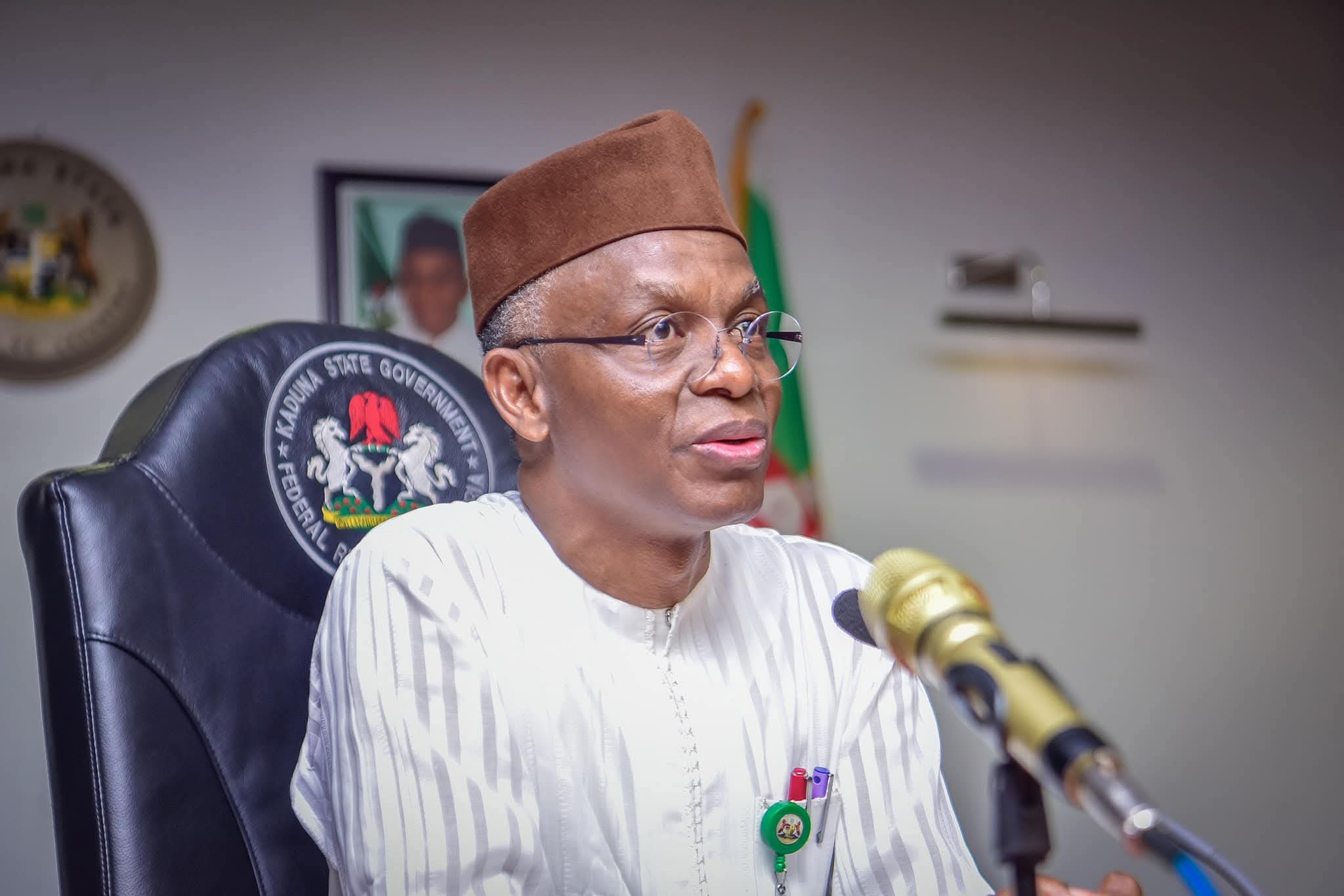
Former Kaduna State Governor Nasir El-Rufai has criticized Senate President Godswill Akpabio, blaming him for the controversy surrounding the Electoral Act amendment.
While speaking during an interview on Trust TV, El-Rufai stated that Akpabio is the problem, not the Senate, and described him as a “scumbag” serving the interests of powerful political forces, particularly President Bola Tinubu.
“The problem is not the Senate. Akpabio is the problem,” El-Rufai said, adding that, “by every standard, he is a scumbag.”
El-Rufai urged senators opposed to the amendment to unite and take a firm stand against it, saying they must “come together, protest, and stop it from happening.”
He dismissed the title “distinguished” often used for senators, citing his long-standing relationship with Akpabio since the 1990s as grounds for speaking candidly.
This is coming following the removal of real-time electronic transmission of results, with critics arguing it weakens safeguards against electoral manipulation.
The Senate is reconvening today to address the issue, with protesters demanding the restoration of real-time transmission.
At least nine worshippers were abducted by suspected bandits in the early hours of Sunday during a vigil at St. John’s Catholic Church in Ojije, Utonkon District of Ado Local Government Area of Benue State.
Diaspora Digital Media gathered that the incident occurred around 2 a.m. while the church was observing a vigil as part of a 30-day religious programme.
Confirming the incident, the National Publicity Secretary of the Ufia Development Association in Ado LGA, Comrade Jude Onwe, said the victims included women and youths.
“Around 2 a.m., nine worshippers, including women and youths, were abducted from St. John’s Catholic Church while they were at the vigil,” Onwe said.
The Chairman of Ado Local Government Area, Sunday Oche, also confirmed the abduction and expressed concern that the church failed to involve security agencies despite prior warnings.
“We received the sad news of the abduction, and I have mobilised all the security agencies. We are working seriously,” Oche said.
He urged residents to always involve security personnel in night activities, warning that failure to do so exposes communities to risk.
“Our concern is that people refuse to adhere to advice to involve the police whenever a night activity, whether a marriage, burial or festival, goes past 9 p.m.,” he added.
Reacting to the incident, the spokesperson for the Benue State Police Command, Udeme Edet, said tactical teams had been deployed to the area.
“Security personnel are on the trail of the abductors, and efforts to rescue the worshippers are ongoing,” Edet said.
The abduction adds to growing security concerns in Benue State, which has witnessed repeated violent attacks in recent years, including the June 2025 massacre in Yelwata that reportedly claimed about 200 lives and attracted national and international condemnation.
President Bola Tinubu on Sunday night brokered a fresh truce between Rivers State Governor Siminalayi Fubara and the Minister of the Federal Capital Territory, Nyesom Wike, following a closed-door meeting at the Presidential Villa, Abuja.
Presidency officials familiar with the meeting confirmed that although the two political rivals arrived separately at the Villa, they departed together in the same vehicle after the President’s intervention, a development described as a symbolic signal of reconciliation.
“Both of them did not come together. Governor Fubara arrived first, while Wike came later. But after the meeting with the President, they left together in the same vehicle,” a source said. “That alone suggests that some level of settlement was reached.”
Another official confirmed the meeting, saying President Tinubu met with both leaders late Sunday night but declined to disclose details of the discussions.
“Yes, he met them last night. It is true. He spoke to both of them, and they settled, but I cannot say what he told them,” the source said.
Earlier reports indicated that Governor Fubara accompanied Wike to his residence in Guzape, Abuja, after leaving the Villa.
The meeting signals a possible turning point in the prolonged political crisis in Rivers State, which has disrupted governance in the oil-rich state for nearly two years.
The rift between Wike and his former political ally, Fubara, began shortly after the governor assumed office in May 2023.
Tensions escalated in October when lawmakers loyal to Wike in the Rivers State House of Assembly initiated impeachment proceedings against the governor.
In response, Fubara ordered the demolition of the Assembly complex following a mysterious fire incident and relocated legislative activities to temporary chambers, deepening the political impasse.
In December 2023, President Tinubu intervened to broker a fragile peace deal that saw Fubara concede several political appointments to Wike’s loyalists. However, the agreement later collapsed, leading to renewed hostilities.
The crisis reached a peak on March 18, 2025, when President Tinubu declared a state of emergency in Rivers State, citing escalating insecurity and administrative paralysis. The declaration suspended the governor’s executive powers for an initial six-month period and led to the appointment of a sole administrator, former Chief of Naval Staff, Vice Admiral Ibok-Ete Ekwe Ibas (retd.).
The emergency rule was lifted in September 2025 following another presidential intervention.
Despite the lifting of emergency rule, tensions persisted between Governor Fubara and the Martin Amaewhule-led House of Assembly, with lawmakers issuing a fresh impeachment notice against the governor in recent months.
Sunday’s meeting at the Presidential Villa is seen as the latest effort by the Presidency to restore political stability in Rivers State.
Celebrity makeup artist Black Koko has ignited intense online discussion after opening up about the stigma feminine men face and what he describes as widespread hypocrisy in society.
Speaking during an emotional sit-down on the Clarity Zone Podcast, the beauty expert shared painful memories of being verbally attacked and humiliated simply because of how he expresses himself. According to him, many feminine boys grow up under constant scrutiny, often branded negatively or treated as though something is wrong with them despite doing nothing harmful.
Black Koko said the judgment frequently comes from within their own communities, where expectations about masculinity can be rigid. He explained that the pressure to conform can leave young people battling shame, fear, and isolation.
He added that the criticism is often loud in public but very different behind closed doors.
In one of the most talked-about parts of the interview, Black Koko alleged that some individuals who openly ridicule feminine men are the same ones who privately associate with them, party with them, or even seek their company in secret. The double life, he said, is something he has witnessed repeatedly while working in entertainment and celebrity circles.
Drawing from years in the industry, the makeup artist claimed he has met high-profile personalities at private gatherings who present a completely different attitude in public spaces. While he did not mention any names, his comments were enough to send social media into speculation mode.
“I got tired of pretending,” he said, explaining that he reached a point where he chose to live openly rather than hide parts of himself to make others comfortable. For him, authenticity became more important than approval.
Black Koko also spoke about the emotional toll of constant judgment, noting that many young feminine men struggle with self-esteem because of rejection from family, religious environments, or peers. He stressed the need for empathy, urging people to remember that being different should not automatically make someone a target.
Following the interview, reactions poured in.
Supporters praised him for his courage, saying he voiced realities many people are afraid to discuss. Some shared personal stories of experiencing similar treatment, thanking him for shedding light on what they consider an uncomfortable truth.
Critics, however, argued that his statements unfairly generalized people and risked fueling more division. Others questioned the accuracy of his claims about secret lifestyles in the celebrity world.
Regardless of where people stand, the conversation has once again highlighted the complicated relationship between public morality, private behavior, and the pressure to maintain appearances.
One thing is certain: Black Koko’s decision to speak openly has pushed a sensitive topic back into the spotlight, and the debate is unlikely to fade anytime soon.
Nigeria will continue to rely on borrowing to finance its widening budget deficit, the Senate has disclosed, as lawmakers and fiscal experts warn that rising public debt and weak revenue mobilisation could deepen the country’s economic vulnerabilities.
The Chairman of the Senate Committee on Appropriations, Senator Solomon Adeola, revealed this on Monday during the public hearing on the 2026 Appropriation Bill at the National Assembly in Abuja.
According to Adeola, the 2026 budget proposes total expenditure of N58.47 trillion against projected revenue of N33.19 trillion, leaving a deficit of N25.27 trillion.
“Debt servicing alone is projected to consume N15.90 trillion,” he said, adding that Nigeria cannot avoid borrowing given unpredictable revenue inflows and enormous development needs.
“The key issue is not whether we borrow, but how responsibly we manage these deficits,” Adeola stated.
He said the National Assembly would intensify scrutiny of service-wide votes and vowed that no federal budget would be allowed to extend beyond December 31 of any fiscal year, citing persistent weak implementation and abandoned projects.
“Never again will budget extensions be granted. We must enforce strict timelines and ensure that policies translate into real outcomes,” he said.
Adeola added that future borrowings would be carefully managed to avoid crowding out private-sector credit, with preference given to external loans, public-private partnerships, asset optimisation, privatisation and Eurobond issuances.
He further stressed that no government agency would benefit from service-wide votes without proper accountability, noting that every expenditure item would undergo strict scrutiny to ensure transparency, efficiency and fiscal discipline.
Meanwhile, the Minister of Health, Prof. Mohammed Ali Pate, disclosed that the Federal Ministry of Health received only N36 million of the N218 billion appropriated for its 2025 capital expenditure, citing severe funding constraints.
Pate made the disclosure during the ministry’s 2026 budget defence before the House of Representatives Committee on Healthcare Services, explaining that the shortfall made it impossible to execute capital projects.
According to him, while the ministry’s personnel allocation for 2025 was fully released and utilised, capital spending suffered due to the bottom-up cash planning system operated by the Office of the Accountant-General of the Federation and delays in counterpart funding.
He said the delays prevented the ministry from accessing donor-supported funds tied to capital projects, stalling implementation beyond the ministry’s control.
Pate noted that the health sector’s planning framework is guided by Vision 20:2020, the Medium-Term National Development Plan 2021–2025 and the National Strategic Health Development Plan II, all aligned with the National Health Act and the National Health Policy.
He added that Universal Health Coverage remains central to the ministry’s mandate, particularly in strengthening primary healthcare delivery.
On the 2026 budget proposal, the minister said it was prepared in line with the 2026–2028 Medium-Term Expenditure Framework and Fiscal Strategy Paper and processed through the Government Integrated Financial Management Information System to ensure needs-based resource allocation.
The Chairman of the House Committee on Healthcare Services, Amos Magaji, directed the minister to submit detailed documentation on donor funds received by the ministry and their utilisation.
Nollywood actress Uche Ogbodo has stirred conversation online after sharing her strong opinion about the causes of broken marriages. The actress, known for speaking her mind on social issues, did not hold back as she addressed what she believes is the role men play when unions fall apart.
In a candid statement, Uche claimed that men contribute as much as 95 percent to failed marriages, a remark that immediately sparked debate across social media.
According to her, many women enter marriage hoping for partnership, emotional security, and shared responsibility, but often end up carrying most of the burden. She suggested that problems such as lack of communication, infidelity, poor financial leadership, and emotional neglect frequently trace back to the husband’s actions or inactions.
Uche argued that while women are not perfect, society is often quicker to blame wives whenever a relationship crashes. In her view, the narrative needs to change to reflect what she describes as the deeper accountability men should take within the home.
The actress also hinted at the pressures women face to keep enduring unhealthy situations just to avoid being labeled as failures. She encouraged women to prioritize their wellbeing and not remain in marriages where respect and commitment are absent.
Her comments triggered mixed reactions.
Supporters applauded her for voicing what they believe many women experience but are afraid to say publicly. Some followers flooded her page with testimonies, agreeing that emotional abandonment and dishonesty are recurring issues in many relationships.
However, critics pushed back, arguing that marriage is a partnership and that blame cannot be placed overwhelmingly on one gender. They insisted that every story has two sides and that women, too, must accept responsibility for their part in marital breakdowns.
As the debate continues, one thing is certain: Uche Ogbodo has once again succeeded in getting people talking. Whether people agree or disagree with her percentage claim, her statement has reopened conversations about expectations, accountability, and the realities couples face behind closed doors.
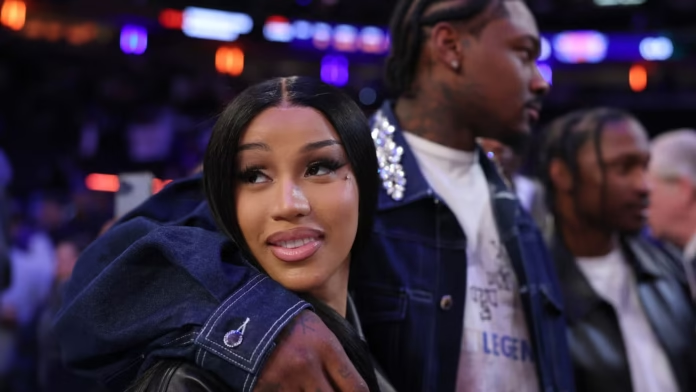
Rumors about Cardi B and NFL star Stefon Diggs took over social media almost as quickly as the Super Bowl itself. By the end of the night, fans were no longer just debating the game, they were trying to decode whether the high-profile pair had quietly ended their relationship.
The spark that lit the fire? Instagram.
Observers noticed that Cardi B and Diggs appeared to have unfollowed each other around Super Bowl weekend, a move many fans interpret as a modern-day breakup announcement. Entertainment outlets quickly picked up the change, and within hours, “Cardi” and “Diggs” were trending across multiple platforms.
But here’s where things get tricky: an unfollow is not a formal statement.
Neither Cardi B nor Stefon Diggs has publicly confirmed a split, and representatives for both have remained silent. Without direct confirmation, everything else circulating online falls into the category of rumor, no matter how convincing it may sound.
Still, fans began piecing together moments from the weekend.
Cardi attended several Super Bowl festivities and was visible during major events tied to the game. Some viewers felt her energy seemed different from the enthusiastic support she has shown in the past. A short pregame “good luck” sentiment in an interview, for instance, was read by some as distant, though others argue people may be reading far too much into a brief comment.
Meanwhile, gossip accounts added extra layers of drama. Posts claimed Cardi left early. Others alleged there were expensive party plans that went unused. Some suggested tensions may have flared after she became aware of who else was present around the field.
However, none of those details have been verified by reliable, on-record sources.
A few publications have even reported that, according to unnamed insiders, the relationship might have been rocky before the Super Bowl,Which might have made Steff diggs lose the game and that what fans witnessed may have been the aftermath rather than the cause. If true, that would mean the game itself wasn’t the breaking point. I just happened to be the most public moment.
As always with celebrity news, timelines become messy when social media, anonymous tips, and emotional fan reactions collide.
There is also the football side of the story. Diggs ending the night without a championship win naturally intensified the narrative. For some fans online, it became a dramatic pile-on: a tough professional moment mixed with apparent personal turmoil.
But again, narrative is not confirmation.
What can be said with confidence is simple:The unfollow happened.nMajor outlets acknowledge the speculation. No official breakup announcement exists.
Everything else lives in the realm of “maybe.”
It’s also worth remembering that celebrities sometimes unfollow and refollow. They argue and reconcile. They go quiet. They surprise everyone. Public clues don’t always equal permanent endings.
Until Cardi or Diggs speaks directly, fans are left interpreting digital breadcrumbs.
For now, the situation remains one of the most talked-about off-field storylines of the Super Bowl proof that in the age of social media, relationship drama can compete with the biggest sporting event in the world.
The Senate is reconvening today for an emergency session amid growing pressure to include mandatory real-time electronic transmission of election results in the amended Electoral Act.
The controversy surrounds the removal of the phrase “real-time” from sections dealing with electronic transmission, sparking concerns about electoral manipulation and post-poll interference.
Critics, including 2023 Labour Party presidential candidate Peter Obi, argue that the absence of real-time transmission weakens safeguards against electoral fraud.
On Monday, Obi led protests at the National Assembly, emphasizing that credible elections are non-negotiable.
Also, protesters have vowed to continue demonstrations until the bill is amended to explicitly mandate real-time electronic transmission.
The Nigerian Guild of Editors and civil society groups also backed the demand, citing the need for transparency and accountability.
The House of Representatives had adopted the clause mandating real-time transmission, but the Senate favors discretion, leaving it to INEC’s judgment.
Meanwhile, a conference committee has been set up to reconcile the differences.
President Bola Ahmed Tinubu silent on genocide against Christians in Nigeria
The Federal Government on Monday formally reopened the Nigeria–Niger Republic border through the Kamba corridor in Kebbi State, marking another step toward restoring cross-border trade and regional economic integration.
The development comes days after President Bola Tinubu approved the resumption of movement along the Nigeria–Benin Republic route via the Tsamiya corridor, in a bid to revitalise regional trade, strengthen economic ties and ease the movement of legitimate goods and services across West Africa.
Speaking at the official reopening ceremony in Kamba, the Area Controller of the Nigeria Customs Service, Kebbi Area Command, Mahmoud Ibrahim, said the Service was committed to implementing the President’s directive as conveyed by the Comptroller-General of Customs.
“We are here today to faithfully carry out the directive of Mr President through the Comptroller-General of Customs. Our officers and personnel are ready to ensure that legitimate trade and lawful commercial activities resume smoothly through this corridor,” Ibrahim said.
He added that Customs would intensify monitoring and enforcement to ensure compliance with trade regulations and prevent smuggling and other illegal activities along the reopened route.
Also speaking, the Controller of the Federal Operations Unit, Zone B, Aminu Suleiman, said the reopening would be accompanied by strict enforcement measures to safeguard national economic interests.
“The reopening of the border does not mean a relaxation of the law. Rather, it calls for greater professionalism and vigilance to ensure transparency and security in cross-border trade,” Suleiman said.
Earlier, the District Head of Kamba, Muhammad Shiko Kamba, thanked the Federal Government for reopening the border, describing the move as timely and economically beneficial to border communities.
“This reopening is a major relief to our people. It will restore livelihoods, stimulate commerce and bring prosperity not only to Kamba but to Kebbi State and Nigeria at large,” he said.
Representing Kebbi State Governor Nasiru Idris, the Chief of Staff to the Governor, Barrister Attahiru Maccido, described the reopening of the Tsamiya and Kamba corridors as a historic milestone for regional trade.
“Today feels like a Sallah celebration. The reopening of these two major border routes is a huge economic boost and a clear signal of renewed hope for our people,” Maccido said.
He, however, urged traders and security agencies to uphold transparency and accountability.
“While this reopening will boost economic activities and create employment opportunities, especially for our youths, all stakeholders must ensure that only lawful and transparent businesses are conducted now and in the future,” he added.
The reopening of the Nigeria–Niger border through Kamba is expected to enhance trade flows, improve livelihoods in border communities and strengthen Nigeria’s economic integration within the West African sub-region.
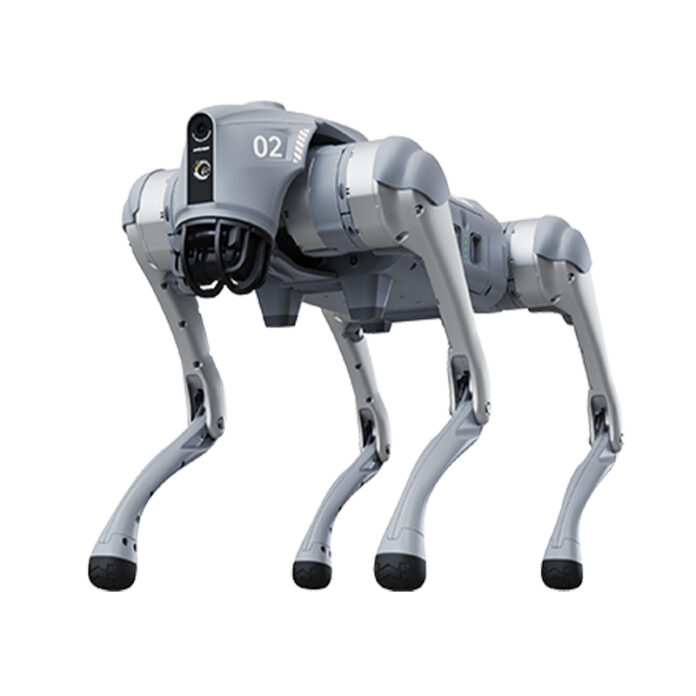
Mexican authorities have unveiled plans to deploy robot dogs to assist police operations during the 2026 FIFA World Cup, as part of enhanced security measures for the global football tournament.
The four-legged robots are designed to enter high-risk or hard-to-access areas and transmit live video footage to security personnel, allowing officers to assess situations before taking action.
The World Cup, scheduled to run from June 11 to July 19, 2026, will be jointly hosted by Mexico, the United States and Canada.
The robot dogs were acquired by the city council of Guadalupe, in Nuevo Leon State, at a cost of 2.5 million pesos (about $145,000).
Guadalupe is part of the Monterrey metropolitan area, which will host one of the tournament’s venues.
A demonstration video released by the local government shows one of the robots navigating an abandoned building, climbing stairs and transmitting live images to police officers positioned nearby.
In the footage, the robot encounters an armed suspect and issues a command through a loudspeaker, ordering the individual to drop his weapon.
Guadalupe Mayor Hector Garcia said the technology was introduced to enhance officer safety during security operations.
“The purpose of these robot dogs is to support police officers during initial interventions and to protect the physical safety of our personnel,” Garcia said, adding that the devices would be deployed “in case of any altercation” during the tournament.
BBVA Stadium, which will be temporarily renamed Estadio Monterrey for the World Cup, is expected to host four matches during the competition.
The United States Department of Homeland Security (DHS) has announced plans to deport an additional 18 Nigerians listed on its “worst-of-the-worst” criminal register, bringing the total number of Nigerians scheduled for removal to 97.
The development comes one week after Diaspora Digital Media exclusively reported that 79 Nigerians convicted of various offences had been marked for deportation by U.S. authorities.
A follow-up check of the DHS website on Monday showed that 18 more names had been added to the list, signalling an expansion of the ongoing enforcement exercise.
According to updated DHS records, wire fraud, mail fraud and identity theft were among the most common offences committed by the newly listed individuals.
An accompanying statement on the DHS website said the arrests and planned removals form part of a nationwide crackdown on criminal immigrants.
“The U.S. Department of Homeland Security is highlighting the worst of the worst criminal aliens arrested by the U.S. Immigration and Customs Enforcement,” the statement read.
“Under Secretary Noem’s leadership, the hardworking men and women of DHS and ICE are fulfilling President Trump’s promise and carrying out mass deportations, starting with the worst of the worst.”
The Nigerians newly listed for deportation include Oluwaseyanu Akinola Afolabi, Olugbeminiyi Aderibigbe, Benjamin Ifebajo, Obinwanne Okeke, Kolawole Aminu, Oluwadamilola Olufunsho Ojo and Franklin Ibeabuchi.
Others are Alex Afolabi Ogunshakin, Joshua Ineh, Stephen Oseghale, Eghosa Obaretin, Adesina Surajudeen Lasisi, Ibrahim Ijaoba, Azeez Yinusa, Charles Akabuogu, Kelechi Umeh, Lotenna Chisom Umeadi, Donald Ehie and Chukwudi Kingsley Kalu.
The updated figures underscore the Trump administration’s continued hardline stance on illegal and criminal immigrants, with several foreign nationals affected, including Nigerians.
Earlier, Diaspora Digital Media reported on February 2 that 79 Nigerians had been listed for deportation.
Those previously named include Boluwaji Akingunsoye, Ejike Asiegbunam, Emmanuel Mayegun Adeola, Bamidele Bolatiwa, Ifeanyi Nwaozomudoh, Aderemi Akefe, Solomon Wilfred, Chibundu Anuebunwa, Joshua Ineh, Usman Momoh, Oluwole Odunowo, Bolarinwa Salau and Oriyomi Aloba.
Others on the earlier list are Oludayo Adeagbo, Olaniyi Akintuyi, Talatu Dada, Olatunde Oladinni, Jelili Qudus, Abayomi Daramola, Toluwani Adebakin, Olamide Jolayemi, Isaiah Okere, Benji Macaulay and Joseph Ogbara.