


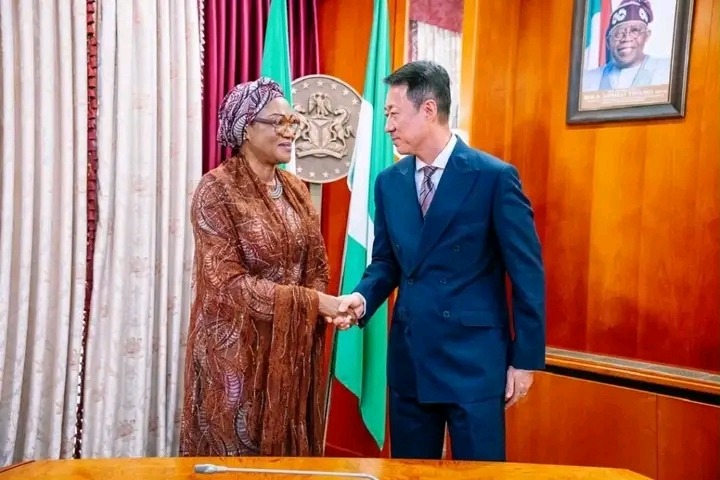
China’s Ambassador to Nigeria, Yu Dunhai, has urged Nigeria to sustain President Bola Tinubu’s economic reforms beyond 2027, arguing that the policies are beginning to produce tangible results and strengthen investor confidence.
The Chinese envoy made the remarks during a courtesy visit to Nigeria’s First Lady, Senator Oluremi Tinubu, at her office in the State House, Abuja, on Thursday.
According to a statement issued by the First Lady’s Senior Special Assistant on Media, Busola Kukoyi, Yu said Nigeria had made significant economic progress over the past three years and should remain committed to the ongoing reforms.

The ambassador said the country was establishing a stronger macroeconomic foundation, adding that China was prepared to explore investment opportunities arising from the changing business environment.
He also highlighted the growth in trade between both countries, which reached $18bn in the first half of 2026.
The figure represents a 35 per cent increase compared with the corresponding period, while Chinese imports from Nigeria reportedly rose by 81 per cent, reflecting expanding commercial exchanges between the two countries.
Yu said Nigeria’s exports to China had increased considerably over the past three years, describing the development as an indication of the growing economic relationship.
He stressed the importance of maintaining the current reform direction to consolidate the progress recorded so far, particularly as Nigeria approaches another general election in 2027.
China, he added, would continue strengthening its economic engagement with Nigeria through investments that prioritise local resources, domestic expertise and sustainable development.
The envoy’s remarks come as Tinubu’s administration continues to defend its economic policies, particularly the removal of the petrol subsidy and changes to the foreign exchange market.
Introduced in 2023, the measures were intended to reduce pressure on public finances, improve foreign exchange management and create a more attractive environment for private investment.
However, the policies have also contributed to increased living costs, leaving many Nigerian households struggling with higher transportation, food and other essential expenses.
The debate over the reforms has therefore centred on whether their long-term economic benefits will outweigh the immediate difficulties experienced by citizens.
Tinubu has maintained that the changes are necessary to address longstanding structural weaknesses in the economy. In his October 1 Independence Day address, the President said the country was moving from economic stabilisation towards a phase focused on delivering broader prosperity.
Yu’s call for continuity adds an international perspective to discussions about Nigeria’s economic direction after the 2027 elections.
For investors, consistent policies can help reduce uncertainty when making long-term commitments. Nevertheless, the sustainability of economic reforms also depends on effective implementation, institutional stability and the ability to translate economic gains into improved living standards.
During the meeting, Oluremi Tinubu welcomed China’s interest in supporting Nigeria’s development priorities, particularly in agriculture, technology and food security.
She said collaboration with China could help advance efforts to support vulnerable Nigerians and improve agricultural productivity.
The First Lady also described China’s support for the President’s second-term ambition as encouraging, highlighting the importance of continued cooperation between the two countries.
Nigeria and China elevated their relationship to a comprehensive strategic partnership in 2024 during Tinubu’s state visit to China. Since then, both governments have continued exploring opportunities for cooperation in trade, investment and development.
The latest discussions reinforce the importance of that relationship as Nigeria seeks to attract investment, expand exports and strengthen its economic position.
Whether Tinubu’s reforms continue unchanged beyond 2027 will ultimately depend on Nigeria’s political leadership and economic priorities. For now, the Chinese envoy’s position underscores the importance Beijing attaches to policy continuity and the further development of economic ties between both countries.




