
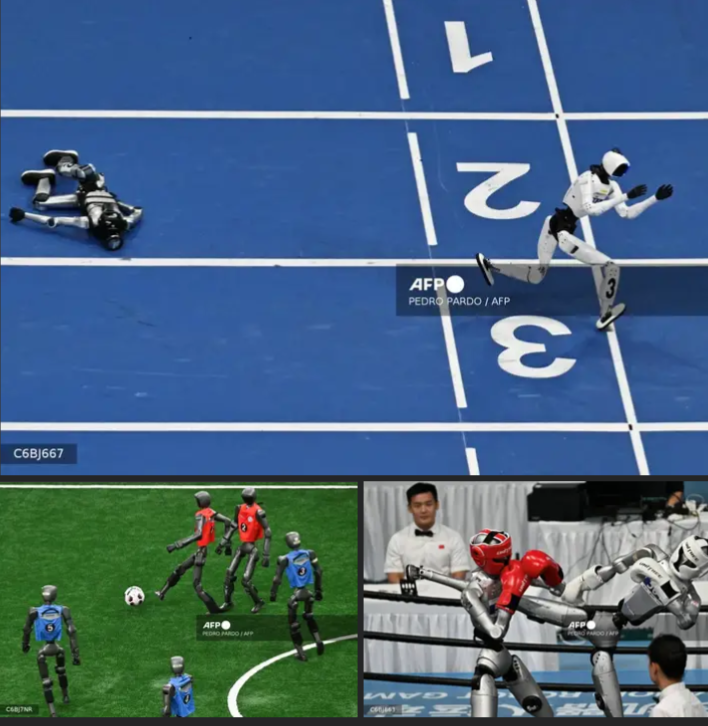
A Chinese humanoid robot has stunned spectators at the World Humanoid Robot Games in Beijing after running 100 metres faster than the long standing human world record set by Jamaican sprint legend Usain Bolt.
The robot, named Tiangong Ultra and developed by the Beijing Humanoid Robot Innovation Center, completed the 100 metre race in 9.39 seconds during the opening day of the five day competition. The performance was enough to surpass Bolt’s famous 9.58 second world record, which the eight time Olympic champion established at the 2009 World Athletics Championships in Berlin.
Although the robot’s achievement cannot be compared directly with a human athletic record because it is a machine competing in a separate event, the performance has nevertheless highlighted the rapid progress being made in humanoid robotics, particularly in China.

Tiangong Ultra did not have the fastest start in its race and initially trailed another Chinese humanoid robot called Lightning. However, it accelerated strongly towards the finish and eventually overtook its rival to record the winning time of 9.39 seconds.
Lightning, developed by Chinese smartphone manufacturer Honor, also produced an extraordinary performance, finishing the race in 9.47 seconds. The company had previously reported that Lightning completed a 100 metre test run in 9.32 seconds before the competition, reaching a peak speed of 14.5 metres per second.
The results represent a dramatic improvement in just one year. At the inaugural World Humanoid Robot Games in 2025, the fastest humanoid robot completed the 100 metres in 21.50 seconds. The latest performances therefore demonstrate how quickly engineers have improved robotic movement, balance, power and speed.
However, the machines still have obvious limitations. After reaching the finish line at high speed, the robots struggled to slow down safely. Tiangong Ultra stumbled towards the side of the track, while Lightning fell heavily and had to be carried away on a stretcher. Organisers had placed protective padding beyond the finish line to reduce the risk of serious damage when the machines could not stop immediately.

The unusual scenes provided an entertaining contrast to the impressive sprinting performances. While the robots demonstrated extraordinary acceleration and mechanical power, their difficulty with braking showed that speed is only one part of the challenge facing humanoid robotics.
The World Humanoid Robot Games are designed to demonstrate developments in robotics through sporting and practical challenges. The 2026 edition features more than 2,000 humanoid robots representing 666 teams from 16 countries, with competitions covering athletics, football, table tennis, boxing, gymnastics and other activities.
The competition is also being used to test robots outside traditional sporting environments. Organisers have introduced scenario based challenges involving tasks similar to those found in factories, restaurants and emergency situations. More than 40 percent of the competitions require robots to operate autonomously, putting greater emphasis on artificial intelligence, perception, coordination and decision making.

Another remarkable achievement at the games came in the standing high jump. A humanoid robot developed by Beijing based X Humanoid reached 2.88 metres, exceeding the human men’s high jump world record of 2.45 metres set by Cuba’s Javier Sotomayor in 1993.
The impressive performances underline China’s growing ambitions in humanoid robotics. Chinese technology companies and research institutions have invested heavily in artificial intelligence, advanced motors, sensors and robotic control systems as the country seeks to expand the use of humanoid machines in manufacturing and other industries.
For engineers, however, the ultimate goal is not simply to make robots run faster than humans. Real world usefulness will depend on whether humanoids can safely perform complicated tasks, manipulate objects accurately, understand unpredictable environments and work independently without constant human intervention.
Bolt’s 9.58 second record remains one of the most iconic achievements in human athletics, and the Jamaican remains the fastest man ever recorded over 100 metres in an official human race. The emergence of robots capable of running faster does not diminish what he achieved, but it does provide a striking illustration of how technology is beginning to push beyond some of the physical limits of the human body.
The World Humanoid Robot Games will continue until August 26, giving spectators more opportunities to witness how far robotic technology has advanced. As the machines become faster and more capable, the competition is increasingly becoming a showcase of not only athletic spectacle but also the future possibilities of artificial intelligence and robotics.