


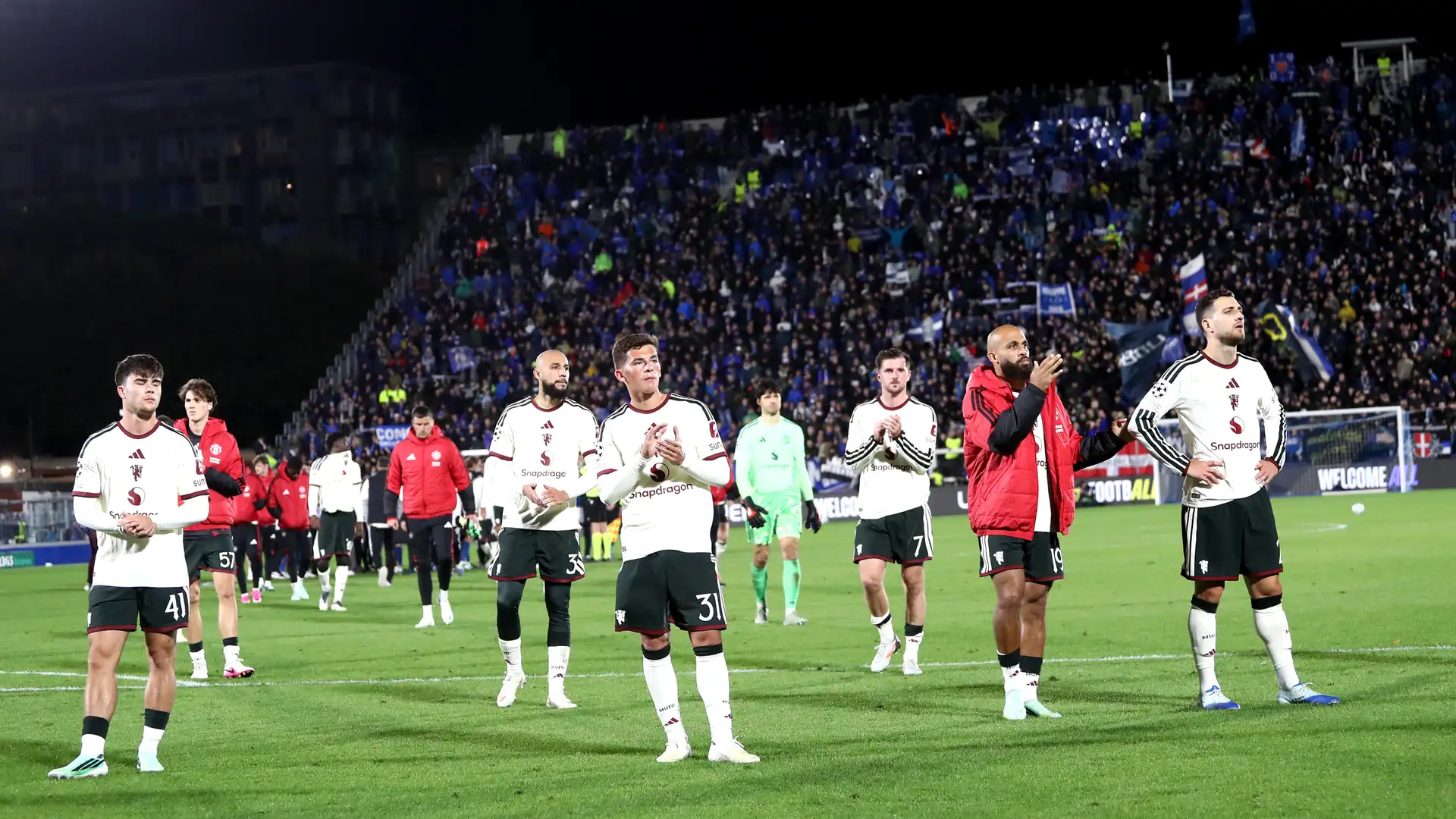
Manchester United’s humiliating 4-1 defeat to Como in the UEFA Champions League was more than a damaging result for Michael Carrick. It was a demonstration of how intelligent positional play, coordinated pressing and the exploitation of defensive gaps can dismantle a team struggling to maintain its tactical structure.
At the centre of Como’s historic victory was Nico Paz, whose two goals and assist helped Cesc Fàbregas deliver one of the most memorable European nights in the Italian club’s history. United, meanwhile, suffered their heaviest defeat in European competition since November 1994, when they lost 4-0 to Barcelona.
The significance of the result lies not only in the scoreline but also in how Como achieved it. Fàbregas’s side repeatedly found ways to exploit the spaces between United’s midfield and defence, while Carrick’s team struggled to establish control, protect its backline or build dangerous attacks consistently.

According to the match statistics cited in the tactical analysis, Como enjoyed 54 per cent possession and recorded an expected goals figure of 1.97, compared with United’s 0.62. The difference illustrates the central problem for the visitors: they were unable to prevent Como from reaching dangerous attacking positions, even when they managed to retain possession themselves.
The opening goal, scored by Paz inside two minutes, immediately exposed the consequences of poor defensive spacing. After receiving a pass from Lucas da Cunha, the Argentine created room to shift the ball onto his left foot and curl a finish into the far corner.
United had already threatened through Diogo Dalot, who failed to convert an early opportunity. Instead of capitalising on that opening, Carrick’s side conceded almost immediately, allowing Como to establish the conditions for the tactical battle that followed.
The early breakthrough gave Fàbregas’s team greater freedom to dictate the tempo. Como could circulate possession, draw United’s players out of their defensive positions and attack the spaces created when the visitors attempted to press.
The tactical report described Como’s nominal 4-2-3-1 formation as a more aggressive 3-2-5 during possession. The objective was to stretch United horizontally through advanced full-backs while keeping Paz in positions where he could receive the ball between the opposition’s midfield and defensive lines.
That positioning proved particularly damaging because United struggled to maintain compactness. When the midfield stepped forward to pressure the ball, space appeared behind it. When the defensive line dropped to protect the penalty area, the gap between the two units became available for Como’s attacking players.
Paz by exploited this uncertainty. Rather than remaining fixed in the central attacking position, he moved into pockets of space where United’s midfielders had to decide whether to follow him or preserve their positions.
Such decisions are fundamental to positional football. If a midfielder follows an attacking player out of position, another opponent can exploit the space left behind. If the midfielder refuses to engage, the receiver gains time to turn, combine with teammates or advance towards the penalty area.
Como’s attacking structure appeared designed to provoke precisely these dilemmas. Paz’s movement created opportunities for runners, while the positioning of the full-backs stretched the defensive line and complicated United’s attempts to close the central channels.
The visitors’ problems were not restricted to their defensive shape. Their attacking structure also struggled to provide a reliable route forward.
Bruno Fernandes, ordinarily one of United’s principal creative outlets, was reportedly forced to drop deeper to receive possession. Although this gave him more opportunities to participate in the build-up, it also reduced his presence in the final third, where his passing and movement could have caused greater problems for Como.
Bryan Mbeumo and Matheus Cunha also struggled to receive the ball in positions that allowed them to attack defenders directly. When wide forwards receive possession with their backs to goal or under immediate pressure, they have fewer opportunities to accelerate into space or combine effectively with overlapping teammates.
This weakened United’s ability to respond through transitions. Winning the ball was not enough because the team lacked the immediate passing options and forward movement needed to turn defensive recoveries into dangerous counter-attacks.
Como’s second goal exposed the problem again. Four minutes after the interval, Paz threaded a through ball into the path of Anastasios Douvikas, who escaped the defensive line and finished past the advancing goalkeeper.
The goal illustrated the danger of defending without adequate protection against runs behind the backline. Once Paz received the ball in a position to look forward, United’s defenders had to respond to both the passer and the runner. Douvikas exploited that uncertainty to double Como’s advantage.
Carrick attempted to change the game’s direction by introducing Carlos Baleba and Amad Diallo at half-time. The substitutions suggested a desire to strengthen the midfield physically while giving United additional penetration in attack.
However, the adjustment did not solve the underlying structural problems. United conceded again in the 57th minute, when Paz capitalised on a costly error by Baleba, recovered possession and drove forward before finishing his second goal of the evening..
At 3-0, the contest was effectively beyond United’s reach. The visitors needed to take greater attacking risks, but doing so also increased the possibility of leaving additional space behind their midfield.
Como continued to take advantage. In the 76th minute, Kaiki Bruno advanced down the left and delivered a cross that Jacobo Ramón converted with a header to make it 4-0.
Joshua Zirkzee scored a late consolation for United in stoppage time, but the goal did little to change the broader tactical picture.
The historical dimension makes the defeat even more significant. United’s previous four-goal loss in European competition was a 4-0 defeat to Barcelona in the 1994-95 Champions League campaign, when the Spanish side featured players including Romário and Hristo Stoichkov.
More than three decades later, Como inflicted another four-goal European defeat on the English club, although Zirkzee’s late goal meant the final margin was three goals rather than four.
For Como, the victory represented a landmark achievement against one of European football’s most recognisable clubs. For Fàbregas, it demonstrated how a coordinated tactical structure can magnify the influence of technically gifted players such as Paz.
For Carrick, the performance raised difficult questions about United’s defensive distances, pressing coordination and ability to adjust when an opponent repeatedly attacks the same weaknesses.
Injuries and absences may have limited Carrick’s options, but they do not fully explain the problems visible throughout the contest. The decisive issue was how United’s available players responded to Como’s movement and whether the coaching staff could reorganise the side before the damage became irreversible.
Ultimately, Como’s victory was built on more than individual brilliance. Fàbregas’s attacking structure created the conditions for Paz to thrive, exposed the spaces United struggled to defend and punished mistakes with remarkable efficiency.
The 4-1 scoreline will dominate the headlines, but the deeper lesson is tactical: a team can possess talented individuals and still become vulnerable when its defensive lines lose cohesion, its pressing lacks coordination and its attacking transitions fail to offer an effective response.
Against Como, Manchester United suffered on all three fronts. The result was a historic European setback, and the manner of the defeat left Carrick facing questions that extend far beyond one disappointing night in Italy.




