ASABA, NIGERIA — The Delta State Government says it is prosecuting more than 15 human trafficking cases before the State High Court, as it intensifies efforts to dismantle trafficking networks, protect vulnerable residents and prevent the exploitation of children and young people.
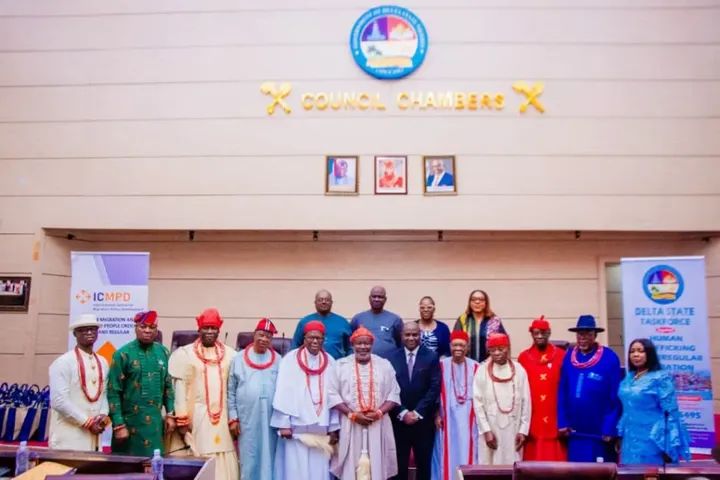
The Attorney-General and Commissioner for Justice, Mr Ekemejero Ohwovoriole, SAN, disclosed this on Thursday, November 26, 2026, during an advocacy engagement with members of the Delta State Traditional Rulers Council.
Ohwovoriole, who also chairs the Delta State Task Force on Human Trafficking and Irregular Migration, called on traditional rulers to strengthen community vigilance, expose suspicious activities and work with relevant authorities to prevent traffickers from exploiting residents.
He said the state government remained committed to enforcing the Delta State Human Trafficking (Prohibition) Law, 2024, which provides the legal framework for prosecuting offenders and protecting victims.
According to him, the Department of Public Prosecutions is currently handling more than 15 human trafficking cases before the state High Court, while the National Agency for the Prohibition of Trafficking in Persons (NAPTIP) is also pursuing trafficking-related cases before Federal High Courts in Delta State.
The Attorney-General stressed that government institutions alone could not eliminate human trafficking without the active involvement of communities, particularly traditional institutions whose leaders command considerable influence among residents.
The advocacy meeting, organised under the theme, “The Royal Voice Against Human Trafficking: Protect Our Children, Preserve Our Culture,” focused on strengthening collaboration between government agencies and traditional rulers to prevent trafficking, support victims and ensure that perpetrators face justice.
Ohwovoriole described traditional rulers as critical partners in the campaign, noting that their authority and influence could help expose criminal networks, discourage harmful practices and encourage residents to report suspected trafficking activities.
“In our communities, when royal fathers speak, people listen. Your influence and standing make you vital partners in this fight. That is why we are here to seek your support and partnership,” he said.
He warned that traffickers increasingly target young people through deceptive promises of football trials, scholarships, employment opportunities and better living conditions in major cities and foreign countries.
According to him, some victims are lured into trafficking networks through seemingly attractive opportunities before being subjected to exploitation, forced labour and other forms of abuse.
The commissioner also raised concerns about the misuse of traditional beliefs and practices to intimidate victims and prevent them from reporting their experiences.
He specifically cautioned against the use of forced oaths, shrines and threats of spiritual consequences to silence victims or their families, insisting that no cultural practice should be used to conceal criminal activities or obstruct access to justice.
Ohwovoriole urged traditional rulers to discourage such practices and ensure that rescued victims receive acceptance and support when they return to their communities.
He emphasised that victims should not be blamed, rejected or stigmatised because of their experiences. Instead, they should receive understanding, protection and assistance to rebuild their lives.
The Attorney-General further appealed to monarchs to encourage residents to provide credible information to law enforcement agencies whenever they suspect trafficking activities, stressing that those involved in the illegal trade would be held accountable under the law.
Responding, the Chairman of the Delta State Traditional Rulers Council and Orodje of Okpe Kingdom, His Royal Majesty, Major General Felix Mujakperuo (retd.), Orhue I, pledged the council’s support for the state government’s anti-trafficking campaign.
The monarch warned that traffickers and their accomplices would be exposed and made to face the law, urging traditional rulers and community leaders to remain vigilant and report suspicious activities.
He also called on residents to cooperate with security agencies and relevant government institutions to prevent criminal networks from operating within their communities.
The state government’s campaign builds on the establishment of the Delta State Task Force Against Human Trafficking and Irregular Migration in 2019 and the subsequent creation of an Anti-Human Trafficking Unit within the Ministry of Justice in 2021.
The 2024 law further strengthened the state’s legal framework for addressing trafficking-related offences, protecting victims and prosecuting suspected offenders.
The latest engagement also comes amid growing concerns over fraudulent overseas recruitment, irregular migration and online schemes targeting Nigerians seeking better economic opportunities abroad.
Authorities have warned that traffickers increasingly exploit social media platforms, fake job advertisements and promises of lucrative employment to deceive unsuspecting individuals.
For Delta State, the challenge extends beyond arresting and prosecuting offenders to preventing exploitation before it occurs. This requires sustained public education, effective law enforcement, community cooperation and adequate support for survivors.
The government is therefore seeking to make traditional institutions an active part of its prevention strategy, with monarchs expected to use their influence to protect children, identify suspicious movements and discourage practices that enable traffickers to operate.
With more than 15 cases already before the State High Court, the government says it is pursuing legal action alongside public enlightenment and community engagement to strengthen its response to human trafficking across Delta State.