


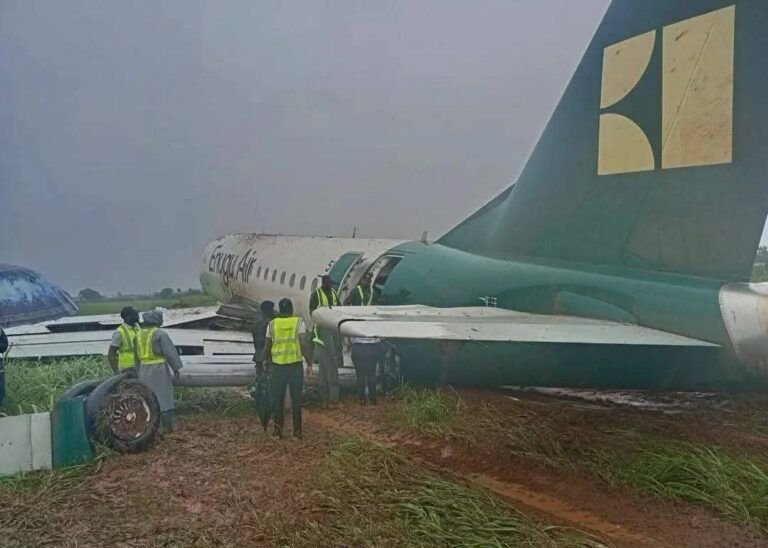
The Nigerian Safety Investigation Bureau (NSIB) has released its preliminary report on the ongoing investigation into the accident involving an Embraer ERJ 170-100LR aircraft operated by Enugu Air Limited.
The aircraft, with nationality and registration marks 5N-ENR, was involved in the accident on July 23, 2026, at about 2:55 p.m. while operating scheduled passenger flight ENU4264 from Murtala Muhammed International Airport, Lagos, to Oba Akenzua II Airport, Benin, Edo State.
The bureau revealed that the aircraft’s autobrake system was not working at the time of the accident.
According to the report, the flight crew had identified the malfunctioning autobrake system before landing and planned to use manual braking.

The report revealed that as the aircraft approached Benin, however, weather conditions deteriorated, with rain and reduced visibility reported around the airport.
The crew had initially been cleared for an Instrument Landing System approach to Runway 23 but requested an RNAV approach to Runway 05, which was approved by air traffic control.
At about 2:42 p.m., Benin Tower advised the crew that the approach path to Runway 05 appeared cloudy, while the approach path to Runway 23 appeared better. The crew acknowledged the information but elected to continue the RNAV approach to Runway 05.
The NSIB report said that at about 2:48 p.m., the crew was advised that visibility was approximately 1,500 metres in moderate rain.
During the approach briefing, the First Officer stated that the autobrake system was not working and that manual braking would therefore be used during landing.
The crew also cross-checked an approximate landing weight of 32,000kg.
At 2:53:24 p.m., the tower cleared the aircraft to land on Runway 05 and informed the crew that the surface was wet. The aircraft subsequently touched down at about 2:54:49 p.m., approximately 1,641.5 metres from the threshold of the 2,400-metre runway.
The aircraft’s recorded groundspeed at touchdown was approximately 138.2 knots.
The report also found that the aircraft experienced a tailwind during the final approach and landing. At the runway threshold, the estimated tailwind component was about 12 knots, reducing to approximately 6.4 knots at touchdown.
Following touchdown, flight recorder data showed an increase in brake pressure and activation of the ground spoilers.
The aircraft’s thrust reversers were also found in the deployed condition after the accident.
Despite the braking action, the aircraft was unable to stop within the available runway distance and overran the end of Runway 05.
It crossed the runway-end blast pad and entered the unpaved area beyond the runway, where it struck approach-lighting installations and two fixed concrete structures associated with a decommissioned localizer installation.
The impact caused the nose landing gear, right main landing gear and left main landing gear to separate from the aircraft.
The aircraft eventually came to rest about 325 metres beyond the end of Runway 05.
Seven approach lights were damaged, while the aircraft sustained substantial damage, including damage to its landing gear, engine cowling, horizontal stabiliser, forward lower fuselage skin, ailerons and flaps.
Despite the severity of the runway excursion, the accident was survivable. All 68 occupants were evacuated without injury through the rear-left emergency exit slide.
The NSIB also found that weather conditions had deteriorated during the aircraft’s arrival. The 1400 UTC meteorological report recorded visibility of 1,000 metres with moderate rain.
The Bureau noted that the ATC communications reviewed did not contain any transmission of a Runway Condition Report or Runway Condition Code to the flight crew.
It further found that the weather information display equipment at the Benin control tower was unserviceable at the time of the accident.
An incomplete building structure was also found to be obstructing the control tower’s line of sight towards the end of Runway 05.
The NSIB has issued four immediate safety recommendations to the NCAA, FAAN and NiMet, including the removal of the fixed structures of the decommissioned localizer installation at the runway end, improvements to control tower visibility and restoration of the weather information display system.
The Bureau stressed that the preliminary report does not constitute a final determination of the cause of the accident.
However, further investigation will examine runway conditions, runway-condition reporting, meteorological information, the aircraft’s landing gear and impact sequence, crew training and experience, operational decision-making and Enugu Air’s procedures.
The agency said the sole objective of the investigation, in accordance with Annex 13 to the Convention on International Civil Aviation, is the prevention of future accidents and incidents and not the apportionment of blame or liability.




