


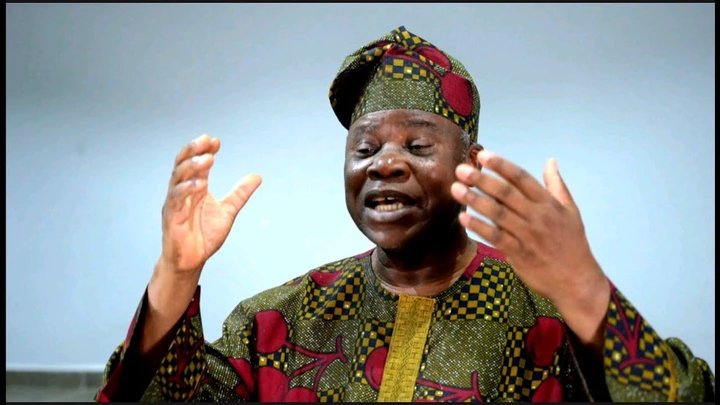
ABUJA, NIGERIA — Dr. Akin Fapohunda, Director of Research of the Afenifere socio-cultural group, has proposed that the Nigerian government explore voluntary asset recovery measures involving wealthy individuals suspected of holding illegally acquired assets.
Fapohunda made the proposal while speaking on Naija Unfiltered on SYMFONI, where he discussed corruption, wealth accumulation, asset recovery and Nigeria’s financial challenges.
Fapohunda Counts 61 Private Jets
Fapohunda said he visited Abuja approximately two weeks before appearing on the programme and personally counted at least 61 private jets at the airport.
He argued that the concentration of private aircraft demonstrated the level of wealth held by some individuals in the country.

However, his observation does not establish that the owners of the aircraft obtained their wealth or aircraft through illegal means.
Fapohunda used the observation to advance his broader argument that the government should pursue stronger mechanisms for recovering assets suspected to have been acquired through corruption.
Proposal For Voluntary Surrender
The Afenifere research director suggested that the government could establish a framework that gives individuals suspected of holding illicit assets an opportunity to surrender them voluntarily.
Under his proposal, wealthy individuals could be encouraged to hand over assets or proceeds to the government rather than face lengthy investigations and court proceedings in every case.
He specifically suggested that owners of private jets could sell the aircraft and surrender the proceeds to the government.
Fapohunda argued that such an approach could potentially generate substantial funds for the country at a time when Nigeria continues to face significant fiscal pressures.
Saudi Arabia Example
To support his argument, Fapohunda referred to Saudi Arabia’s anti-corruption campaign.
He cited the 2017 Saudi crackdown, during which dozens of prominent businessmen, princes and officials were detained at the Ritz-Carlton hotel in Riyadh as authorities pursued allegations of corruption and illicit enrichment.
The Saudi government subsequently reached financial settlements with some of those detained.
Fapohunda suggested that Nigeria could develop its own asset-recovery framework based on voluntary surrender rather than simply replicating Saudi Arabia’s approach.
Debt Concerns
Fapohunda linked his proposal to Nigeria’s continuing concerns over public debt and government finances.
He argued that recovering proceeds from suspected illicit wealth could provide additional resources for government spending and reduce financial pressures.
His comments come amid broader public discussions about Nigeria’s debt obligations, revenue challenges and the resources available to fund infrastructure and social programmes.
Claim Requires Verification
Fapohunda’s statement about seeing 61 private jets at Abuja airport was presented as his personal observation.
It does not, by itself, establish the number of private aircraft owned by Nigerians or prove that the aircraft he saw represented proceeds of corruption.
Similarly, allegations that particular individuals acquired assets illegally would require evidence and appropriate legal proceedings before such claims could be established.
The distinction is important because ownership of a private jet, without additional evidence, does not establish involvement in financial wrongdoing.
Asset Recovery Debate
Nigeria has previously pursued asset recovery through criminal investigations, prosecutions, forfeiture proceedings and international cooperation.
Fapohunda’s proposal instead emphasises creating incentives for suspected holders of illicit assets to surrender them voluntarily.
He argued that such a framework could reduce the time and resources required for conventional investigations and litigation while allowing the government to recover assets more quickly.
The proposal has therefore added another perspective to the ongoing debate over how Nigeria can combat corruption, recover public resources and strengthen its finances.
Call For Broader Action
Fapohunda maintained that the government should look beyond conventional revenue measures and examine wealth and assets that may have been acquired through unlawful means.
His suggestion specifically focuses on voluntary asset surrender, including the possible sale of private aircraft, as a way of generating funds for government.
However, any such mechanism would need clear legal safeguards, transparent procedures and evidence-based assessments to distinguish legitimately acquired assets from property linked to unlawful activity.




