

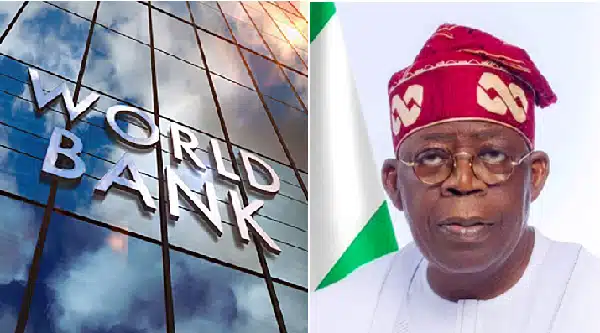
The administration of President Bola Tinubu has secured $11.40 billion in World Bank loan approvals within roughly three years in office, marking one of the fastest paces of multilateral borrowing in Nigeria’s recent history. The impressive volume of approvals underscores the Federal Government’s reliance on concessional financing to fund wide-ranging economic reforms, infrastructure development, energy expansion, agriculture, healthcare, education, social protection, and private sector growth. However, the rapid increase in approved financing has also reignited concerns over Nigeria’s growing debt profile and the long-standing question of whether the borrowed funds will generate sufficient economic returns to justify future repayment obligations.
With the latest approvals, Tinubu’s administration has already secured approximately 78.2 per cent of the $14.59 billion in World Bank financing approved during the entire eight-year administration of former President Muhammadu Buhari. The figures suggest that if the current pace continues, the Tinubu government will require only about $3.19 billion in additional approvals to surpass the total World Bank commitments secured under Buhari before the end of its current term.
According to DDM News, the figures highlight the Federal Government’s strategy of leaning heavily on development financing to support difficult structural reforms aimed at stabilising the Nigerian economy after years of fiscal pressures, foreign exchange challenges, subsidy costs, and declining public revenues.
While the approval figures appear substantial, they do not represent money already received by the country. Data indicate that only $2.32 billion of the $11.40 billion approved under the Tinubu administration has so far been disbursed, leaving approximately $8.41 billion yet to be released. This places the overall disbursement rate at roughly 20.3 per cent, demonstrating that the majority of the approved financing remains tied to ongoing project implementation and compliance with agreed conditions.
This contrasts sharply with projects approved during the Buhari administration. Of the $14.59 billion approved over eight years, approximately $11.94 billion has already been disbursed, while only $1.53 billion remains available for drawdown. The difference largely reflects the maturity of older projects, many of which have either reached completion or progressed significantly through their implementation stages.
Development finance experts note that World Bank loan approvals should not be interpreted as immediate cash inflows. Instead, funds are released gradually based on agreed milestones, project performance, procurement processes, policy reforms, and compliance with implementation benchmarks established between the Nigerian government and the World Bank.
A significant portion of Tinubu’s World Bank financing has been directed toward supporting the administration’s ambitious economic reform programme.
The single largest approval came in June 2024, when the World Bank approved a $2.25 billion financing package designed to strengthen Nigeria’s macroeconomic stability and improve public revenue mobilisation. The package consisted of $1.5 billion for the Nigeria Reforms for Economic Stabilisation to Enable Transformation programme and an additional $750 million for the Accelerating Resource Mobilisation Reforms initiative.
These facilities were specifically designed to support the Federal Government’s far-reaching policy changes, including the removal of petrol subsidies and the liberalisation of Nigeria’s foreign exchange market. Both reforms fundamentally reshaped government finances by reducing subsidy expenditures and allowing market-driven exchange rates.
Although international financial institutions, including the World Bank, have consistently argued that the reforms are necessary to restore fiscal discipline and strengthen investor confidence, their implementation has come with significant social costs.
The removal of fuel subsidies contributed to sharp increases in transportation expenses, while currency liberalisation accelerated inflation, pushing up food prices and increasing the cost of living for millions of Nigerians. Labour unions, civil society organisations, and opposition groups have repeatedly criticised the pace of the reforms, arguing that adequate social protection measures should have accompanied their implementation.
Despite the criticism, the World Bank has maintained that the reforms remain essential to restoring macroeconomic stability, improving revenue generation, and creating conditions for sustainable long-term economic growth.
The Federal Government’s World Bank financing portfolio expanded further in 2026 with the approval of a $1.25 billion package under the Nigeria Actions for Investment and Jobs Acceleration Programme.
The financing comprises two facilities valued at $500 million and $750 million, forming part of the World Bank’s broader Country Partnership Framework for Nigeria covering 2026 to 2032.
The new framework prioritises private sector-led economic growth, employment generation, expanded electricity access, improved digital infrastructure, enhanced agricultural productivity, and broader economic competitiveness. The programme is expected to stimulate investment while creating opportunities for businesses and young Nigerians seeking employment.
Infrastructure development continues to account for a substantial share of the World Bank’s financial support to Nigeria.
The power sector, in particular, remains one of the largest beneficiaries under the Tinubu administration. In June 2023, the World Bank approved $750 million for the Power Sector Recovery Performance-Based Operation, followed by another $750 million in December 2023 for the Nigeria Distributed Access through Renewable Energy Scale-up Project.
The renewable energy initiative aims to provide new or improved electricity access to approximately 17.5 million Nigerians through decentralised renewable energy solutions, particularly in underserved rural and peri-urban communities. Despite the ambitious targets, implementation remains gradual, with only one of the project’s financing facilities recording any significant disbursement so far.
Agriculture has also emerged as another priority sector attracting multilateral support. In March 2026, the World Bank approved $500 million for the Nigeria Sustainable Agricultural Value-Chains for Growth Project. The initiative seeks to strengthen agricultural productivity by supporting smallholder farmers, improving market access, expanding agricultural value chains, and creating employment opportunities across rural communities. However, like several recently approved projects, no disbursement had yet been recorded at the time of the latest financial update.
Human capital development also occupies a central place within the administration’s borrowing strategy.
Education, healthcare, women’s empowerment, and nutrition programmes have attracted significant World Bank financing over the past three years. The Adolescent Girls Initiative for Learning and Empowerment received $700 million in September 2023, while the Nigeria for Women Programme Scale-Up Project secured $500 million in June 2023.
In September 2024, the World Bank approved another $1.5 billion for three major projects focusing on education, primary healthcare, and irrigation development. Nevertheless, implementation remains at an early stage, with combined disbursements amounting to only $111.35 million, representing approximately 7.4 per cent of the total approved amount.
The growing pace of World Bank financing comes against the backdrop of Nigeria’s rising external debt obligations.
According to data from the Debt Management Office, Nigeria’s debt exposure to the World Bank increased by $2.08 billion within one year, reaching $19.89 billion as of December 31, 2025. This means World Bank obligations now account for approximately 38.36 per cent of Nigeria’s total external debt stock of $51.86 billion, making the institution the country’s largest single external creditor.
The expanding debt profile continues to divide economists and financial analysts.
Supporters argue that World Bank loans remain among the most favourable sources of external financing because they generally carry lower interest rates, longer repayment periods, and more flexible repayment terms than commercial loans or international bond issuances.
Critics, however, caution that even concessional borrowing can become unsustainable if economic growth fails to accelerate, government revenues remain weak, and debt servicing continues consuming a substantial share of public finances. They argue that Nigeria’s real challenge is not merely the volume of loans being approved but whether those funds translate into productive investments capable of boosting output, creating jobs, expanding infrastructure, and strengthening public services.
According to DDM News, the effectiveness of the Tinubu administration’s borrowing strategy will ultimately be judged not by the size of the approved loans but by the tangible outcomes delivered across the economy. With World Bank approvals now averaging roughly $3.7 billion annually, compared to about $1.82 billion per year during the Buhari administration, expectations have risen significantly.
As Nigeria continues implementing ambitious reforms amid persistent economic challenges, the growing pipeline of World Bank financing presents both an opportunity and a responsibility. If effectively utilised, the funds could accelerate infrastructure development, improve social services, strengthen agriculture, expand electricity access, and stimulate private investment. However, if implementation remains slow or projects fail to deliver measurable economic benefits, the country risks adding to its debt burden without achieving the growth and productivity needed to sustain long-term repayment and economic resilience.