


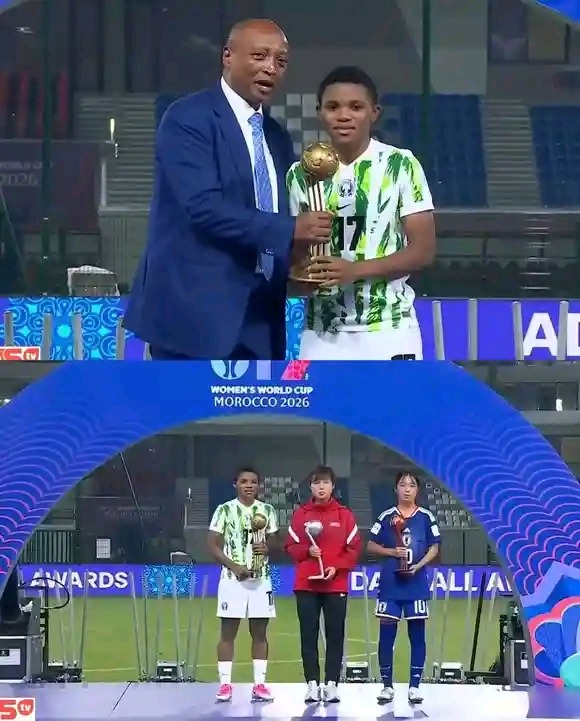
Nigeria’s teenage sensation Oluebube Umejiaku has added another remarkable chapter to the country’s football history after winning the prestigious Golden Ball award as the best player of the 2026 FIFA U-17 Women’s World Cup in Morocco.
The 16-year-old forward received the individual honour following her outstanding performances throughout the competition, where she played a decisive role in guiding Nigeria’s Flamingos to their maiden world title.
Umejiaku’s recognition came just hours after she helped Nigeria defeat Japan 2-1 in Saturday’s final at the Mohammed VI Football Complex in Rabat, becoming the first African nation to win the FIFA U-17 Women’s World Cup.

The Heartland Queens forward was instrumental in Nigeria’s historic campaign, contributing four goals to the team’s success, including the decisive strike that secured victory over Japan in the final.
After Awawu Bashiru opened the scoring in the 39th minute, Umejiaku doubled Nigeria’s advantage just two minutes into the second half, displaying remarkable composure to control a long pass from Esther Stephen before delicately lifting the ball over Japan goalkeeper Kou Kadowaki.
Although Japan reduced the deficit through Fuki Ito in the 80th minute, the Flamingos held on to their advantage to secure a historic victory and send millions of Nigerians into celebration.
Umejiaku’s influence extended beyond the final, as she consistently delivered important performances during Nigeria’s journey to the championship.
She scored against Poland, North Korea and Mexico, while also providing assists against Puerto Rico and Brazil. Her contribution in the quarter-final victory over Venezuela, where she won a crucial penalty, further demonstrated her importance to the team.
Her performance against Japan earned her the Player of the Match award in the final, making the Golden Ball recognition an additional reward for an exceptional tournament.
The young forward’s achievement is particularly significant considering Nigeria’s difficult start to the competition. The Flamingos opened their campaign with a 2-1 defeat to Poland, raising questions about their ability to challenge for the trophy.
However, Akeem Busari’s side responded impressively, defeating Puerto Rico before overcoming defending champions North Korea 3-1 to progress from their group.
They subsequently defeated Mexico 2-1 in the Round of 16, overcame Venezuela in the quarter-finals and produced an impressive 3-1 victory over Brazil in the semi-finals to book their place in the final.
Their eventual triumph over Japan completed one of the most remarkable comebacks in the competition’s history, as Nigeria became the first team to lose its opening match and still go on to win the tournament.
Beyond Umejiaku’s individual recognition, the championship represents a major milestone for Nigerian and African women’s football.
Nigeria also became the first African country to win the FIFA U-17 World Cup in both the men’s and women’s categories, further strengthening the country’s reputation as a major force in youth football.
Meanwhile, other outstanding performers at the tournament also received individual recognition.
DPR Korea’s Yu Jong-hyang won the Silver Ball, while Japan’s Fuki Ito received the Bronze Ball. United States forward Maddie DiMaria claimed the Golden Boot after finishing as the tournament’s leading scorer with 12 goals.
DPR Korea goalkeeper Kim Son-gyong won the Golden Glove award, while Japan received the FIFA Fair Play Trophy.
For Umejiaku, however, the Golden Ball represents more than an individual achievement. It is recognition of a young footballer whose performances helped deliver a historic world championship for Nigeria and Africa.
Having announced herself on the international stage at just 16, the Heartland Queens striker will undoubtedly attract greater attention following her remarkable performances in Morocco.
With the Flamingos returning home as world champions and Umejiaku recognised as the tournament’s best player, Nigeria’s latest generation of female footballers have given the country another reason to believe in the future of women’s football.




