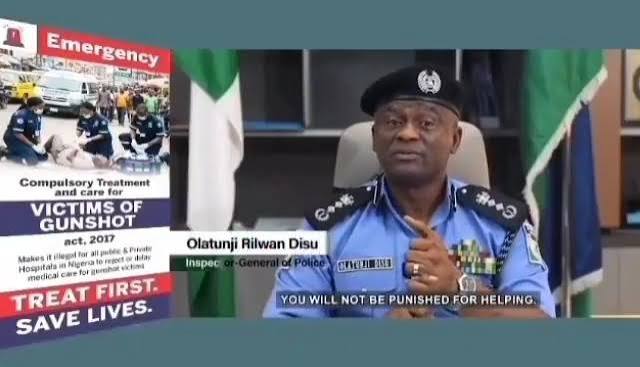
Inspector-General of Police, Olatunji Rilwan Disu, has urged hospitals and medical personnel across Nigeria to provide immediate medical attention to victims of gunshot injuries without demanding police reports or clearance before treatment.
Disu made the appeal in a public sensitisation message shared on Thursday, November 19, 2026, through the official X account of the Nigeria Police Force.
Addressing police officers, healthcare workers and members of the public, the Inspector-General described the treatment of gunshot victims as a matter of life and death, warning that administrative procedures must not prevent injured persons from receiving urgent medical attention.
According to him, Nigerian law does not require a police report before a hospital can attend to someone with gunshot wounds.
“When a gunshot victim is brought to any hospital, the law does not require a police report before treatment,” Disu stated.
He specifically appealed to doctors, nurses and other healthcare professionals to prioritise saving lives rather than waiting for police documentation.
“To our doctors and healthcare workers, you are enjoined to treat gunshot victims immediately without waiting for a police report,” he said.
The police chief also reassured Nigerians that the responsibility of the police was to protect lives and not create fear among citizens.
“Our duty is not to create fear, but to protect lives. We wish to reassure citizens of their safety at all times,” he added.
Disu further encouraged members of the public to assist injured persons during emergencies, assuring them that helping victims would not attract punishment.
“To members of the public, if you see someone injured, do not hesitate to help. You will not be punished for helping,” he said.
The directive reinforces provisions of the Compulsory Treatment and Care for Victims of Gunshots Act, 2017, which requires every public and private hospital in Nigeria to receive and provide immediate and adequate treatment to people with gunshot wounds, with or without police clearance.
The legislation also places a responsibility on members of the public, including security personnel, to assist gunshot victims and ensure they are taken to the nearest hospital for treatment.
Importantly, the law allows hospitals to notify the nearest police station within two hours after commencing treatment, meaning police investigations can begin without making a police report a condition for emergency medical care.
The Act also provides penalties for violations of its provisions. Section 9 prescribes imprisonment of between five and 15 years, without the option of a fine, for an offence that causes substantial physical, mental, emotional or psychological damage to a victim.
Section 11 separately provides for a fine of ₦500,000, imprisonment for five years or both where a person or authority, including a hospital or police officer, fails to perform a duty under the Act and that failure results in the unnecessary death of a gunshot victim.
By reiterating the provisions of the law, Disu called on healthcare workers, police officers and Nigerians generally to ensure that fear of police procedures or administrative requirements does not cost injured persons their lives.
He concluded with a clear message to hospitals and emergency responders: “Please uphold the law, because every second counts. Treat first, save lives.”