


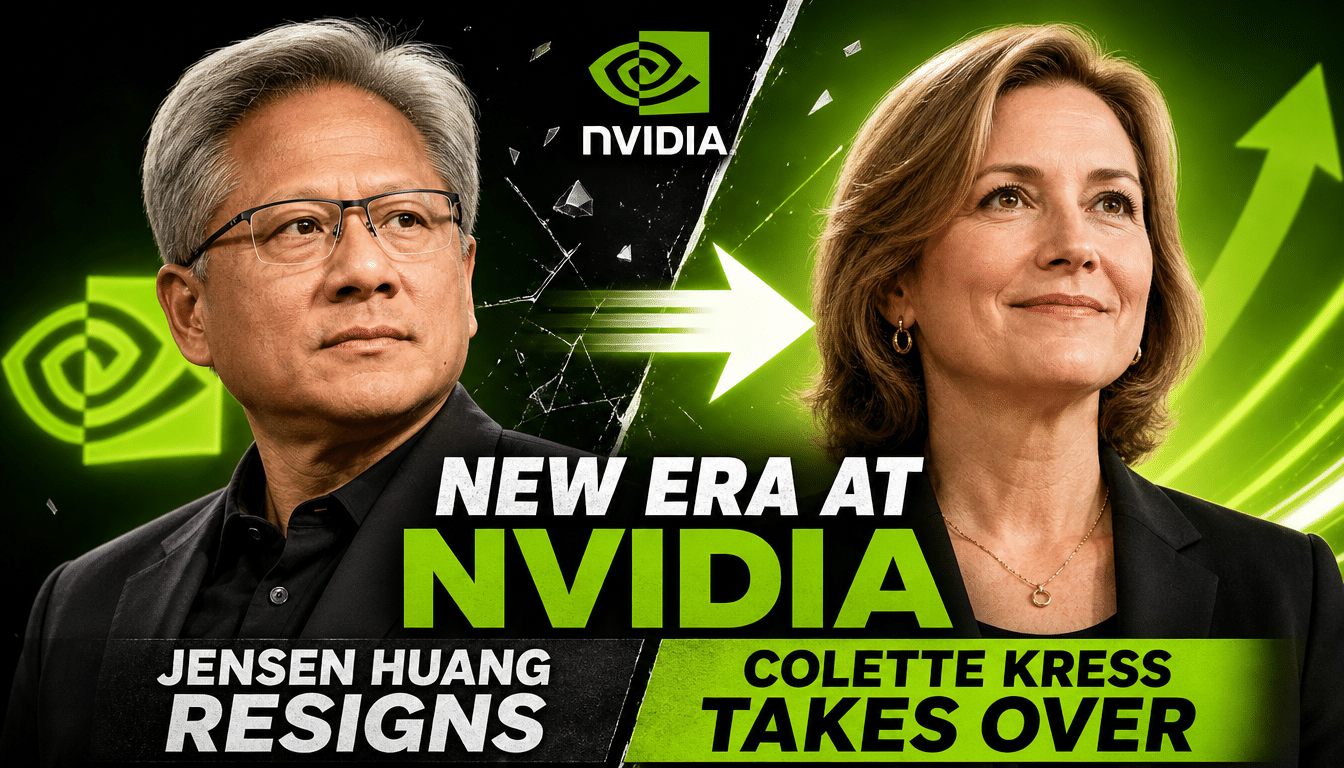
Jensen Huang has resigned as Nvidia CEO and board member. CFO Colette Kress is interim CEO as the chipmaker begins a search for a successor.
Nvidia co-founder Jensen Huang has resigned as president, chief executive and board member, effective immediately, the company announced Thursday. Chief Financial Officer Colette Kress will take over as interim CEO while Nvidia searches for a permanent successor. The announcement ends Huang’s 33-year run leading the chipmaker. Here is what the company confirmed and what remains undecided.
Nvidia confirms Huang’s immediate resignation

Nvidia’s board said Huang had stepped down from all three posts, effective immediately. The company did not announce a reason in its statement. The move followed days of intense scrutiny and a board review. However, Nvidia has not said the review caused Huang’s departure.
Earlier this week, Huang told employees he had been unfaithful to his wife and apologized. Separately, Nvidia’s board opened an independent investigation after reports that Huang had been targeted by a foreign intelligence effort. The board said it had no reason to believe national security or company secrets were compromised. These are distinct matters, and the investigation’s claims have not been established as fact.
Colette Kress becomes Nvidia’s interim CEO
Kress will serve as interim chief executive while retaining her roles as executive vice president and finance chief. She joined Nvidia in September 2013 and has led its finance organization since then. Before Nvidia, she spent nearly 25 years in financial roles at technology companies, including Cisco and Microsoft. The board said it would consider internal and external candidates for the permanent job.
The board expressed confidence in Kress and the leadership team. “We expect the company’s operations, customer commitments and product roadmap to continue without interruption.” — Harvey C. Jones, Chair of the Nvidia Board. That assurance addresses immediate continuity, but the company has not named a permanent successor. The timing of that appointment remains unknown.
Harvey Jones takes Nvidia’s first board chair role
Nvidia also appointed Harvey C. Jones as its first-ever board chair. Jones has served on the board since the company was founded in 1993. He previously led chip-design software maker Synopsys as chief executive and executive chairman. The company said his new role would support the transition.
The leadership change comes as Nvidia faces scrutiny over board oversight and succession planning. Its directors had expressed confidence in Huang on November 8, when they announced an independent investigation. Two days later, independent directors said they had retained outside counsel to conduct a thorough review. The resignation makes leadership succession an immediate issue, alongside that ongoing inquiry.
On November 8, the board said it had no reason to believe national security or Nvidia secrets were compromised. It said independent directors would investigate available information. On November 10, those directors retained former acting U.S. attorney Joon H. Kim and law firm Wachtell, Lipton, Rosen & Katz. Nvidia has not announced a result.
Jensen Huang leaves a 33-year Nvidia legacy
Huang co-founded Nvidia in 1993 and led it from a graphics-chip maker into a central supplier for artificial intelligence computing. The company’s chips now power data centres and AI systems used by technology firms and researchers. Reuters reported that his departure could unsettle Nvidia’s wider AI ecosystem. The company has grown into a major force in the technology industry under his leadership.
The company’s rise followed a change in how its graphics processors were used. Nvidia designed GPUs for graphics, but their parallel computing ability made them useful for scientific work and AI. That shift moved Nvidia from a gaming-chip supplier into a key provider of data-centre infrastructure. It also put Huang at the center of the AI buildout.
Analysts have pointed to the challenge of replacing Huang’s role in coordinating Nvidia’s complex business. “The risk is execution.” — Michael Feldman, portfolio manager at ClearBridge Investments. His view is an analyst’s assessment, not a company forecast. Nvidia says its current operations and product plans will continue.
Nvidia’s next steps after the CEO transition
The board will now search for a permanent chief executive and consider candidates from inside and outside the company. Kress is expected to lead in the interim, with Nvidia’s existing leadership team in place. The company said it will report third-quarter fiscal 2027 results on November 17, as scheduled. That will be the first major company update following Huang’s exit.
Ultimately, Nvidia has confirmed Huang’s resignation, but has not named his successor or given a reason for his departure. Kress will lead the company while the board conducts its search. The separate investigation remains ongoing. Investors and customers will be watchin
g how Nvidia manages the handover.




