



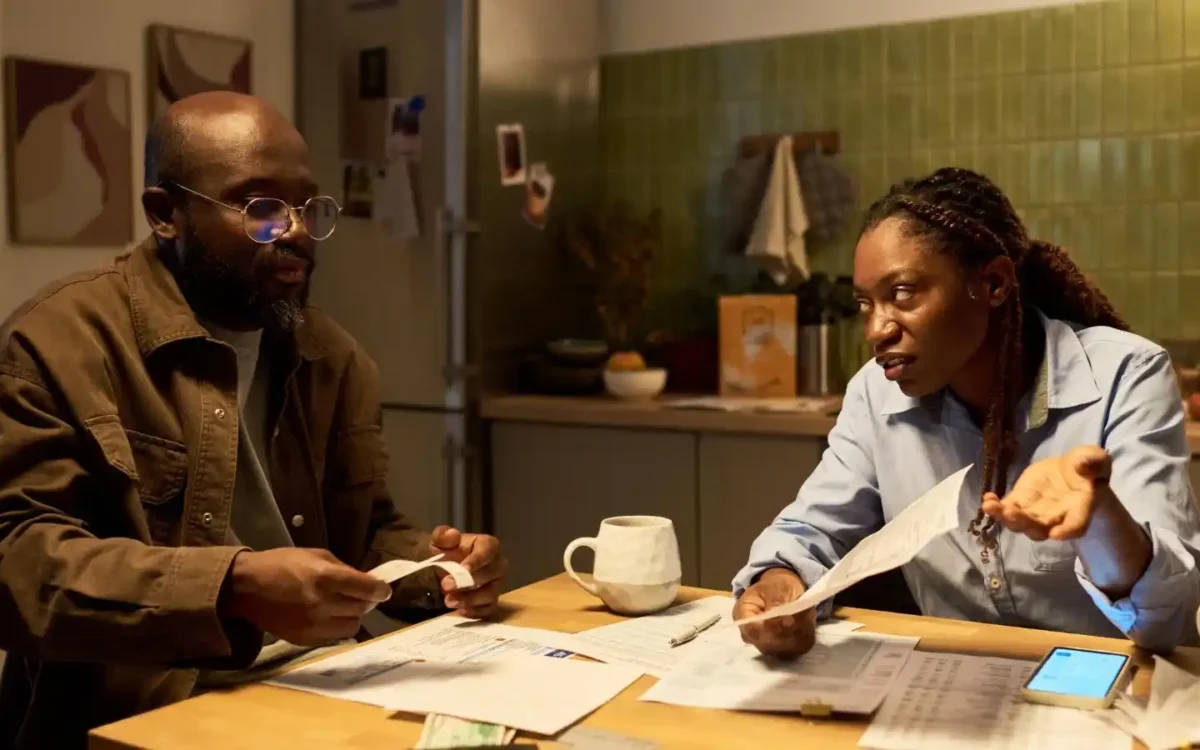
LONDON, UNITED KINGDOM — Nigerian men and women living in the United Kingdom have become embroiled in a heated social media debate over how married couples should share household expenses, with sharply opposing views exposing tensions between traditional gender expectations and the financial realities of life abroad.
The controversy gained momentum after a video featuring three women dancing circulated on social media with the caption: “Date a Nigerian UK man that believes in sharing bills equally or dance.” The post triggered reactions from Nigerians who disagreed over whether husbands should shoulder the bulk of household expenses or whether both partners should contribute financially.
Some men argued that women who are employed should share the cost of running a home, particularly in a country where rent, utilities, transport and childcare can place considerable pressure on household budgets. Others maintained that men should remain the primary providers and criticised the expectation that women should split expenses equally with their husbands.
The disagreement also revived accusations about financial expectations in relationships involving migration. Some male commentators alleged that certain women viewed marriage as a pathway to relocating abroad but became unwilling to contribute to household expenses after arriving in the UK. Women and other social media users challenged such generalisations, arguing that financial contributions should not be discussed without considering the wider responsibilities and expectations placed on both partners.
A major talking point emerged after Nigerian social media user Dr Oluwaseun Olaiya shared an account of a friend’s troubled marriage. According to Olaiya, the man had pursued a woman who initially rejected his advances but later accepted his proposal after learning about his plans to relocate to the United Kingdom.
Olaiya said the couple arranged an introduction and court wedding before the man travelled. He subsequently returned to Nigeria for a larger wedding ceremony before bringing his wife to Britain.
He alleged that the woman, who was already a registered nurse in Nigeria, initially worked in the UK’s care sector but was reluctant to contribute financially to the household. He further claimed that she stopped working after obtaining the necessary UK nursing registration.
The disagreement reportedly intensified when she asked her husband to sponsor her younger brother’s postgraduate studies in the UK. Olaiya said the husband questioned why she had accumulated savings while allegedly declining to support their household expenses.
According to his account, the exchange contributed to a breakdown in the marriage. He claimed the woman later secured a nursing position and moved out of the matrimonial home. The account remains an allegation shared by Olaiya; the woman’s independent response was not established in the published report.
The debate attracted further reactions, including comments from Nigerian community organiser Benjamin Kuti, popularly known as Oluomo of Derby, who argued that couples must recognise the financial realities of living in Britain.
Kuti noted that expenses such as rent, council tax, electricity, gas, water, transportation, groceries and childcare could make it difficult for one partner to carry every financial responsibility. He questioned the expectation that husbands should pay all household bills even when their wives are earning.
However, he cautioned against treating an exact 50/50 arrangement as a universal solution, stressing that marriage should involve cooperation rather than competition. In his view, couples should agree on arrangements that reflect their circumstances and make life easier for both partners.
Oyinlade Oladipo, founder of Clarity House London, a community interest organisation that provides non-clinical companionship and community support, also argued that the dispute extends beyond money.
She said financial, domestic and emotional responsibilities must be considered together, warning that resentment can develop when one partner believes they are contributing significantly more than the other.
Oladipo illustrated the issue with a household in which a husband pays 70 per cent of expenses while his wife handles most childcare, cooking, cleaning and family organisation. In such a situation, she explained, the husband may feel financially burdened while the wife may feel physically and emotionally exhausted.
She therefore advocated a proportionate approach in which contributions reflect each partner’s earning capacity, rather than automatically requiring both individuals to pay identical amounts.
The argument highlights a wider challenge confronting some Nigerian couples in the diaspora: reconciling the marital expectations they grew up with against changing economic circumstances and household arrangements.
For some couples, the traditional expectation that husbands should provide financially remains an important part of marriage. Others believe that two-income households should operate through shared financial commitments, particularly when both partners are employed.
Yet the discussion also raises questions about unpaid domestic work, childcare, differences in income, employment opportunities and the personal agreements couples make before marriage. Equal financial payments do not necessarily mean equal contributions to a household, just as one partner earning more does not automatically settle how responsibilities should be divided.
The controversy has consequently moved beyond the viral video that triggered it. It has become a broader conversation about fairness, financial independence, cultural expectations and the meaning of partnership among Nigerians building families outside their home country.
Ultimately, the debate underscores the importance of discussing money, employment, domestic responsibilities and expectations before marriage. Rather than relying on social media arguments or assumptions about gender, couples must establish arrangements that recognise their individual circumstances and responsibilities.


