


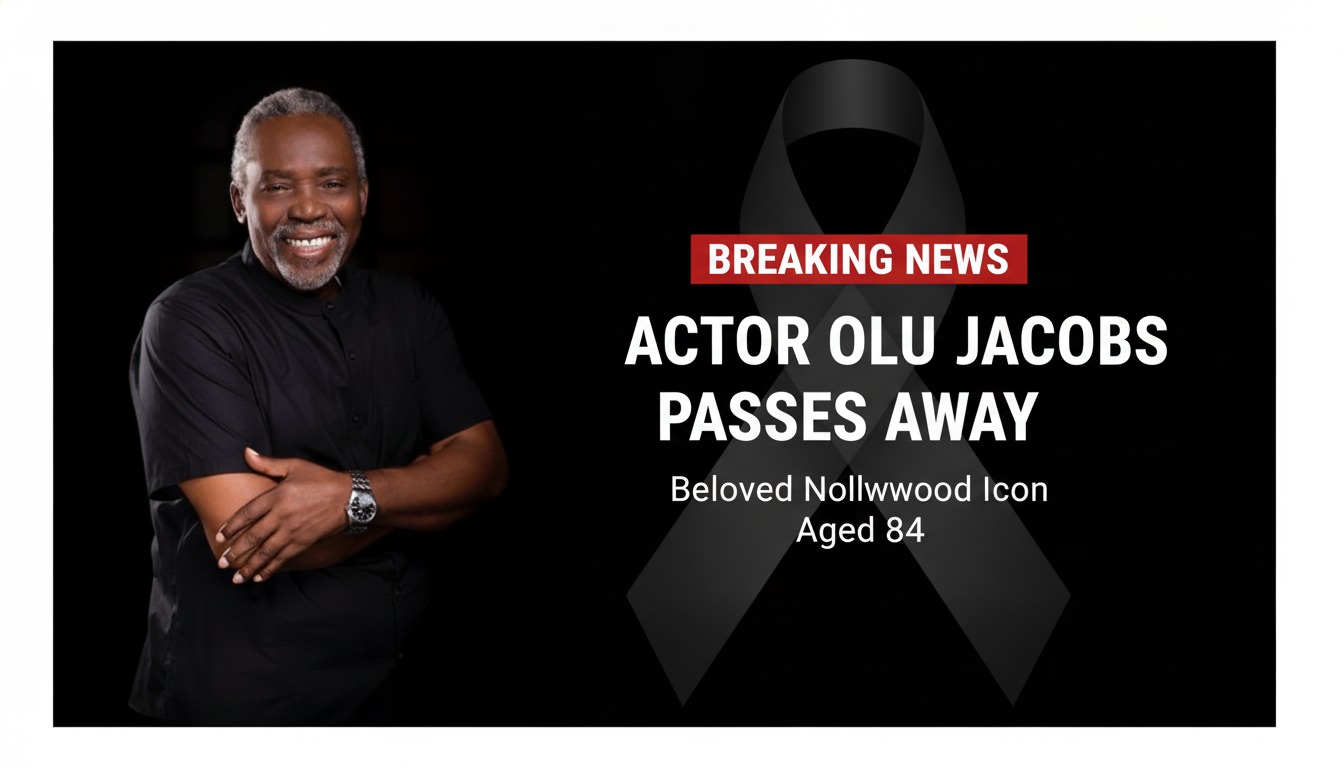
Veteran Nigerian actor, theatre practitioner, film executive and one of the most recognisable faces in African cinema, Oludotun Baiyewu Jacobs, popularly known as Olu Jacobs, has died at the age of 84.
The news of his passing was announced by his family on Wednesday, September 16, 2026, bringing to an end a remarkable career that stretched across more than five decades and took him from the stages of Britain to television screens, international film productions and eventually the heart of Nigeria’s growing film industry.
His son, Olusoji Jacobs, announced the death in a statement on behalf of the family, describing the late actor as “The Lion of Lufodo.” The family also appealed for privacy as they mourn the loss of a husband, father, grandfather and uncle.
Jacobs was born on July 11, 1942, and spent his formative years in Kano. It was there that his interest in acting began to take shape.

As a young man, Jacobs encountered the work of legendary Nigerian theatre practitioner Hubert Ogunde during one of Ogunde’s annual concert parties at the Colonial Hotel in Kano. The experience reportedly left a lasting impression on him and helped convince him that acting was the path he wanted to pursue.
He eventually travelled to England to receive professional training, enrolling at the prestigious Royal Academy of Dramatic Art in London.
That training became the foundation for a career that would take him far beyond Nigeria.
A Career That Began on the British Stage
Long before Nollywood became a global cultural force, Olu Jacobs was already building a reputation as a professional actor in Britain.
His stage career included an early role as The Boy in A Taste of Honey at the newly opened Crucible Theatre in Sheffield in 1972. He subsequently appeared in a number of British television productions and theatre performances.
His television credits during the 1970s included productions such as The Goodies, Till Death Us Do Part, Barlow at Large, The Venturers, Angels, 1990, The Tomorrow People and The Professionals.
He also appeared on major stages and worked with respected institutions and productions in Britain.
Among his notable international theatre credits was Night and Day, a Tom Stoppard production in which he appeared alongside performers including Diana Rigg and John Thaw. His work also connected him with institutions such as the Royal Shakespeare Company and Britain’s National Theatre.
His international screen career included appearances in films such as The Dogs of War, Pirates and Baby: Secret of the Lost Legend.
According to his Lufodo profile, his professional body of work eventually included productions associated with major international companies and broadcasters including Universal Pictures, MGM, Walt Disney and the BBC.
But despite establishing himself abroad, Jacobs would eventually return home to Nigeria.
Returning Home and Helping Shape Nollywood
Olu Jacobs returned to Nigeria at a time when the country’s modern film industry was beginning to develop into the force it would later become.
His arrival brought with it years of professional training and international experience that he would apply to Nigerian theatre, television and film.
In 1990, he appeared in the Nigerian television detective series The Third Eye, marking another important stage in his career at home.
As Nollywood expanded during the 1990s and 2000s, Jacobs became one of its most recognisable veteran performers.
His deep voice, commanding screen presence and ability to portray characters with authority made him particularly memorable to audiences.
He played fathers, kings, traditional rulers, businessmen, politicians, elders, community leaders and other powerful figures, but his range extended beyond those roles.
Over the course of his career, he appeared in more than 100 Nigerian films, while Lufodo’s official profile places his Nigerian film work at more than 300 movies.
For many Nigerians and African viewers, his face became synonymous with quality acting and the generation of performers who helped establish Nollywood as a major African storytelling industry.
More Than an Actor
For Olu Jacobs, acting was never simply about appearing in front of a camera.
He was also a theatre director, producer, writer and film executive.
Together with his wife, veteran actress Joke Silva, he became involved in building institutions designed to support the performing arts and develop future generations of actors.
The couple established the Lufodo Group, which grew to include Lufodo Productions, Lufodo Distribution, Lufodo Consult and the Lufodo Academy of Performing Arts.
The academy became part of their broader effort to contribute to professional training within Nigeria’s entertainment industry.
Their work demonstrated that Jacobs’ contribution to Nigerian entertainment extended beyond the characters he played.
He was also involved in creating structures through which other performers could learn, train and build careers.
Olu Jacobs and Joke Silva
Away from the stage and screen, one of the most recognised parts of Jacobs’ life was his marriage to fellow actress Joke Silva.
The two met through theatre and eventually became one of Nigeria’s most prominent entertainment couples.
Their relationship developed into both a family partnership and a professional collaboration.
They married in 1989 and built a family together while continuing to pursue careers in theatre, television and film.
Together, they became closely associated with Lufodo and with efforts to promote professional theatre and film practice in Nigeria.
Their partnership also became one of the enduring stories within Nigeria’s entertainment industry, with both actors maintaining distinguished careers of their own.
Recognition and Awards
Throughout his career, Olu Jacobs received numerous honours for his contribution to acting and the creative industry.
In 2007, he won the Africa Movie Academy Award for Best Actor in a Leading Role.
He was also recognised for his broader contribution to African cinema and received a Lifetime Achievement Award from the Africa International Film Festival in 2016.
Nigeria also honoured him with the national title of Member of the Order of the Federal Republic, MFR.
His official Lufodo profile lists several other international and African recognitions, including the Five Continents Best Actor Award and lifetime achievement honours received in Cameroon and Ghana.
These honours reflected a career that had moved comfortably between theatre, television and film while maintaining a strong connection to Nigeria’s cultural development.
The Later Years
In the later years of his life, Jacobs gradually withdrew from the public eye.
His absence from film and public events led to repeated speculation about his wellbeing, including false reports of his death.
Those reports were repeatedly rejected before his family confirmed his actual passing in September 2026.
His wife, Joke Silva, had previously spoken publicly about his health and revealed in 2021 that he had been living with dementia with Lewy bodies.
The condition kept him largely away from the spotlight in his final years.
Yet even as he became less visible publicly, his influence remained evident through the work of actors, filmmakers and theatre practitioners who had grown up watching him.
A Voice and Presence That Defined a Generation
There are actors whose performances entertain an audience for a moment, and there are performers whose presence becomes part of a country’s cultural memory.
Olu Jacobs belonged to the latter group.
For generations of Nigerian viewers, his performances were associated with a particular kind of screen authority.
He could enter a scene and immediately command attention.
Whether playing a traditional ruler, a father, a wealthy businessman, a community leader or a difficult authority figure, Jacobs brought a level of theatrical discipline shaped by years of professional training and stage experience.
His career also represented a bridge between different eras of Nigerian entertainment.
He belonged to the generation that understood traditional theatre and live performance, while also becoming an important figure in the development of modern Nigerian film.
That ability to move between worlds became one of the defining features of his career.
The Legacy of “The Lion of Lufodo”
Olu Jacobs’ death marks the end of a remarkable chapter in Nigerian entertainment.
He was part of the generation that helped demonstrate that Nigerian actors could build careers that crossed borders, theatres, television networks and film industries.
He trained abroad but returned home.
He worked internationally but invested in Nigerian theatre.
He became a major film star but also helped create institutions for future performers.
And alongside his wife, Joke Silva, he contributed to a cultural legacy that extended beyond individual performances.
His work will continue to live through the films he made, the theatre productions he participated in, the students and performers influenced by his work, and the audiences who watched him across generations.
For those who grew up seeing him on Nigerian television and in Nollywood films, his passing will represent the loss of a familiar presence.
For the Nigerian film industry, it represents the departure of one of its veteran pillars.
For the theatre community, it is the loss of a performer whose professional journey began on some of Britain’s most respected stages before returning to contribute to the growth of Nigerian entertainment.
And for his family, it is the loss of a husband, father and grandfather whose public career was only one part of a much larger personal life.
Olu Jacobs was born on July 11, 1942.
He died on September 16, 2026, aged 84.
Between those two dates was a life spent telling stories.
He performed on stage.
He appeared on television.
He acted in international films.
He helped build Nigerian cinema.
He trained and supported other performers.
He created alongside his wife.
And he left behind a body of work that will continue to introduce his name and talent to audiences who were not yet born when his career began.
As Nigeria mourns one of its most recognisable acting figures, the curtain has finally fallen on Olu Jacobs’ extraordinary career.
But the performances remain.
The stories remain.
And the legacy of “The Lion of Lufodo” remains.




