


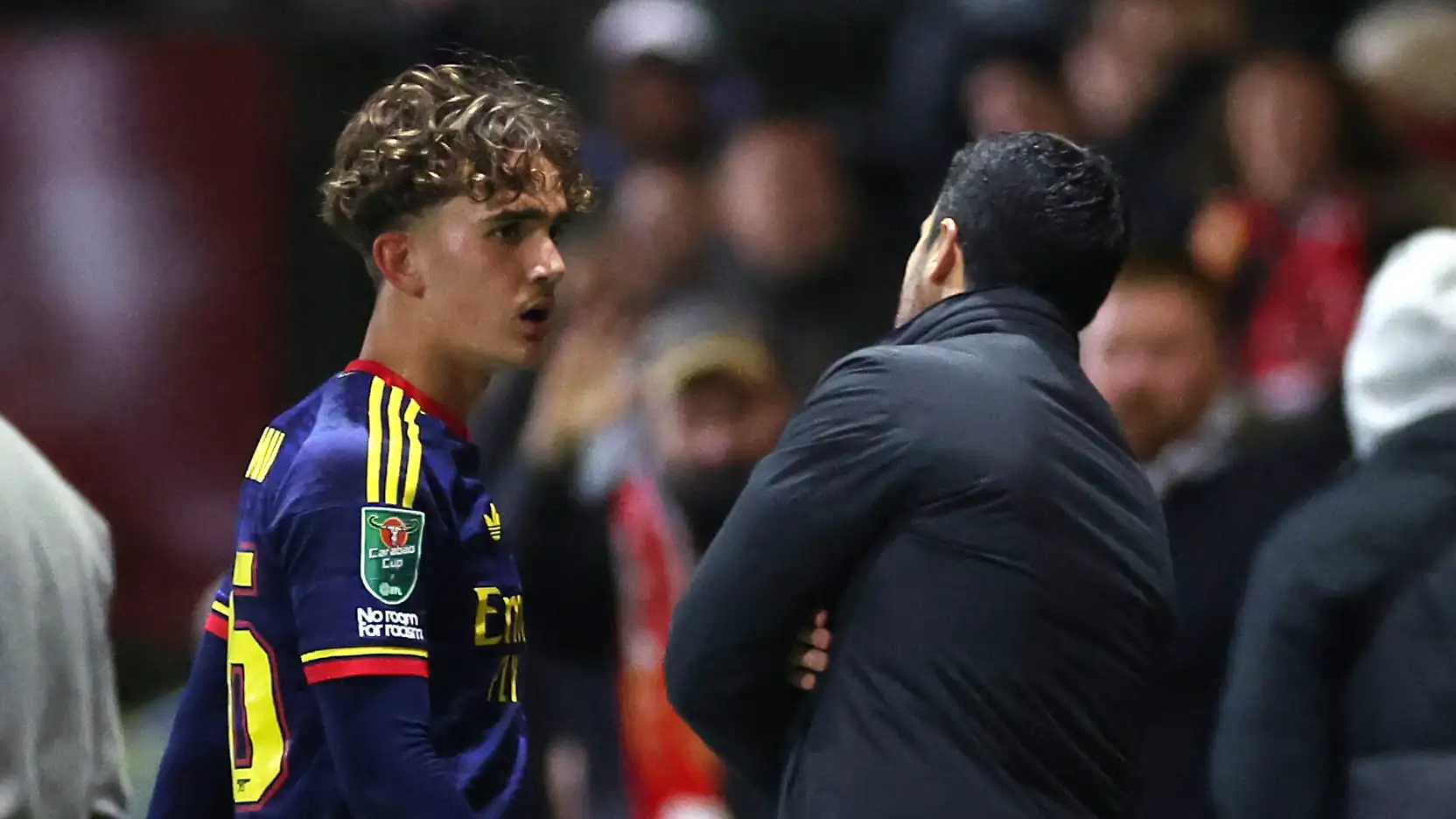
Arsenal legend Paul Merson has criticised Mikel Arteta over his reaction to teenage winger Max Dowman following the youngster’s dismissal in Arsenal’s humiliating Carabao Cup defeat to fourth-tier Fleetwood Town.
The Gunners were eliminated from the competition after losing 5-3 on penalties following a 1-1 draw at Highbury Stadium on Tuesday night, October 27, in a result that sent shockwaves through English football.
However, while Fleetwood celebrated a historic victory to reach the quarter-finals, attention also turned to Arteta’s angry reaction as Dowman walked off the pitch after receiving a straight red card in the closing stages.

Merson, who made more than 100 appearances for Arsenal during his playing career, questioned the manager’s decision to confront the 16-year-old rather than offer immediate reassurance following a difficult moment in the youngster’s development.
Speaking on Sky Sports, the former England international suggested that Arteta’s treatment of Dowman was unnecessarily harsh, particularly given the teenager’s age and the circumstances surrounding his dismissal.
“I’d be more interested to see what Mikel Arteta said to him when he was walking off. This didn’t look good to me at all,” Merson said.
He questioned whether the Arsenal manager would have reacted similarly if the player involved had been an experienced international such as Viktor Gyokeres.
“If that’s Gyokeres, who’s an experienced international, he isn’t doing that. But he does that to a 16-year-old kid?” Merson added.
The pundit argued that Dowman needed guidance and encouragement after making a costly mistake, rather than appearing to face the manager’s anger in front of the cameras.
“He’s not the last person to get sent off for Arsenal, nor the first. If it was me, I’d have put my arm around him,” he said.
Merson also stressed that Arsenal were still level at 1-1 when Dowman was dismissed, meaning the teenager’s departure did not automatically end his team’s chances of progressing.
“We all say things in life we wish we hadn’t and if he could have that back, he’d do it differently,” he added, suggesting that the young winger would learn from the experience.
The criticism followed a disappointing night for Arsenal, who entered the tie as strong favourites against a Fleetwood side competing in League Two, the fourth tier of English football.
Despite enjoying approximately 78 per cent possession and registering 26 shots, Arteta’s side struggled to convert their dominance into goals and ultimately paid the price in the penalty shootout.
Fleetwood took a surprise lead in the 21st minute through Aaron Loupalo-Bi, who capitalised on an Arsenal defensive lapse before finishing past goalkeeper Illan Meslier.
The goal gave the home side an opportunity to defend their advantage, and Fleetwood showed considerable discipline as Arsenal searched for an equaliser.
Arteta responded by introducing Martin Odegaard at half-time, and the substitution helped Arsenal increase the pressure after the break.
The visitors drew level five minutes into the second half when Gyokeres finished from close range following a move involving teenage debutant Ceadach O’Neill.
The equaliser appeared to put Arsenal in a position to take control of the contest, particularly given their superiority in possession and attacking opportunities.
However, Fleetwood refused to surrender and continued to frustrate the Premier League champions with determined defending and an outstanding performance from goalkeeper Jay Lynch.
Arsenal’s hopes of securing a late winner suffered another setback in the 85th minute when Dowman was sent off for violent conduct.
The teenager became involved in an altercation with Fleetwood midfielder Harrison Neal after a strong challenge. Dowman reacted by moving his leg towards his opponent, prompting referee Michael Salisbury to show him a straight red card.
The dismissal left Arsenal with 10 players for the closing stages and intensified the pressure on Arteta’s team.
Dowman appeared visibly disappointed as he left the field, while Arteta approached him and delivered a stern message. The manager’s reaction subsequently became a major talking point, particularly after Merson questioned whether the teenager should have received a more supportive response.
The Arsenal boss, however, indicated that Dowman’s behaviour had been discussed before the match and that the squad had been warned about maintaining emotional discipline against opponents expected to make the contest physically demanding.
Asked about his reaction to the dismissal, Arteta declined to reveal exactly what he had said to the youngster.
“It was something that we discussed before the game,” the Spaniard explained.
He added that Arsenal had prepared specifically for the challenges they expected to encounter, emphasising the importance of controlling emotions throughout the match.
“When we prepared the context of the match, we were very clear on the things to respect, the things that emotionally we have to dominate. It was very clear,” Arteta said.
The manager’s comments suggested that he was particularly disappointed because the team had been warned about the need to remain composed under pressure.
Arteta also indicated that he wanted to review the incident before reaching a final judgment on the red card itself.
Nevertheless, the dismissal became one of the defining moments of Arsenal’s elimination, with the Gunners unable to find a decisive second goal before the contest reached penalties.
Both teams converted their opening three attempts in the shootout before Lynch emerged as Fleetwood’s hero by saving Bruno Guimaraes’ effort.
Conor Haughey subsequently converted the decisive penalty, securing a 5-3 shootout victory and sparking celebrations among the home supporters.
The result represented a remarkable achievement for Fleetwood, who entered the contest 84 places below Arsenal in the English football pyramid.
It also ended Arsenal’s hopes of progressing to the Carabao Cup quarter-finals, leaving Arteta to reflect on a night when his side failed to make its overwhelming statistical advantage count.
The defeat raises questions about Arsenal’s attacking efficiency, their ability to handle physically demanding matches and the management of young players during high-pressure situations.
For Dowman, the experience represents an important learning opportunity at the beginning of his senior career. The teenager has already demonstrated his potential, including scoring twice in Arsenal’s previous Carabao Cup round against Ipswich Town, but the dismissal provides a reminder of the discipline required at the highest level.
Merson’s intervention has also introduced a wider debate about how managers should respond when young players make mistakes. While Arteta has emphasised accountability and preparation, the former Arsenal midfielder believes that protecting a teenager’s confidence in a difficult moment is equally important.
Neither position necessarily excludes the other. A manager can demand discipline while still offering emotional support, particularly when dealing with a player who is only 16.
For Arsenal, however, the immediate priority will be recovering from an embarrassing cup exit and preparing for their next fixture.
The Gunners must now turn their attention to the Premier League, where they face Liverpool in a high-profile encounter that offers an opportunity to respond to the disappointment.
Fleetwood, meanwhile, can celebrate one of the most memorable victories in the club’s history after eliminating the Premier League champions and securing a place in the Carabao Cup quarter-finals for the first time.
Although the result will be remembered for Fleetwood’s giant-killing achievement, the debate surrounding Arteta’s reaction to Dowman’s red card is likely to continue as Arsenal assess the lessons from a deeply frustrating evening.




