


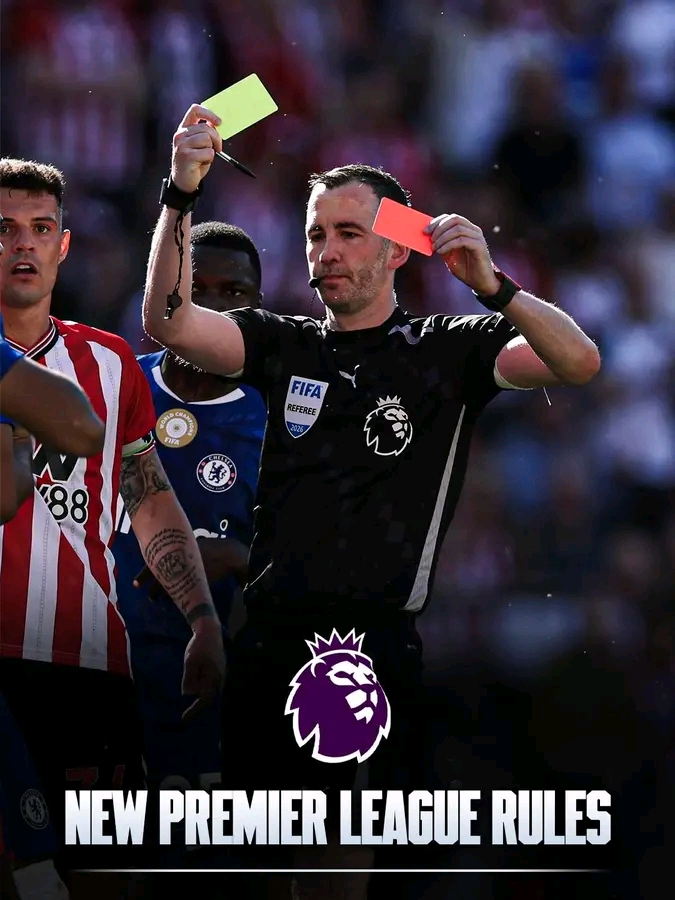
The Premier League has confirmed a series of significant changes to the Laws of the Game ahead of the 2026/27 season, with several new measures designed to reduce time wasting, improve the flow of matches and give referees additional powers in specific VAR situations.
The changes, approved under the updated 2026/27 Laws of the Game by The International Football Association Board (IFAB), will introduce stricter time limits for injured players, substitutions, throw ins and goal kicks. The Premier League will also implement an experimental rule aimed at preventing goalkeeper injury stoppages from being used as tactical timeouts.
The new measures represent one of the most significant attempts in recent years to increase playing time and reduce unnecessary interruptions in Premier League matches.
Injured Players Must Spend One Minute Off the Pitch

One of the biggest changes concerns players who receive treatment or assessment on the pitch.
Under the new rule, an outfield player who receives on field medical treatment or causes play to be stopped because of an injury will generally be required to leave the field and remain off it for at least one minute after play resumes.
The Premier League previously operated with a 30 second period in relevant situations, meaning the new requirement doubles the minimum time a treated player must remain outside the pitch.
The measure is intended to discourage tactical use of minor injuries to interrupt the rhythm of matches while still allowing medical staff to properly assess players.
There are exceptions under the Laws of the Game for specific situations where the player does not have to leave the pitch.
Five Second Countdown Introduced for Throw Ins and Goal Kicks
Another major change will target players and teams that deliberately delay restarts.
When the referee believes a team is unfairly delaying a throw in or goal kick, a five second visual countdown can be introduced.
If the throw in is not taken before the countdown expires, possession will be awarded to the opposing team from the same position.
For a delayed goal kick, the opposition will instead be awarded a corner kick on the side closest to where the goal kick was supposed to be taken.
The new rule could have a major impact on teams that regularly take their time before restarting play, particularly late in matches when protecting a lead.
Substituted Players Given 10 Seconds to Leave
Players coming off the pitch will also face a strict time limit.
Once the referee signals a substitution or the substitution board is displayed, the player being replaced will have 10 seconds to leave the field.
If the player fails to leave within that period, they must still exit as quickly as possible, but their replacement will not be allowed onto the pitch until the first stoppage after one minute has elapsed.
The rule is designed to prevent players from deliberately walking slowly towards the touchline in an attempt to consume valuable seconds.
VAR Gets New Power Over Incorrect Second Yellow Cards
VAR will also receive a limited extension of its powers.
Under the new protocol, VAR can review a red card that results from a clearly incorrect second yellow card.
This means that when a player receives a second yellow card and is subsequently sent off, the incident can be reviewed if there is clear evidence that the second caution was wrong.
However, the change does not mean VAR will routinely review every yellow card. The intervention remains limited to clearly defined circumstances.
The new VAR protocol also provides for reviews involving mistaken identity, while competitions have the option to review clearly incorrect corner kick decisions provided the review can be completed immediately without delaying the restart.
Goalkeeper Injury Trial Could Force Teams to Lose a Player Temporarily
The Premier League will also introduce an experimental measure aimed specifically at goalkeeper injury stoppages.
If play is stopped because of a goalkeeper injury, the manager or head coach will be required to nominate an outfield player to leave the pitch.
That player must remain off the field for at least one minute after the game restarts.
The Premier League says the trial is intended to prevent goalkeeper injury stoppages from being used to slow the game, disrupt an opponent’s momentum or create opportunities for tactical instructions from the technical area.
There are exceptions, including certain situations involving fouls on the goalkeeper, collisions involving the goalkeeper and an outfield player, and cases where the goalkeeper is bleeding.
What Is Not Being Introduced
Despite several changes, not every proposal or measure associated with recent international football competitions will be adopted in the Premier League.
Hydration breaks will not become a standard Premier League rule as part of these changes.
There will also not be a general VAR system for reviewing incorrectly awarded corners in every situation. Under the IFAB framework, competitions have the option to use such reviews only where the decision can be corrected immediately without delaying the restart.
The changes therefore represent a targeted approach rather than a complete overhaul of VAR or match management.
What the Changes Mean for the Premier League
The overall objective is clear: more football and fewer unnecessary delays.
The Premier League has increasingly focused on improving the amount of time the ball is actually in play. The new five second restart countdown, one minute injury absence, 10 second substitution rule and goalkeeper injury trial all target different forms of disruption.
For managers and players, the changes could also create new tactical considerations. Teams leading late in matches will have less freedom to slow down restarts, while players who deliberately take their time leaving the pitch could unintentionally leave their teams temporarily short handed.
The effectiveness of the changes will ultimately depend on how consistently referees apply them throughout the season.
With the 2026/27 campaign approaching, supporters can expect faster restarts, stricter management of stoppages and a more intervention focused approach to certain controversial decisions.
The question now is whether the new rules will successfully improve the spectacle of Premier League football without creating unnecessary confusion or additional controversy.
Do you agree with the new Premier League rules for the 2026/27 season? Which change do you think will have the biggest impact?




