


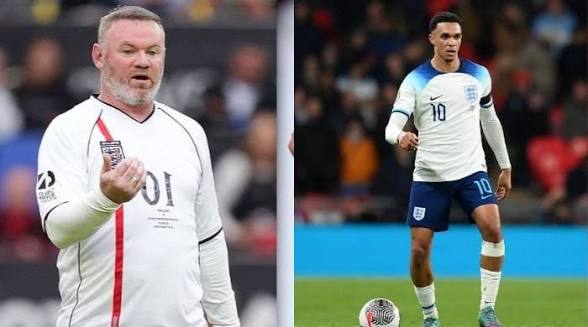
Former England captain Wayne Rooney has publicly questioned the decision by England head coach Thomas Tuchel to exclude right back Trent Alexander-Arnold from recent national team selections, as debate continues over squad planning ahead of the 2026 FIFA World Cup.
Rooney made his comments during a recent discussion on his podcast, where he analysed England’s current defensive options and the direction of Tuchel’s squad rebuilding process. He said he found it difficult to understand why Alexander-Arnold has been left out of the latest squads, especially considering his long standing contribution to the national team and his established reputation at club level.
According to Rooney, Alexander-Arnold remains one of the most technically gifted full backs available to England. He highlighted the player’s passing range, creativity in advanced positions, and his ability to influence attacking phases of play, particularly through crosses and set pieces. Rooney suggested that such qualities are rare and should make the player an important part of any competitive international squad.

The former Manchester United striker also emphasised that selection decisions for a major tournament should not only focus on defensive solidity but also on how players can change matches at the highest level. In his view, Alexander-Arnold brings a unique dimension to England’s play that is not easily replaced by other options in the squad.

Despite this, Tuchel has continued to assess different combinations in the right back position since taking charge of the England team. His recent selections have included players such as Reece James, Ben White, Tino Livramento, and Djed Spence, reflecting what appears to be a broader evaluation process aimed at identifying the most balanced defensive structure.
Tuchel is understood to be prioritising tactical discipline, defensive stability, and overall team shape as he builds towards the World Cup. His approach has placed strong emphasis on players who can maintain defensive consistency while also adapting to different formations and in game situations.
Rooney, however, expressed concern that such an approach may be overlooking players whose strengths lie in attacking contribution. He acknowledged the importance of defensive organisation at international level but insisted that England must also maximise their creative output from wide defensive positions, especially when facing tightly organised opposition.

He pointed out that Alexander-Arnold has repeatedly demonstrated his ability to unlock defences with long range passing and quick transitions from defence to attack. Rooney suggested that excluding such a player entirely could limit England’s tactical flexibility in matches where breaking down compact teams becomes a challenge.
The discussion comes at a time when competition for places in the England squad is becoming increasingly intense. With the World Cup approaching, Tuchel is expected to continue rotating players as he finalises his preferred system and identifies those who fit his long term strategy.
Alexander-Arnold, who has been a regular feature in England squads over several international cycles, now faces a crucial period in his career as he seeks to reaffirm his place in the national setup. His situation has attracted significant attention from fans and analysts, many of whom remain divided on whether his attacking strengths outweigh concerns about his defensive consistency at elite international level.
Rooney’s remarks have added further weight to an ongoing debate within English football regarding the balance between attacking creativity and defensive reliability in modern full back roles. Some analysts agree with Rooney’s view that players like Alexander-Arnold offer a rare skill set that can change the outcome of matches, while others support Tuchel’s more conservative selection approach.
As preparations continue for the 2026 FIFA World Cup, England’s squad decisions are expected to remain under close scrutiny. The final selection will likely reflect a combination of form, tactical suitability, and physical readiness, with competition in the defensive positions remaining one of the most closely contested areas.
For now, the omission of Alexander-Arnold continues to generate discussion across media platforms and among supporters, highlighting the broader challenge Tuchel faces in assembling a squad capable of competing at the highest level while balancing both defensive resilience and attacking innovation.