


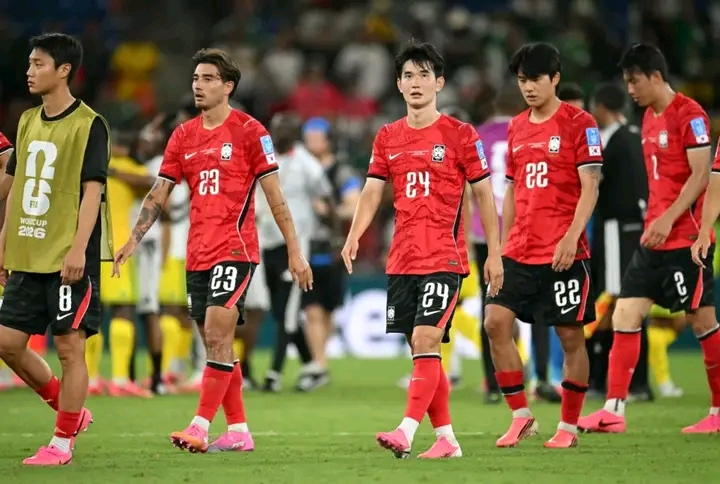
South Korean President Lee Jae Myung has publicly apologised to the nation following the country’s painful exit from the 2026 FIFA World Cup at the group stage, describing the campaign as deeply disappointing and promising that lessons would be learned to restore the country’s footballing reputation.
The President’s emotional message came just hours after South Korea’s elimination was confirmed, bringing an abrupt end to a tournament that had begun with high expectations for one of Asia’s most consistent football nations. Rather than celebrating a place in the knockout rounds, millions of South Korean supporters were left reflecting on missed opportunities, tactical shortcomings and a campaign that failed to meet the standards expected of the Taeguk Warriors.
Addressing the nation, President Lee admitted that the results had fallen well below expectations and acknowledged the frustration felt by football fans across the country. He stressed that the government shared the disappointment of supporters and promised that every aspect of the national team’s preparation and administration would be thoroughly reviewed.

The President emphasised that while defeats are part of sport, the manner of South Korea’s elimination raised important questions that could not be ignored. According to him, the country must examine what went wrong and ensure similar failures do not occur in future international competitions.
South Korea entered the expanded 48 team FIFA World Cup with optimism after another successful qualification campaign. The nation has built a proud football tradition over the past several decades, regularly qualifying for the World Cup and producing internationally respected players who have competed at the highest level across Europe and Asia.
Many football analysts predicted that South Korea possessed enough quality and experience to progress beyond the group stage. However, inconsistent performances throughout the opening matches left qualification hanging in the balance before the team ultimately failed to secure one of the available knockout positions.
The early elimination came as a major surprise to supporters who had expected another competitive showing from a nation that reached the semi finals as co hosts in 2002 and has remained one of Asia’s strongest football powers ever since.
President Lee’s apology went beyond expressing sympathy for disappointed supporters. He also called for accountability from those responsible for managing the national football programme.
He urged football authorities to carefully evaluate every decision made before and during the tournament, including coaching appointments, player preparation, technical planning and administrative leadership. According to the President, improving South Korean football requires honest self assessment and the willingness to introduce meaningful reforms where necessary.
The President reportedly instructed relevant government agencies, including the Ministry of Culture, Sports and Tourism, to work closely with football authorities in reviewing the national team’s performance and identifying areas requiring urgent improvement.
His intervention reflects the significance of football within South Korean society, where the national team’s performances often unite millions of supporters and generate enormous public interest.
Attention has naturally shifted toward head coach Hong Myung Bo, whose leadership came under increasing criticism during the tournament. Questions surrounding team selection, tactical organisation and overall strategy intensified after South Korea struggled to produce convincing performances against their group stage opponents.
Following the elimination, Hong accepted responsibility for the disappointing campaign and announced his resignation, acknowledging that the results did not reflect the ambitions of the players, supporters or the nation.
His departure marks the end of a challenging chapter for South Korean football and opens the door for the Korea Football Association to begin searching for a new coach capable of rebuilding confidence ahead of future international competitions.
The tournament has also sparked discussions about the future of national team captain Son Heung Min, widely regarded as one of the greatest footballers in South Korean history.
For more than a decade, Son has served as the face of South Korean football, inspiring younger generations with his professionalism, leadership and remarkable achievements in European football. His performances for both club and country have earned global recognition, making him one of Asia’s most celebrated athletes.
Following the World Cup disappointment, speculation has grown regarding whether the Tottenham Hotspur forward will continue leading the national team or gradually begin stepping away from international football as younger talents emerge.
Despite the disappointment, many football experts believe South Korea possesses the resources necessary to recover quickly. The country has invested heavily in football development over the years, producing technically gifted players and maintaining competitive domestic and youth football structures.
Analysts argue that improving coaching methods, strengthening player development programmes and modernising football administration could help South Korea return to competing consistently with the world’s leading football nations.
Supporters have also urged the Korea Football Association to use the painful experience as an opportunity to rebuild rather than simply searching for short term solutions. Many believe the current setback should serve as motivation to strengthen every level of the national football system ahead of future tournaments.
Across South Korea, fans have continued expressing both disappointment and hope. While the group stage exit remains difficult to accept, there is widespread belief that the country’s football tradition remains strong enough to produce another generation capable of challenging on the global stage.
President Lee’s apology has therefore been widely interpreted as more than a symbolic gesture. It represents a commitment to transparency, accountability and long term improvement while recognising the emotional investment millions of South Koreans place in their national football team.
As preparations begin for upcoming international competitions, South Korea now faces the challenge of rebuilding confidence, restoring public trust and ensuring that the painful memories of the 2026 FIFA World Cup become the foundation for a stronger and more successful future.




