


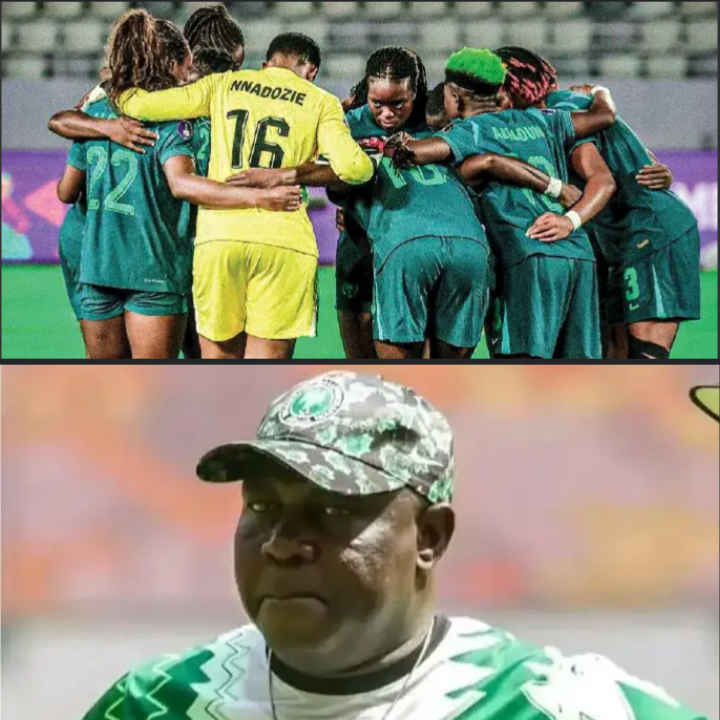
Super Falcons head coach Justine Madugu has apologised to Nigerians following the team’s painful failure to qualify for the 2027 FIFA Women’s World Cup, admitting that costly mistakes and poor finishing contributed to their 2 1 defeat to South Africa in the decisive playoff.
The result brought Nigeria’s remarkable record of appearing at every edition of the Women’s World Cup since the tournament began in 1991 to an end. For a country that has traditionally dominated women’s football in Africa, the elimination represents one of the biggest setbacks in the history of the Super Falcons.
Madugu accepted responsibility for the disappointing outcome and acknowledged the frustration of millions of Nigerians who had expected the team to find a way past Banyana Banyana.

The Super Falcons entered the crucial encounter knowing that victory was necessary to keep their hopes of reaching the 2027 tournament in Brazil alive. Instead, South Africa produced a disciplined performance and secured a 2 1 victory that sent Nigeria out of the qualification race.
The Nigerian team had opportunities during the match but struggled to make them count. According to Madugu, the failure to convert chances ultimately proved costly against a South African side that was more clinical when important opportunities arrived.
The defeat was particularly difficult because Nigeria had already suffered disappointment at the 2026 Women’s Africa Cup of Nations. The Falcons were eliminated by Cameroon in the quarter finals after a 1 0 defeat, forcing them into the additional qualification route for the World Cup.
South Africa were also searching for redemption after losing 2 1 to Morocco at the same stage of the continental competition. The playoff therefore became a high pressure battle between two of Africa’s most respected women’s football teams.
The opening half was closely contested, with both sides showing caution while looking for an opportunity to take control. Nigeria created attacking moments but could not find the decisive finish required to break the deadlock.
The match changed shortly after the restart when South Africa found the breakthrough.
Thembi Kgatlana put Banyana Banyana ahead in the 56th minute, giving the South Africans a crucial advantage. The experienced forward’s goal immediately placed greater pressure on the Super Falcons, who now had to chase an equaliser.
Nigeria attempted to respond, but South Africa remained organised and continued to threaten on the counter. Super Falcons goalkeeper Chiamaka Nnadozie was also called upon to make important interventions as Banyana Banyana searched for a second goal.
That second goal eventually arrived in the 77th minute.
South African captain Refiloe Jane’s effort took a deflection before finding the back of the net, leaving Nnadozie unable to prevent the ball from crossing the line.
At 2 0 down, Nigeria’s World Cup hopes appeared to be slipping away.
However, the Super Falcons showed character and continued fighting until the closing stages. Their persistence was rewarded deep into stoppage time when Nigeria was awarded a penalty following a handball incident.
Christy Ucheibe stepped up and converted the spot kick in the 90+3rd minute, giving Nigeria a lifeline and reducing the deficit to 2 1.
The late goal created a dramatic finish, with the Falcons throwing everything forward in search of an equaliser. South Africa were also reduced to 10 players after Jane received a second yellow card, increasing the pressure on Banyana Banyana.
Despite the numerical disadvantage, South Africa managed to survive the final moments and secure the victory.
For Madugu and his players, the final whistle brought enormous disappointment.
The coach’s apology reflects the magnitude of the result and the expectations surrounding the Super Falcons. Nigeria has historically been the most consistent African team at the Women’s World Cup, making its absence from the 2027 tournament a major moment for the country’s football.
Madugu’s comments also come at a time when questions are likely to be asked about the team’s preparation, tactical decisions, squad selection and ability to convert opportunities in crucial matches.
The Super Falcons possess several experienced players who have performed at the highest level of international football, including Asisat Oshoala, Chiamaka Nnadozie and captain Rasheedat Ajibade. The team also has a new generation of talented players capable of carrying Nigerian women’s football forward.
However, the latest setback demonstrates that reputation alone is no longer enough to guarantee success in increasingly competitive African women’s football.
South Africa, Morocco, Zambia and other emerging nations have continued to invest heavily in their women’s teams, creating a much more competitive continental environment.
For Nigeria, the challenge now is to learn from the disappointment and rebuild.
Missing the World Cup will deprive the Super Falcons of an opportunity to compete on the global stage, but it also provides an opportunity to examine the structures supporting women’s football in the country.
The players will undoubtedly be disappointed, but their response to this setback could determine the direction of the team in the coming years.
For Madugu, the immediate priority will be restoring confidence within the squad and ensuring that the players understand that the disappointment can become a foundation for improvement.
Nigerian supporters, meanwhile, will be hoping that the apology is followed by meaningful action. The country’s women’s football programme has produced generations of outstanding players, and there remains enormous talent capable of returning the Super Falcons to the top of African football.
For now, however, the reality is painful. South Africa have advanced, while Nigeria’s historic World Cup streak has come to an end.
Madugu has accepted that the team fell short when it mattered most. His apology may not erase the disappointment, but it underlines an important message: the Super Falcons recognise the significance of what they have lost and must now find a way to rebuild.




