



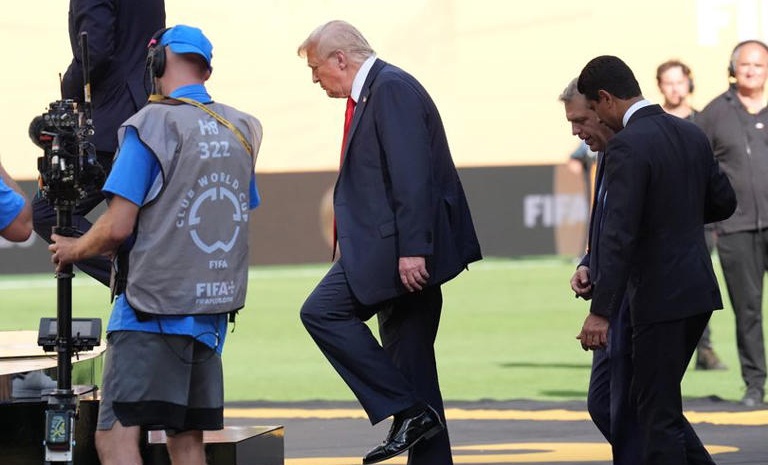
United States President Donald Trump departed for China on Wednesday ahead of a major summit with Chinese leader Xi Jinping, insisting Washington does not need Beijing’s help to end the ongoing conflict with Iran.
Speaking before leaving Washington, Trump dismissed suggestions that China could play a decisive role in resolving the crisis, despite Tehran’s close economic ties with Beijing and the growing tension around the Strait of Hormuz a key global oil route that handles nearly a fifth of the world’s oil supply.
“We don’t need help with Iran,” Trump told reporters. “We’ll resolve it one way or another peacefully or otherwise.”
The remarks come as negotiations between Washington and Tehran remain stalled more than a month after a fragile ceasefire took effect.

The United States is demanding that Iran abandon its nuclear programme and ease restrictions around the Strait of Hormuz, while Tehran is pushing for compensation over war damage, an end to the U.S. blockade, and a halt to fighting involving its regional allies, including Hezbollah in Lebanon.
Trump has repeatedly rejected Iran’s demands, describing them as unacceptable.
At the same time, reports indicate Iran is strengthening its grip on regional energy routes. Sources familiar with the matter say Tehran has reached oil and gas export arrangements with Iraq and Pakistan, while other countries are reportedly considering similar deals.
Ahead of the summit, the Trump administration said U.S. and Chinese officials had already agreed that no nation should impose tolls or restrictions on international shipping through the region a move seen as an attempt to ease concerns over global trade disruptions.
As the conflict drags on, its financial impact is becoming harder to ignore.
Trump, however, said rising costs for American households are not influencing his approach to the war.
“The only thing that matters is that Iran cannot have a nuclear weapon,” he said. “I’m not thinking about Americans’ financial situation when it comes to this issue.”
His comments are likely to trigger political backlash at home, especially as inflation continues to rise ahead of the U.S. midterm elections.
Fresh economic data released Tuesday showed U.S. consumer inflation accelerated in April, driven by higher food, housing, and airfare costs.
Meanwhile, the International Energy Agency warned that disruptions linked to the Iran conflict could reduce global oil supply by nearly 3.9 million barrels per day in 2026. More than one billion barrels of Middle Eastern oil supply have already been affected by the crisis.
Brent crude prices hovered around $107 per barrel after several days of sharp gains linked to uncertainty around the Strait of Hormuz.
The Pentagon also disclosed that the war has now cost the United States about $29 billion roughly $4 billion more than previous estimates. Officials said the updated figure includes operational expenses as well as the repair and replacement of damaged military equipment.
Public opinion in the United States appears increasingly divided over the conflict. A recent Reuters/Ipsos poll found that most Americans believe the administration has not clearly explained the reasons behind the war.
Despite mounting pressure, Iranian officials remain defiant. State-linked media reported that Iran’s Revolutionary Guards recently carried out military drills focused on “preparation to confront the enemy,” while officials signaled plans to expand strategic control across parts of the Strait of Hormuz.




