


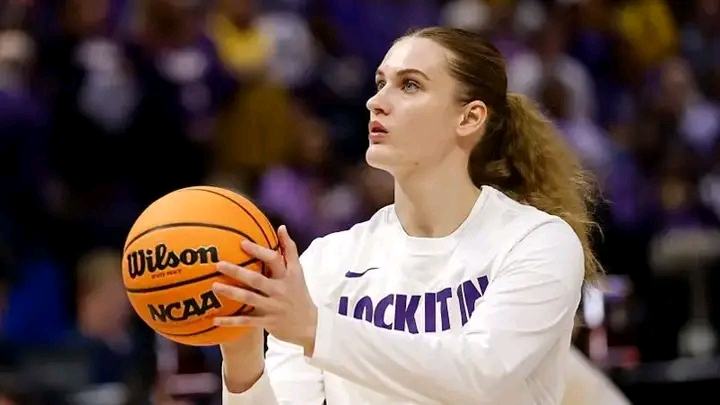
Ukrainian basketball player Kate Koval has left Louisiana State University’s women’s basketball programme after the school signed Russian prospect Anna Minaeva, saying the ongoing war between Russia and Ukraine made the situation too personal for her to continue.
Koval, 20, had been expected to play an important role for LSU in the new college basketball season after establishing herself as a key frontcourt player. Her departure was initially announced by LSU coach Kim Mulkey as being for personal reasons, but Koval has now explained that the decision was directly connected to the programme’s recruitment of a Russian player.
In a statement shared this week, Koval said she had originally planned to return to LSU following the previous season. However, she said she was informed in April, several days after the NCAA transfer portal had closed, that the programme intended to sign a Russian player.

That decision forced Koval to reconsider her future at the university because of the devastating impact Russia’s war in Ukraine has had on her family and homeland.
Koval was born in Kyiv and has a particularly close connection to the conflict. Her father serves in the Ukrainian military, while she said people close to her have been killed or wounded during Russian attacks. She also explained that places where she grew up and began playing basketball have been damaged or destroyed by missile strikes.
For Koval, the situation was therefore much more than a normal college basketball recruitment decision. She said the personal consequences of the war made it difficult for her to separate the arrival of a Russian player from the reality being experienced by her family and people in Ukraine.
The controversy emerged after LSU announced the signing of Anna Minaeva, a 17-year-old Russian post player, on August 14. Minaeva previously played professionally for MBA Moscow before moving to the United States to join the Tigers. LSU described the signing as an addition that would strengthen its frontcourt for the upcoming season.
Minaeva’s recruitment came at a sensitive time for Koval, who had already spent one season at LSU after transferring from Notre Dame. The Ukrainian player averaged 8.3 points and 6.3 rebounds per game during her LSU campaign and was expected to have a significant role going into the new season.
Mulkey said she had spoken with Koval before the Russian player’s arrival, acknowledging the deeply personal nature of the situation. According to the coach, the conversation was intended to show respect for Koval and her family while explaining that LSU’s recruitment decisions were based on what the coaching staff believed would strengthen the team.
After Koval ultimately decided to leave, Mulkey said it was a difficult decision for the player because of her attachment to LSU. The coach maintained that the programme respected her choice and wished her well.
Koval’s exit has nevertheless highlighted the unusual intersection between international conflict and American college sports. While universities routinely recruit athletes from different countries, the Russia-Ukraine war has created circumstances in which nationality can carry an intensely personal meaning for athletes with direct family or community connections to the conflict.
The situation also comes at a significant point in Koval’s young career. Before joining LSU, she was a highly regarded prospect who played college basketball at Notre Dame. She also represented Ukraine in international competition, including the FIBA 3×3 World Cup this summer.
Despite leaving LSU, Koval has indicated that she still wants to continue her basketball career. Her immediate future remains uncertain, but she has expressed hope that she will be able to find another opportunity to play college basketball.
Her departure has consequently left LSU facing the challenge of replacing a talented player while the programme continues preparing for the new season. Minaeva, meanwhile, remains part of Mulkey’s plans as LSU seeks to build a competitive roster.
The episode has generated significant discussion beyond the basketball court, particularly because of Koval’s family circumstances and the continuing war. It has also raised broader questions about how universities and sports programmes should handle situations where recruitment decisions intersect with athletes’ personal experiences of international conflicts.
For Koval, however, the decision appears to have been less about basketball and more about remaining true to her family, her country and the experiences that have shaped her life.
Her decision underscores how, for athletes directly affected by war, sport cannot always be separated from the realities beyond the court.




