


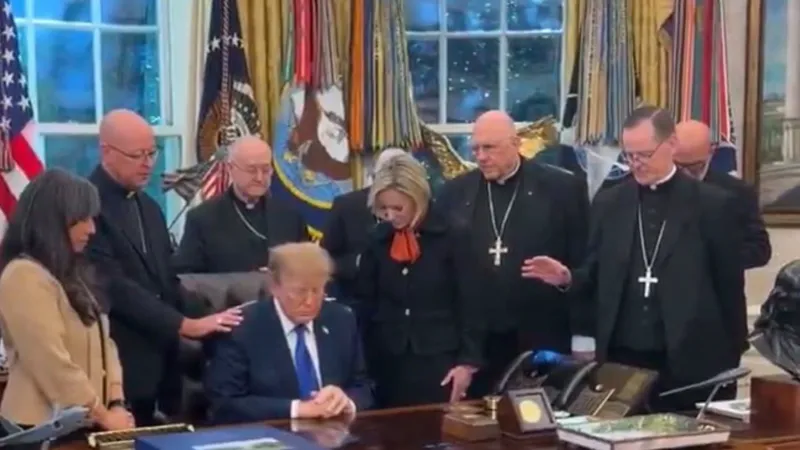
Two Catholic bishops in the United States have expressed regret over their meeting with President Donald Trump at the White House after images of them praying with him triggered concerns that the encounter could be interpreted as political endorsement.
The meeting took place on October 22, 2026, in the Oval Office, where photographs and a video showed Trump standing with a group of bishops around the Resolute Desk.
Milwaukee Archbishop Jeffrey Grob, one of the participants, said he had understood that the meeting was private and was not intended to become “a political photo opportunity”.
Bishop William Joensen of Des Moines, Iowa, also clarified that the gathering was arranged to discuss issues affecting the Church and vulnerable communities, including immigration, visas for international clergy and the exploitation of poor people.

In a statement published online, Joensen said none of the bishops intended to endorse any political party or candidate through their participation.
“I wish I had been more shrewd and less simple, like those who exploited our meeting for partisan political purposes,” he said.
Bishops Raise Concerns Over Publicity
Grob said the bishops spent about 90 minutes meeting with White House officials before being taken into the Oval Office to pray with Trump.
According to him, the subsequent release of photographs and video raised concerns among members of his congregation, particularly those affected by the administration’s policies.
He said he received messages from people worried that he had inadvertently participated in a political event less than two weeks before a national election.
The archbishop added that some members of his congregation felt hurt because of the impact of Trump’s policies on them and their families.
Grob also maintained that the participants had not authorised the public release or online posting of the images and video.
The footage was shared by Margo Martin, a special assistant to the president and communications adviser who frequently posts behind-the-scenes content featuring Trump on social media.
The White House did not directly address the bishops’ concerns when contacted by the BBC.
However, White House spokeswoman Taylor Rogers defended the president’s record among Catholics, saying, “There has never been a greater president for Catholic Americans than President Trump, and his strong record proves it.”
Trump Faces Tensions Over Immigration Policies
The controversy comes amid strained relations between Trump and Pope Leo XIV, as well as criticism from some Catholic leaders over the administration’s immigration crackdown.
Nine days before the meeting, Bishop Brendon Cahill and Walter Kim, president of the National Association of Evangelicals, issued a joint statement calling for compassion and wisdom in the immigration debate.
They warned that the crackdown had contributed to fear, family separation, the denial of due process and the vilification of immigrants.
The US Conference of Catholic Bishops has also criticised the administration’s plans to livestream a military execution, which were later abandoned.
Despite the tensions, some prominent Catholic figures have maintained ties with the Trump administration. Vice-President JD Vance and Secretary of State Marco Rubio are both Catholics who have visited the Vatican during Trump’s second term.
Bishop Robert Barron of Minnesota and former New York Archbishop Timothy Dolan have also been associated with the president’s Religious Liberty Commission.
Survey Shows Declining Catholic Support for Trump
The episode comes as polling suggests declining approval of Trump among Catholic voters.
According to the Pew Research Center, 30 per cent of US Catholics surveyed this month approved of Trump’s job performance, down from 47 per cent when he returned to the White House in 2025.
The survey also found that 42 per cent of Catholic respondents preferred Democratic candidates in their local House of Representatives races, compared with 39 per cent who favoured Republicans.
The figures could have implications for the November 3, 2026, midterm elections, which will determine control of Congress.
The bishops’ response underscores the sensitivity surrounding religious leaders’ public appearances with political figures, particularly as debates over immigration and the administration’s policies continue to divide American society.




