
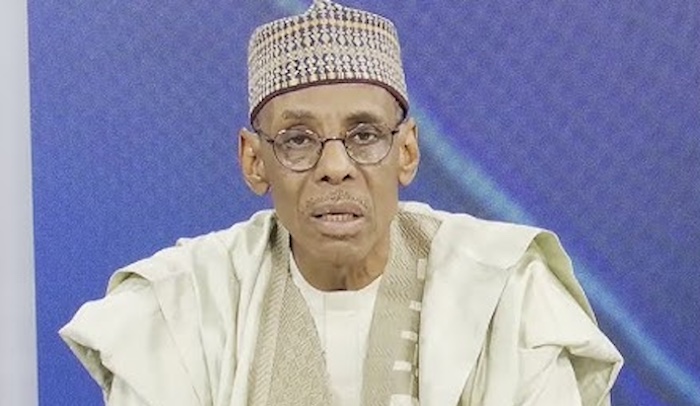
As political realignments ahead of Nigeria’s 2027 general elections continue to gather momentum, fresh warnings have emerged over the internal stability of the African Democratic Congress (ADC). In a blunt assessment that has sparked renewed debate within opposition circles, former spokesperson of the Northern Elders Forum, Dr. Hakeem Baba-Ahmed, has predicted that the ADC may face serious internal turmoil and possible defections after its presidential convention, should former Vice President Atiku Abubakar clinch the party’s ticket.
Speaking on Channels Television’s Politics Today on Tuesday, Baba-Ahmed offered a candid analysis of the evolving dynamics within the ADC, describing the party as a political melting pot of powerful ambitions that may prove difficult to reconcile once the process of candidate selection begins in earnest. According to him, while the ADC has successfully attracted a number of influential political actors seeking a viable platform ahead of 2027, that very diversity of interests could become its biggest liability.
DDM NEWS reports that Baba-Ahmed was unequivocal in his prediction that Atiku Abubakar, Nigeria’s former vice president and serial presidential contender, is well-positioned to emerge as the ADC’s flag bearer. However, he warned that such an outcome would almost certainly trigger discontent among other aspirants and factions within the party, many of whom also harbour presidential ambitions and may not be willing to play a subordinate role.
“The ADC will bleed after its convention,” Baba-Ahmed said pointedly. “Almost certainly Vice President Atiku Abubakar will get the ticket, and when he does, some people will walk out.”
His remarks reflect a growing concern among political analysts that the ADC, like many Nigerian parties before it, may struggle to manage internal competition without fragmenting. Baba-Ahmed noted that the party currently accommodates several heavyweight politicians, each entering the fold with expectations of influence, relevance, and, in some cases, outright leadership of the presidential race.

According to him, once the ADC formally begins the process of choosing its presidential candidate, the clash of ambitions will become unavoidable. In Nigerian politics, where party defections are often driven by personal calculations rather than ideological differences, Baba-Ahmed suggested that losing aspirants may simply seek alternative platforms rather than submit to party discipline.
DDM NEWS further reports that Baba-Ahmed also weighed in on the position of former Anambra State governor Peter Obi, whose name has repeatedly surfaced in discussions around opposition coalitions and third-force movements. While acknowledging Obi’s popularity and political capital, Baba-Ahmed questioned whether his style and expectations align with the realities of a competitive party primary such as the one the ADC is likely to conduct.
“One of the reasons Peter Obi is saying, ‘Look at me, I’m not here for number two, I’m not here for convention, I’m here to fly the flag,’ is that he has people who were initially whispering politely to him,” Baba-Ahmed explained. “But now they are telling him, ‘Join the queue. You’re not the only one with ambition here.’”
In Baba-Ahmed’s view, Obi’s political trajectory has largely been shaped by scenarios in which he was either adopted or rallied around as a consensus figure, rather than subjected to intense intra-party contests involving multiple strong aspirants. This, he suggested, could create friction within a party like the ADC, where power blocs and competing interests are unlikely to easily concede ground.
“Peter Obi doesn’t participate in convention; he goes there to be anointed,” Baba-Ahmed remarked, a statement that has since generated strong reactions from Obi’s supporters and critics alike. He argued that such expectations, whether accurate or not, may not sit well with other ADC stakeholders who believe that the party’s ticket should be decided through a competitive and transparent process.
The broader implication of Baba-Ahmed’s comments, as analysed by DDM NEWS, is that the ADC is approaching a critical juncture. While its emergence as a potential rallying point for opposition forces has raised hopes among Nigerians seeking an alternative to the dominant political parties, its ability to survive the pressures of internal democracy remains uncertain.
Political observers note that Atiku Abubakar’s long political career, extensive network, and experience in party politics give him a significant edge in any convention-based contest. However, those same factors may also fuel resentment among younger politicians and reform-minded figures who believe the opposition should project a break from the past rather than a recycling of familiar faces.
Baba-Ahmed hinted that this generational and ideological divide could become more pronounced once Atiku secures the ticket, leading to defections by those who feel marginalised or disillusioned. Such an outcome, he warned, could weaken the ADC’s cohesion at a time when unity is crucial to mounting a credible challenge against the ruling party in 2027.
The former Northern Elders Forum spokesperson also used the opportunity to reflect on the broader culture of Nigerian party politics, where conventions are often less about ideology and more about power negotiation. In such an environment, he argued, parties that fail to manage expectations and balance interests tend to fracture, sometimes irreparably.
DDM NEWS notes that while Baba-Ahmed’s predictions are speculative, they echo a familiar pattern in Nigeria’s political history, where parties experience waves of defections following primaries and conventions. Whether the ADC can defy this trend will depend largely on its leadership’s ability to foster inclusiveness, manage ambitions, and persuade aggrieved members that staying within the fold serves their long-term interests.
As the countdown to 2027 continues, the ADC’s next steps—particularly how it structures its convention and handles competing presidential aspirations—will be closely watched. Baba-Ahmed’s warning serves as both a forecast and a cautionary note: without careful management, the very convention meant to unify the party around a candidate could instead expose its fault lines and trigger a political hemorrhage.
For now, the ADC remains a key player in Nigeria’s evolving opposition landscape, but as DDM NEWS observes, its resilience will soon be tested not by external rivals, but by the ambitions within its own ranks.