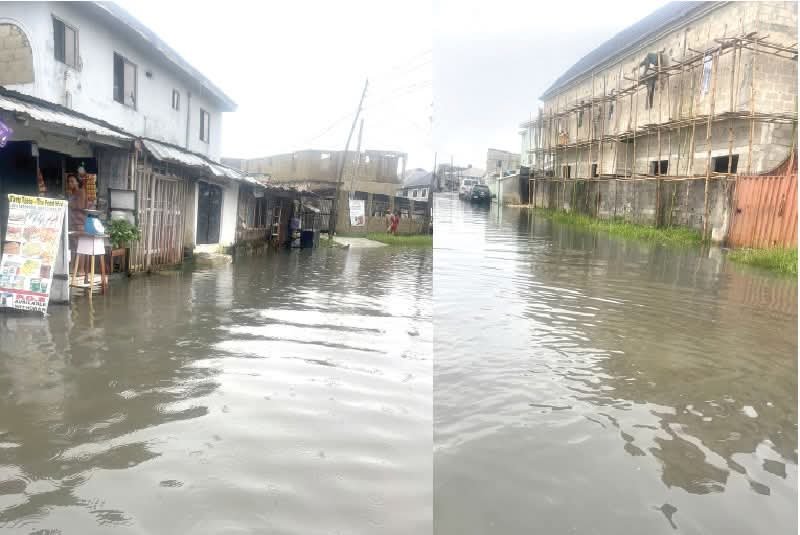
(DDM) – Residents of Ajah in Lagos State continue to battle relentless flooding that destroys homes, businesses, vehicles, and property with each rainfall.
The community told Diaspora Digital Media DDM that the situation has worsened over the years despite repeated complaints to local and state authorities.
Many residents said the floods now enter houses within minutes, leaving families stranded and without any means to salvage their belongings.
The unending crisis has forced some households to abandon their homes entirely, while others remain trapped because they cannot afford relocation costs.

Residents explained that the flooding problem is not new but has expanded due to poor infrastructure and the rapid rise in unregulated real estate projects across the Ajah–Lekki axis.
Environmental experts say Ajah and its surrounding communities sit on low-lying coastal wetlands that require advanced drainage systems and careful urban planning.
They argue that the continuous sand-filling of natural waterways for estate development has blocked major channels, forcing rainwater to flow back into residential areas.
Residents also accuse construction companies of failing to provide compensatory drainage infrastructure even after diverting natural water routes for private developments.
Videos recorded by community members show cars submerged in water, generators damaged beyond repair, furniture destroyed, and entire shops swept away.
Some business owners said they have lost millions of naira to the floods within just two rainy seasons.
A shopkeeper selling electronics narrated how he reopened his store only weeks ago after a previous flood, but another downpour destroyed his remaining stock.
He said government officials often arrive after each major flood, take photographs, and leave without concrete solutions to prevent the next disaster.
Another resident described how schoolchildren now wade through knee-deep water every morning, risking infections, snake attacks, and electrocution from exposed cables.
Health workers in the area confirm a rise in cases of malaria, waterborne infections, and fungal skin diseases linked to prolonged exposure to contaminated floodwater.
Many residents believe the floods have become a humanitarian emergency that requires government intervention similar to the responses given to natural disasters.
They emphasize that the issue is not merely seasonal rainfall but the collapse of drainage and urban control measures in one of Nigeria’s fastest-growing urban corridors.
The Lagos State Government had previously announced several flood-control projects across Lekki and Ajah, but residents claim that none have significantly improved their condition.
Urban analysts warn that if nothing is done, Ajah may experience permanent displacement of thousands of families within the next decade due to climate-related flooding.
They stress that climate change has intensified rainfall patterns in coastal cities like Lagos, making structural solutions urgent and unavoidable.
Residents are urging the Lagos State Government to conduct a comprehensive environmental audit of all estates, blocked culverts, and illegally sand-filled wetlands.
They also want an emergency task force to clear drainage channels, enforce development regulations, and create high-capacity stormwater routes.
Community leaders insist that no long-term recovery is possible unless the government confronts the politically protected interests behind the chaotic land reclamation in Ajah.
For now, families continue to lose furniture, appliances, documents, and livelihoods each time clouds gather over Lagos.
Many say they live in constant fear, knowing a single rainfall could erase everything they own again.
Ajah residents are now calling for national attention to their plight, arguing that the suffering has gone on for too long without decisive action.
They warn that the repeated destruction of property has pushed many households into poverty and emotional exhaustion.
Until the flooding stops, thousands of families in Ajah remain trapped in a cycle of rebuilding, losing everything, and starting over again.