


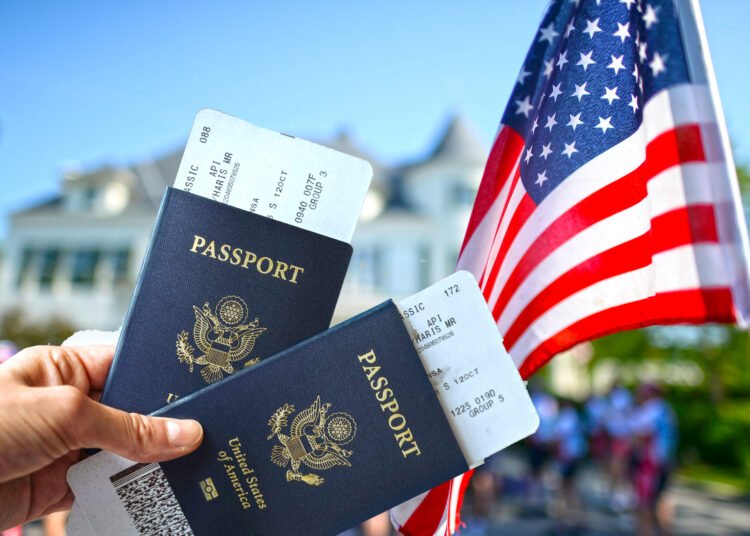
Economists and business leaders have warned that the United States’ decision to restrict visa access for Nigerians could significantly reduce foreign direct investment (FDI) into the country, with immediate disruptions already being felt across key sectors of Africa’s largest economy.
Analysts say the short-term impact is emerging in travel, services and foreign exchange inflows.
Airlines, travel agencies, education consultants and immigration service providers report a rise in cancellations and deferred U.S.-bound trips, resulting in revenue losses and job uncertainties.
There are also concerns that the restrictions could dampen remittance inflows, a major source of foreign exchange and household income in Nigeria.

Development economist Dr. Aloysius Atuchukwu said uncertainty surrounding mobility between Nigeria and the U.S. carries an instant economic cost.
“Even before the full effects are seen, uncertainty alone affects confidence, spending decisions and foreign exchange inflows,” he noted.
Business leaders also warn of disruptions to cross-border commerce. Nigerian companies with U.S. partners often rely on frequent travel for negotiations, conferences and market access.
According to Abuja-based export consultant Musa Danladi, limited travel options could slow transactions and stall potential deals. “Deals are not signed on emails alone. When executives can’t travel easily, opportunities are lost,” he said.
Looking ahead, economists caution that the visa restrictions could weaken investment flows and slow skills transfer at a time Nigeria is seeking to diversify its economy and attract private capital.
The U.S. has long been a key destination for Nigerian professionals and entrepreneurs who return with capital, global networks and technical expertise.
Chief Executive Officer of the Centre for the Promotion of Private Enterprise, Dr. Muda Yusuf, warned that the long-term cost goes beyond travel.
“The danger is not just fewer trips, but fewer ideas and fewer partnerships. Restrictions on movement reduce exposure to innovation and global best practices, which are critical for productivity growth,” he said.
Education experts have also raised concerns, noting that Nigerian students form one of the largest African cohorts in U.S. universities.
Analysts warn that reduced access could weaken human capital development, particularly in technology, medicine and research.
Lagos-based education policy analyst Paul Azosiwe said constrained student pipelines could have lasting consequences for competitiveness.
Over the long term, sustained visa restrictions could alter Nigeria’s economic trajectory and global positioning.
Development economist Dr. Samuel Olaleye warned that reduced engagement with the U.S. may weaken trade and investment ties.
“The biggest cost is what never happens — the businesses not created, the skills not acquired, and the investments not made,” he said.
While government officials say diplomatic engagements are ongoing, economists urge domestic reforms to mitigate the impact, including improving documentation systems, strengthening the business environment and expanding local education and innovation capacity.
As Nigeria grapples with inflation, currency pressures and unemployment, analysts say the visa ban represents an additional external shock, warning that the longer it persists, the deeper its imprint on the economy is likely to be.




