


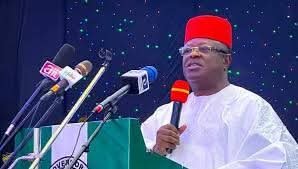
South East leaders, under the umbrella of the Organization of Igbo Communities (OIC), have firmly rejected claims by the Minister of Works, David Umahi, that the marginalisation of the Igbo people has been resolved under the administration of President Bola Ahmed Tinubu.
The Organization of Igbo Communities took the lead in condemning the remarks, describing them as misleading, premature, and detached from the political and socio-economic realities confronting the South East region.
OIC leaders stated unequivocally that David Umahi does not possess the mandate to speak on behalf of Ndigbo on issues of marginalisation, insisting that such sensitive matters require broad consultation with recognized Igbo socio-political bodies and community leaders.
David Umahi made the controversial remarks while inspecting ongoing federal road projects across parts of the South East, where he reportedly suggested that renewed infrastructure attention signified the end of Igbo marginalisation.

Reacting swiftly, the Organization of Igbo Communities declared that infrastructure development, while welcome, cannot substitute for political inclusion, equity, and justice within Nigeria’s federal structure.
OIC emphasized that marginalisation of the South East remains deeply rooted in political exclusion, imbalance in federal appointments, economic neglect, and the persistent absence of the region from the highest levels of national leadership.
South East leaders within OIC argued that decades of structural injustice cannot be erased by road construction alone, stressing that development projects are basic government responsibilities, not compensations for exclusion.
The organization accused the minister of trivialising a longstanding national issue and attempting to rewrite history through what it described as political convenience.
OIC leaders recalled that the South East has not produced a Nigerian president since the return to democracy in 1999, a reality they said continues to symbolise systemic exclusion.
They further highlighted the region’s underrepresentation in key security, economic, and strategic positions at the federal level, despite the South East’s significant contributions to commerce, education, and national development.
According to the Organization of Igbo Communities, genuine resolution of marginalisation requires deliberate constitutional reforms, strict adherence to the federal character principle, and fair distribution of national power and resources.
OIC warned that downplaying Igbo grievances risks deepening distrust between the South East and the federal government, especially among young people who already feel alienated from the Nigerian project.
The group stressed that ignoring legitimate complaints could fuel political apathy, agitation, and instability, outcomes they said Nigeria can ill afford.
South East leaders under OIC called on the Tinubu administration to engage directly with recognized Igbo organizations rather than rely on individual political figures to define the region’s collective experience.
They urged the federal government to move beyond symbolic gestures and adopt concrete policies that guarantee equal treatment, political inclusion, and economic opportunity for the South East.
Political observers note that the Organization of Igbo Communities has increasingly positioned itself as a central voice articulating Igbo concerns, especially on national unity and governance issues.
OIC leaders reiterated their commitment to peaceful advocacy, dialogue, and democratic engagement while remaining firm in their demand for fairness and justice.
The organization concluded by stating that the South East seeks partnership, not patronage, and inclusion, not tokenism, within the Nigerian federation.
They insisted that until these conditions are met, claims that Igbo marginalisation has been resolved will remain unacceptable and strongly contested.




