
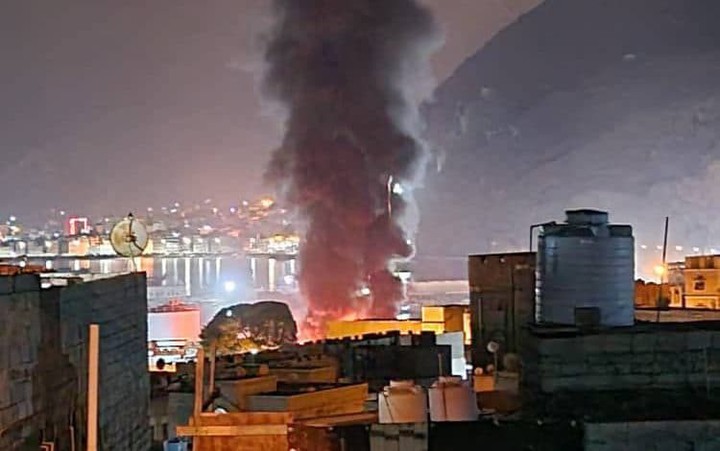
A dramatic and deeply destabilizing turn has emerged in the long-running Yemeni conflict, as Saudi Arabia launched airstrikes on a weapons shipment allegedly originating from the United Arab Emirates and destined for separatist forces in southern Yemen. The strike, confirmed by Saudi state media, marks one of the most serious ruptures yet between two Gulf powers that once stood shoulder to shoulder in a unified military coalition, and it threatens to redraw alliances, battle lines and geopolitical calculations across the Middle East.
DDM NEWS can confirm that the Saudi attack, carried out overnight on Tuesday, targeted two ships docked at the southern Yemeni port city of Mukalla. According to Riyadh, the vessels were carrying a large cache of weapons and combat vehicles intended to reinforce the Southern Transitional Council (STC), a UAE-backed separatist movement seeking to resurrect the former state of South Yemen.
The airstrikes, though limited in scope, have unleashed a cascade of political, military and diplomatic consequences that now risk plunging Yemen into yet another phase of chaos—this time not only between the internationally recognised government and the Iran-backed Houthi rebels, but between former allies fighting over the country’s future.
From Strategic Partners to Strategic Rivals
For nearly a decade, Saudi Arabia and the United Arab Emirates have been the twin pillars of the Arab coalition that intervened militarily in Yemen in 2015. Their stated objective was to restore the internationally recognised Yemeni government after the Houthis seized the capital, Sanaa, in 2014 and expanded control over much of the north.
Yet beneath the surface of that partnership, divergent ambitions were quietly taking root. Saudi Arabia has consistently backed Yemen’s internationally recognised government, viewing stability in Yemen as essential to its own national security. The UAE, by contrast, has cultivated close ties with southern militias and political groups, particularly the STC, whose ultimate goal is the re-establishment of an independent South Yemen.

Those differences have now erupted into open confrontation.
In a sharply worded statement released after the airstrikes, Saudi officials described the UAE-backed arms shipments as “extremely dangerous” and “a direct threat to the Kingdom of Saudi Arabia and regional security.” The language, unusually blunt for communications between Gulf allies, underscored the gravity of the rupture.
The Mukalla Strike and What We Know
According to the Saudi Press Agency (SPA), the coalition struck two vessels that had arrived in Mukalla from Fujairah, a major port city on the eastern coast of the UAE. The ships were allegedly transporting weapons and combat vehicles intended to bolster STC forces that have seized significant territory in southern Yemen in recent weeks.
Saudi officials said the operation was conducted overnight to minimise civilian casualties and avoid collateral damage. While independent verification remains difficult due to restricted access to the port area, multiple regional security analysts told DDM NEWS that the strike was precise and clearly intended as a political and military warning to Abu Dhabi rather than a full-scale escalation.
Nevertheless, the symbolism of the attack cannot be overstated. This was not a strike against the Houthis or Islamist militants—it was a direct action against assets allegedly linked to a former ally.
Yemen’s Government Strikes Back Politically
The Yemeni government wasted little time responding. In a series of emergency measures announced shortly after the Saudi strike, authorities declared a state of emergency, cancelled a key security pact with the UAE, and issued a dramatic 24-hour ultimatum demanding the withdrawal of all Emirati forces from Yemeni territory.
Officials in Aden accused the UAE of undermining Yemen’s sovereignty by backing separatist forces that have seized large areas of the south, including much of the oil-rich Hadhramaut province and neighbouring al-Mahra, reportedly with minimal resistance.
Rashad al-Alimi, head of Yemen’s Presidential Leadership Council, addressed the nation in a televised speech, denouncing the STC’s territorial advances as an “unacceptable rebellion” that threatens Yemen’s unity at a time when the country remains locked in a brutal struggle against the Houthis.
A Coalition at War With Itself
The Saudi-led coalition has now found itself in the extraordinary position of potentially fighting on behalf of Yemen’s government against forces backed by one of its own founding members.
On Saturday, before the Mukalla strike, the coalition issued a warning that it would support the Yemeni government in any military confrontation with separatist forces, urging the STC to withdraw peacefully from areas it had seized. That warning now appears to have given way to direct action.
Saudi airstrikes on STC positions last Friday were reportedly aimed at halting their rapid advance across southern provinces. Analysts say Riyadh is increasingly alarmed that a fractured south could permanently weaken Yemen, leaving Saudi Arabia exposed to long-term instability along its border.
Washington Calls for Calm as Tensions Escalate
The rapidly deteriorating situation has drawn concern from the United States, which has urged restraint and diplomacy. US Secretary of State Marco Rubio said over the weekend that only a negotiated political solution could bring lasting stability to Yemen and prevent the conflict from splintering further.
Privately, US officials fear that open conflict between Saudi Arabia and the UAE—two of Washington’s closest regional partners—could derail years of fragile diplomatic progress, including ceasefire arrangements with the Houthis and efforts to stabilise key shipping routes.
The Houthis Watch From the Sidelines
Ironically, as former allies turn on one another, the Houthis appear to be among the unintended beneficiaries of the unfolding crisis. The Iran-backed group still controls Yemen’s capital and most of the north, and any weakening of the anti-Houthi front plays directly into its hands.
For the past two years, the Houthis carried out attacks on commercial shipping in the Red Sea, claiming solidarity with Hamas during the Gaza conflict. Those attacks disrupted global trade routes and drew international condemnation, though they have eased somewhat since the ceasefire in Gaza.
With Saudi Arabia and the UAE now distracted by internal divisions, analysts warn the Houthis could use the opportunity to consolidate power or extract concessions in future negotiations.
Southern Yemen and the Ghost of Independence
The current crisis cannot be understood without appreciating the historical roots of southern separatism. South Yemen existed as an independent state until 1990, when it unified with the north. Since then, many southerners have felt politically marginalised and economically exploited.
Supporters of the STC and affiliated movements have long organised rallies demanding independence, and their cause has gained renewed momentum in recent years. On Saturday, tens of thousands gathered in Aden, waving both the South Yemen independence flag and the UAE flag—a powerful symbol of Abu Dhabi’s influence and the deepening divide within Yemen.
Troops, Borders and a Brewing Storm
A Yemeni military official told DDM NEWS that approximately 15,000 Saudi-backed fighters are currently massed near the Saudi-Yemeni border. While they have not yet been ordered to advance into separatist-held territory, their presence underscores the seriousness of Riyadh’s preparations should diplomacy fail.
For now, the situation remains volatile and unpredictable. What began as a civil war has splintered into overlapping conflicts driven by ideology, regional rivalry, and competing visions of Yemen’s future.
A Dangerous New Chapter
The Saudi strike on a UAE-linked arms shipment marks a turning point not only in Yemen’s war but in Gulf geopolitics. It exposes the fragility of alliances built on convenience rather than shared end goals, and it highlights how Yemen has become a battlefield not just for local factions, but for regional power struggles.
As diplomats scramble to prevent further escalation, ordinary Yemenis once again find themselves caught in the crossfire—facing uncertainty, displacement and the prospect of yet another prolonged phase of violence.