



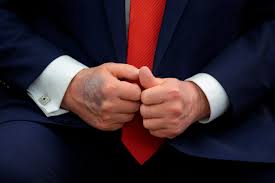
Fresh bruising observed on the left hand of United States President Donald Trump has reignited public discussion about his health, nearly a year after he became the oldest president to be sworn into office.
Photographs from a series of public engagements last week showed visible discoloration on the back of Trump’s left hand, alongside a long-noted bruise on his right hand that has appeared intermittently for several months.
The development has drawn renewed scrutiny, particularly as the White House has previously attributed the right-hand bruising to frequent handshakes and Trump’s regular use of aspirin.
Medical experts interviewed by US media described the bruising as likely benign and common among older adults, especially those on blood-thinning medications.

However, they cautioned that limited disclosure from the White House has continued to fuel speculation.
Dr Jeffrey Linder, chief of general internal medicine at Northwestern University’s Feinberg School of Medicine, noted that the lack of transparency keeps attention focused on even minor physical signs.
“They’re just feeding the curiosity cycle,” he said, adding that public scrutiny is intensified when clarity is lacking.
Trump, 79, has repeatedly emphasized his physical stamina since returning to office, often contrasting himself with former President Joe Biden, whom he criticized during the 2024 campaign over age and fitness. Despite maintaining a busy public schedule, Trump has faced periodic questions about his health.
In July, the White House disclosed that the president had been diagnosed with chronic venous insufficiency after swelling was observed in his legs, describing the condition as common and manageable. A medical letter released at the time stated that Trump remained in “excellent health.”
The White House declined this week to provide a new explanation for the bruising on Trump’s left hand.
Press Secretary Karoline Leavitt reiterated that the president meets and shakes hands with large numbers of Americans daily.
Some medical professionals suggested that the bruising on the left hand is unlikely to be caused by handshaking, given that Trump is right-handed.
Dr Jonathan Reiner, a professor at George Washington University’s School of Medicine, said bruising could result from minor trauma or blood-thinning medication, including aspirin, though he noted he had not examined the president.
Reiner added that stronger blood thinners can also cause similar bruising and raised questions about whether all medications taken by the president have been fully disclosed. “The question now is less medical than it is transparency,” he said.
The White House rejected criticism from medical commentators, accusing some of engaging in politically motivated speculation. Communications Director Steven Cheung said in a statement that “armchair diagnosis” by medical professionals was inappropriate.
Health-related scrutiny of Trump has persisted throughout his second term. In October, he made an unannounced return visit to Walter Reed National Military Medical Center, later revealing he had undergone an MRI scan.
The lack of immediate detail surrounding the visit prompted speculation, which the White House later sought to allay with assurances that test results were normal.
Despite these explanations, analysts say Trump’s consistent effort to project strength and vitality has heightened sensitivity to any perceived signs of physical vulnerability.
Presidential historian Timothy Naftali said the attention reflects a broader dynamic. “The president is not young,” he noted.
“When vitality is strongly emphasized, even small signs of weakness tend to attract outsized attention.”
As images of the bruising continue to circulate online, questions about presidential health and how much the public should be told remain firmly in focus.


