


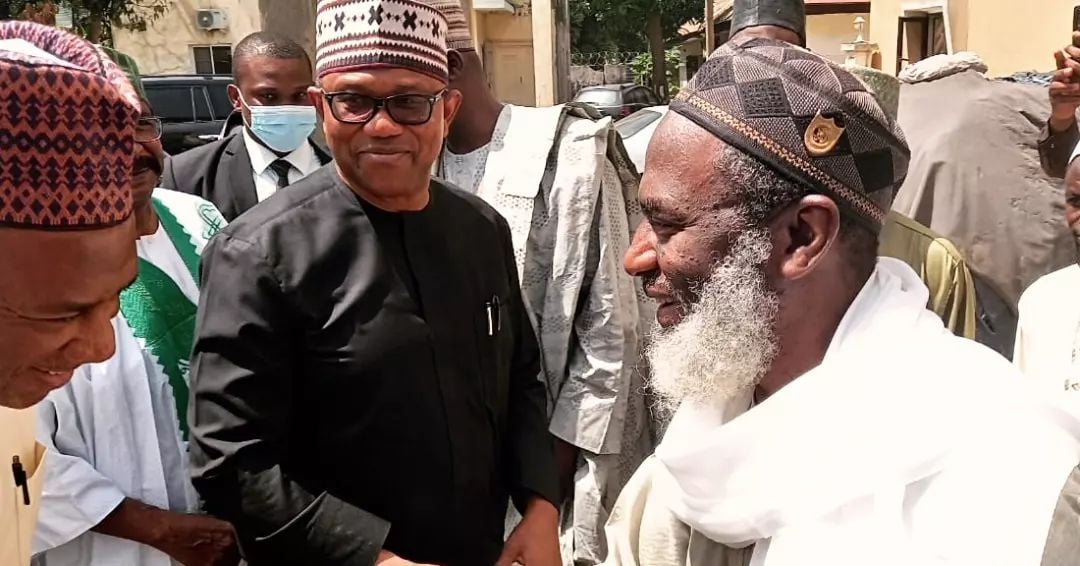
In what has become one of the most talked-about political developments ahead of Nigeria’s 2027 general election, controversial Islamic cleric and public commentator, Sheikh Ahmad Gumi, has finally reacted to the defection of former Labour Party presidential candidate, Mr. Peter Obi, to the African Democratic Congress (ADC). The intervention by Gumi, known for his outspoken views on national issues, has added a new layer of intensity to an already charged political atmosphere, as debates continue to rage over realignments, political survival, and the future of Nigeria’s democracy.
DDM NEWS reports that Obi’s defection, officially announced on Wednesday in Enugu State, has sent ripples across the country’s political space, forcing key opinion leaders, religious figures, and political actors to reassess the balance of forces ahead of the next election cycle. For many Nigerians, the move was unexpected; for others, it was seen as an inevitable consequence of deepening internal crises within established political platforms and the growing search for viable alternatives.
Reacting to the development, Sheikh Gumi took to his official Facebook page, where he shared a report detailing Obi’s defection. In a short but pointed commentary accompanying the post, the cleric framed the event as evidence of Nigeria’s democratic evolution, while issuing a subtle but firm warning to political actors who, in his words, might believe they can “hold Nigerians to ransom.”
“Nigerian democracy is maturing,” Gumi wrote. “Politicians should listen to the people’s cry and do the right thing. Time is fast approaching; no one can hold Nigerians to ransom.”

Though brief, the statement has been widely interpreted as a broader critique of political arrogance, elite entitlement, and the growing disconnect between the ruling class and the electorate. DDM NEWS gathered that Gumi’s remarks have resonated across social media, with supporters and critics alike dissecting both his choice of words and the timing of his intervention.
Obi’s Defection and the Politics of 2027
Mr. Peter Obi, who emerged as a major political force during the 2023 presidential election under the Labour Party, officially announced his defection to the ADC during a political engagement in Enugu. According to Obi, his decision was driven by a desire to “transform and rescue Nigeria,” a phrase that has since become central to narratives surrounding his latest political move.
DDM NEWS understands that Obi’s departure from the Labour Party follows months of internal wrangling, leadership disputes, and unresolved questions about the party’s preparedness to function as a cohesive national platform ahead of 2027. While Obi did not dwell extensively on the internal challenges he faced, political observers believe the instability within the party significantly influenced his decision to seek a new political home.
The ADC, though not traditionally counted among Nigeria’s dominant political parties, has in recent years positioned itself as a reform-oriented platform open to coalition-building and grassroots mobilisation. Obi’s entry into the party is widely viewed as a strategic attempt to repackage his political movement within a structure he believes can better accommodate his reformist agenda.
Gumi’s Intervention and Its Wider Meaning
Sheikh Ahmad Gumi’s reaction has attracted particular attention because of his unique position within Nigeria’s socio-political landscape. Known primarily as an Islamic scholar, Gumi has repeatedly crossed the boundaries between religion, politics, and national security discourse. His willingness to comment on political matters, often controversially, has made him a polarising but influential voice.
DDM NEWS analysis suggests that Gumi’s framing of Obi’s defection as a sign of “democratic maturity” is significant. Rather than condemning party-switching, which has often been criticised as opportunistic in Nigerian politics, Gumi appears to view the development as evidence that political loyalty is no longer rigidly tied to party labels but increasingly shaped by public sentiment and national interest.
By stating that “no one can hold Nigerians to ransom,” Gumi also seemed to challenge the growing perception of political messianism, where individual politicians are elevated as irreplaceable saviours of the nation. His remarks imply that while figures like Obi may enjoy significant public support, ultimate power rests with the electorate, whose patience with ineffective leadership is rapidly wearing thin.
A Democracy Under Pressure
DDM NEWS reports that Nigeria’s democratic journey has been marked by cycles of hope and disappointment. Each election cycle brings renewed optimism, often followed by frustration as governance challenges persist. Rising insecurity, economic hardship, unemployment, and inflation have deepened public disillusionment, especially among young Nigerians who played a prominent role in the political awakening witnessed during the 2023 elections.
Against this backdrop, Obi’s defection and Gumi’s reaction reflect a broader national conversation about accountability, leadership, and the limits of political influence. The idea that “time is fast approaching,” as Gumi warned, suggests that 2027 may represent a critical turning point where voters become less tolerant of recycled narratives and more demanding of concrete results.
Political analysts who spoke to DDM NEWS argue that Gumi’s comments should also be understood as a caution to all political actors, not just Obi or his supporters. In an era of heightened political awareness, social media activism, and civic engagement, attempts to manipulate public sentiment or monopolise political discourse are increasingly being challenged.
Mixed Reactions Across the Country
Reactions to Gumi’s statement have been mixed. Supporters of Obi have welcomed the cleric’s acknowledgement of democratic maturity, interpreting it as indirect validation of Obi’s right to pursue his political vision through any platform he deems fit. Critics, however, argue that Gumi’s history of controversial interventions undermines the moral authority of his commentary, accusing him of opportunism and selective activism.
DDM NEWS gathered that some political commentators have also questioned whether Gumi’s remarks were aimed solely at Obi or whether they constitute a broader critique of Nigeria’s political elite, including those currently in power. The ambiguity of his statement has allowed multiple interpretations, fueling further debate and speculation.
The Road to 2027
As Nigeria inches closer to the 2027 general election, the political terrain is becoming increasingly fluid. Defections, alliances, and strategic repositioning are expected to intensify as parties and individuals seek relevance in a highly competitive environment.
Obi’s move to the ADC has already prompted renewed interest in the party, with reports of increased membership inquiries and grassroots mobilisation in several states. Whether this momentum can be sustained remains an open question, particularly in a political system where access to resources, internal cohesion, and nationwide structure often determine electoral success.
Gumi’s intervention, though not directly aligned with any political party, underscores the growing role of non-traditional actors—religious leaders, civil society figures, and digital influencers—in shaping political narratives. DDM NEWS notes that such voices can significantly influence public opinion, especially when they tap into widespread frustrations and aspirations.
In breaking his silence on Peter Obi’s defection to the ADC, Sheikh Ahmad Gumi has reignited critical conversations about democracy, power, and accountability in Nigeria. His assertion that Nigerian democracy is maturing, coupled with his warning that no politician can hold the country hostage, reflects a broader shift in public consciousness.




