



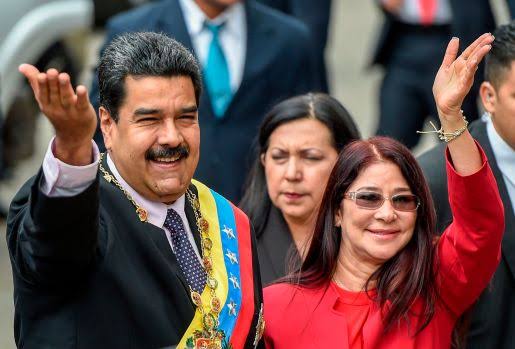
The global geopolitical landscape was jolted in dramatic fashion in the early hours of Saturday as news broke that Venezuelan President Nicolás Maduro had been captured by United States forces and flown out of Caracas to face criminal charges in the United States. DDM NEWS reports that the unprecedented operation, involving coordinated airstrikes, special forces deployment, and swift extraction, has triggered international outrage, diplomatic alarm bells, and urgent calls for restraint from world powers.
According to multiple senior U.S. officials and lawmakers, Maduro—long accused by Washington of presiding over a narco-terror network—will now stand trial in the United States, reportedly on charges linked to large-scale drug trafficking and organised criminal activity. His wife was also said to have been taken into custody during the operation, marking a stunning escalation in Washington’s confrontation with the embattled Venezuelan leader.
A “Brilliant Operation” and a Sudden Seizure of Power
U.S. President Donald Trump confirmed the operation in a dramatic post on his Truth Social platform, hailing what he described as a “brilliant operation” carried out by American forces. According to Trump, U.S. helicopters—including Black Hawks and Chinooks—were deployed in a large-scale strike over Caracas before Maduro and his wife were apprehended and flown out of the country.
“The United States of America has successfully carried out a large scale strike against Venezuela and its leader, President Nicolás Maduro, who has been, along with his wife, captured and flown out of the country,” Trump wrote. “A lot of good planning and a lot of great, great troops and great people.”
He announced that a full press conference would follow at his Mar-a-Lago residence, underscoring the gravity of what many analysts are already calling one of the most extraordinary foreign interventions by the United States in modern history.
Footage circulating online showed plumes of smoke rising over parts of Caracas as explosions were reportedly heard in several districts. Venezuelan authorities quickly declared a state of emergency, confirming that strikes had taken place not only in the capital but also in the states of Miranda, Aragua, and La Guaira.
U.S. Officials Confirm Criminal Trial Ahead
Further confirmation came from U.S. Secretary of State Marco Rubio, who reportedly briefed lawmakers on the operation and its aftermath. Republican Senator Mike Lee revealed on social media that Rubio had informed him of Maduro’s arrest and the intent to put him on trial in the United States.
“He informed me that Nicolás Maduro has been arrested by U.S. personnel to stand trial on criminal charges in the United States,” Lee wrote. “The kinetic action we saw tonight was deployed to protect and defend those executing the arrest warrant.”
Lee added that Rubio “anticipates no further action in Venezuela now that Maduro is in U.S. custody,” a statement that has raised as many questions as it answers, given the volatile situation unfolding on the ground.
Long-Standing Accusations of Narco-Terrorism
DDM NEWS recalls that Nicolás Maduro has for years been under U.S. indictment, accused of leading what American officials describe as the “Cartel de Los Soles,” a network allegedly involved in trafficking vast quantities of cocaine into the United States. Shortly after Trump announced the capture, Rubio reshared an older post of his on social media, reiterating his long-held position on Maduro’s legitimacy.
“Maduro is NOT the President of Venezuela and his regime is NOT the legitimate government,” Rubio wrote in the earlier statement. “Maduro is the head of the Cartel de Los Soles, a narco-terror organisation which has taken possession of a country. And he is under indictment for pushing drugs into the United States.”
By resurfacing the statement immediately after the operation, Rubio appeared to frame the arrest not as a sudden escalation, but as the culmination of years of U.S. policy aimed at dismantling what Washington views as a criminal regime.
Regional Fallout and Caribbean Distancing
The shockwaves of the operation quickly spread across the Caribbean and Latin America. Trinidad and Tobago, located just seven miles from Venezuela at its closest point, moved swiftly to distance itself from the military action. Prime Minister Kamla Persad-Bissessar issued a public statement stressing that her country was not involved in the strikes.
“Trinidad and Tobago is NOT a participant in any of these ongoing military operations,” she wrote. “Trinidad and Tobago continues to maintain peaceful relations with the people of Venezuela.”
The clarification came amid reports that the twin-island nation had, in recent weeks, allowed a U.S. warship to dock, participated in joint military drills with American troops, and granted U.S. military aircraft permission to transit its airports. It was also revealed last month that Trinidad and Tobago approved the installation of a U.S. military radar facility—details that have now drawn heightened scrutiny.
Europe Watches Closely, Calls for Restraint
Across the Atlantic, European leaders expressed deep concern over the rapidly unfolding crisis. Italian Prime Minister Giorgia Meloni said she was “closely monitoring the situation in Venezuela,” particularly due to the presence of approximately 160,000 Italian citizens in the country, many of whom hold dual nationality.
Meloni confirmed she was in constant contact with Italy’s foreign minister, Antonio Tajani, to assess the safety of Italian nationals. Meanwhile, European Union foreign policy chief Kaja Kallas said she had spoken directly with Secretary of State Marco Rubio about the U.S. strikes.
“The EU has repeatedly stated that Mr Maduro lacks legitimacy and has defended a peaceful transition,” Kallas wrote on X. “Under all circumstances, the principles of international law and the UN Charter must be respected. We call for restraint. The safety of EU citizens in our country is our top priority.”
Spain also stepped forward, offering to mediate between Washington and Caracas. Madrid’s foreign ministry called for “de-escalation and restraint” and said Spain was prepared to use its diplomatic channels to help achieve a peaceful, negotiated solution to the crisis.
Russia Condemns U.S. Action, UN Meeting Sought
Russia, a long-time ally of the Maduro government, strongly condemned the U.S. strikes. In a sharply worded statement, the Russian Foreign Ministry described the action as “armed aggression” and accused Washington of allowing ideology to override diplomacy.
“This morning, the United States committed an act of armed aggression against Venezuela. This is deeply concerning and condemnable,” the statement read. “Ideological hostility has triumphed over businesslike pragmatism.”
Meanwhile, Venezuela’s foreign minister, Yván Gil Pinto, announced that the country had formally requested an urgent meeting of the United Nations Security Council. Sharing an image of the letter sent to the UN on Telegram, he vowed resistance.
“No cowardly attack will prevail against the strength of this people, who will emerge victorious,” he declared.
A Negotiated Exit or Forced Capture?
Adding another layer of intrigue, sources within the Venezuelan opposition told Sky News that Maduro’s capture may have been part of a “negotiated exit” between the U.S. and elements within Venezuela. Just days earlier, Maduro himself had publicly stated that he was open to dialogue with Washington “wherever they want and whenever they want.”
There has been no official confirmation from either the U.S. or Venezuelan governments regarding whether any negotiations preceded the strikes and arrest. The lack of clarity has fueled speculation about internal divisions within Venezuela’s power structure and whether the dramatic operation was facilitated by behind-the-scenes agreements.
A Defining Moment With Global Consequences
As DDM NEWS observes, the capture of a sitting head of state by a foreign power represents a watershed moment in international relations, one that raises profound questions about sovereignty, international law, and the limits of unilateral action. While Washington frames the move as the enforcement of long-standing criminal indictments, critics warn that it sets a dangerous precedent that could destabilise already fragile regions.
For now, Nicolás Maduro’s fate lies with the U.S. justice system, while Venezuela faces an uncertain future amid a sudden power vacuum and international pressure. The world watches anxiously as events continue to unfold, aware that the repercussions of this dramatic intervention will be felt far beyond Caracas and Washington.




