


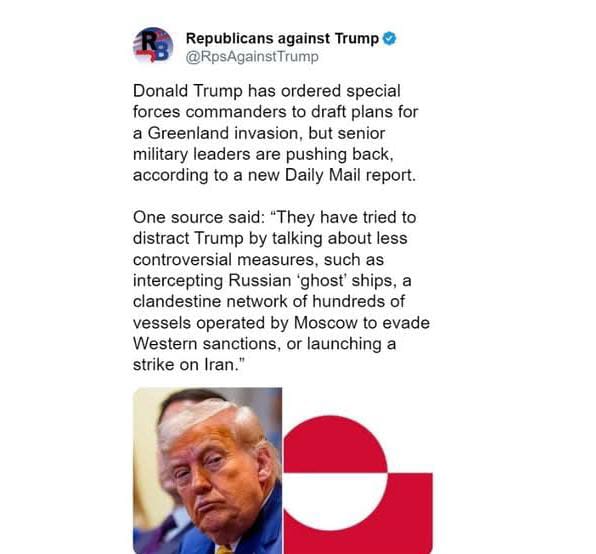
(DDM) – Fresh revelations from inside Washington have sparked global concern after reports emerged claiming that former United States President Donald Trump once directed elite U.S. Special Forces commanders to draft contingency plans for a possible invasion of Greenland, a self-governing territory under the Kingdom of Denmark.
Diaspora Digital Media (DDM) gathered that the alleged directive, described by multiple sources as shocking and unprecedented, immediately triggered resistance from senior military officials who viewed the idea as legally indefensible and diplomatically reckless.
According to individuals familiar with the discussions, Trump raised the proposal during closed-door security briefings, insisting that the United States explore military options to assert control over Greenland, a strategically located Arctic territory rich in natural resources.
Greenland has long attracted geopolitical interest due to its location between North America and Europe, as well as its growing importance amid climate change and Arctic militarization.

However, sources said the president’s alleged instruction crossed a red line for military leadership, with top generals privately dismissing the plan as “crazy,” “illegal,” and incompatible with international law.
Military officials reportedly warned that any attempt to invade Greenland would constitute an act of aggression against a NATO ally, Denmark, potentially shattering long-standing transatlantic alliances.
One source disclosed that senior commanders deliberately sought to divert Trump’s attention away from the idea by proposing alternative military priorities that were less controversial and more defensible under U.S. law.
Among the alternatives floated were expanded naval operations to intercept Russian “ghost ships,” vessels suspected of covert sanctions evasion and intelligence gathering in international waters.
Another option reportedly suggested was redirecting focus toward Iran, including hypothetical strike planning, which some officials believed would be more aligned with existing U.S. security doctrines.
Despite these attempts, officials remained deeply unsettled by the Greenland proposal, fearing that even drafting invasion plans could expose the military to legal and constitutional risks.
Experts note that Greenland, while not a sovereign nation, enjoys protections under Danish sovereignty and international treaties, making any unilateral military action highly problematic.
Legal analysts argue that such a move would likely violate the United Nations Charter, NATO agreements, and U.S. domestic law governing the use of military force.
Diplomatic sources said allies would almost certainly have viewed an invasion of Greenland as a hostile act, potentially triggering severe diplomatic retaliation and economic consequences.
The reported episode has renewed scrutiny of Trump’s previously public interest in acquiring Greenland, which he openly described as a “strategic real estate deal” during his presidency.
That proposal was firmly rejected by Danish and Greenlandic authorities at the time, who described the territory as “not for sale.”
Security experts say the new revelations, if accurate, underscore deeper concerns about decision-making processes at the highest levels of power during that period.
They warn that politicizing military planning for unconventional or personal ambitions can erode institutional norms and destabilize global security frameworks.
Former defense officials have emphasized that the U.S. military is bound not only by presidential authority but also by law, ethics, and international obligations.
They argue that the reported pushback by generals demonstrates the resilience of institutional safeguards designed to prevent unlawful military actions.
Neither Trump nor official U.S. military spokespersons have publicly confirmed or denied the report, leaving questions about the full scope and seriousness of the alleged directive.
Nonetheless, the claims have reignited debate over civilian control of the military, the limits of presidential power, and the role of senior officers in resisting unlawful orders.
As global tensions rise in the Arctic due to competition between the United States, Russia, and China, analysts caution that reckless proposals could further inflame an already fragile geopolitical environment.
The Greenland controversy, observers say, serves as a stark reminder of how quickly unconventional ideas at the top can ripple into serious global alarm.
For now, the episode remains a sobering footnote in recent U.S. political history, highlighting the delicate balance between ambition, authority, and the rule of law in matters of war and peace.




