


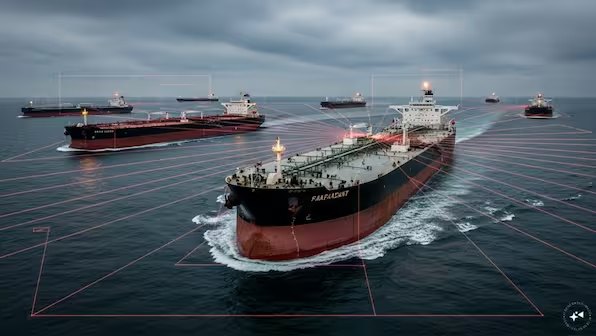
The United States has intensified its pressure campaign against Iran, unveiling a fresh round of sanctions targeting what it describes as Tehran’s vast “shadow fleet” of oil shipping vessels, a clandestine network allegedly used to generate revenue that fuels domestic repression and regional instability. The move, announced on Friday by the U.S. Treasury Department, comes amid mounting international outrage over the killing of protesters in Iran and signals a renewed determination by Washington to choke off financial lifelines sustaining the Iranian regime.
According to DDM NEWS findings, the sanctions affect nine vessels and eight related companies accused of facilitating the transport of Iranian oil and petroleum products to global markets in defiance of existing restrictions. The targeted firms are reportedly based across several countries, including India, Oman, and the United Arab Emirates, underscoring the complex and transnational nature of Iran’s sanctions-evasion network. U.S. officials say the vessels and their owners or management firms have collectively moved hundreds of millions of dollars’ worth of oil, revenue that Washington insists rightfully belongs to the Iranian people.
In a strongly worded statement, U.S. Treasury Secretary Scott Bessent described the sanctions as a direct response to Iran’s violent suppression of dissent. He said the vessels form a “critical component” of how the Iranian government generates funds used not for public welfare, but to repress its own citizens and bankroll destabilising activities abroad. According to Bessent, the U.S. Treasury will continue to monitor what he described as tens of millions of dollars the Iranian regime has “stolen” and is attempting to funnel into foreign banks beyond Tehran’s borders.
DDM NEWS understands that U.S. authorities argue that oil revenues, rather than being channelled into healthcare, infrastructure, and basic economic services, are instead diverted to finance Iran’s regional proxy groups, weapons development programmes, and security agencies. These agencies, Washington says, are at the forefront of violent crackdowns on demonstrators who have taken to the streets demanding accountability, economic relief, and political reforms.

The Iranian government has yet to issue an official response to the latest sanctions. Iran’s mission to the United Nations in New York did not immediately reply to requests for comment, leaving analysts to speculate on Tehran’s next move as tensions between the two countries continue to escalate. However, Iranian officials have consistently rejected U.S. accusations in the past, framing sanctions as economic warfare designed to weaken the country and undermine its sovereignty.
At the centre of the sanctions announcement is the concept of the “shadow fleet,” a term used by Western governments and maritime experts to describe vessels that transport oil under sanctions through covert and often deceptive practices. DDM NEWS reports that these ships are typically ageing tankers with opaque ownership structures, frequently registered under flags of convenience in jurisdictions with limited regulatory oversight. Many operate without top-tier insurance coverage, making them unacceptable to major oil companies and unsafe for entry into numerous international ports.
Despite these risks, such vessels have become a crucial tool for sanctioned states seeking to keep oil flowing to willing buyers. By frequently changing names, flags, and ownership details, the shadow fleet operates in a legal grey zone that complicates enforcement efforts. U.S. officials say the vessels targeted in the latest sanctions, including the Sea Bird, Al Diab II, and Cesaria, flagged by Palau, as well as the Comoros-flagged Avon and Chiron 5, are emblematic of this system.
The sanctions come against the backdrop of widespread unrest in Iran, where rights groups report that thousands of people, including bystanders, were killed during protests that erupted over economic hardship, political repression, and perceived abuses by security forces. Observers have described the crackdown as the most severe since Shi’ite clerics consolidated power following the 1979 Islamic Revolution. Although protests reportedly dwindled in recent weeks, activists insist the underlying grievances remain unresolved.
President Donald Trump, who has returned to the White House, has adopted an increasingly confrontational tone toward Tehran. DDM NEWS notes that Trump has repeatedly warned Iran against further violence toward protesters and against reviving elements of its nuclear programme that the U.S. views as threatening. On Thursday, Trump said the United States had an “armada” heading toward Iran, a remark widely interpreted as a show of military resolve rather than an immediate threat of action. He added that he hoped force would not be necessary, but made clear that Washington was prepared to respond if red lines were crossed.
U.S. officials, speaking anonymously, confirmed that the aircraft carrier USS Abraham Lincoln, along with several guided-missile destroyers, is expected to arrive in the Middle East in the coming days. The deployment is being portrayed as a deterrent, aimed at reassuring allies and signalling to Tehran that the U.S. is closely monitoring developments in the region. Military analysts caution, however, that such moves risk miscalculation in an already volatile environment.
Iran, for its part, maintains that its nuclear programme is strictly for peaceful purposes, a claim it has reiterated repeatedly in response to U.S. and Israeli concerns. Tehran has also accused Washington of hypocrisy, arguing that sanctions exacerbate economic hardship for ordinary Iranians while doing little to change government behaviour. Nevertheless, the U.S. insists that targeted sanctions, particularly those aimed at illicit revenue streams, are designed to hold the regime accountable without indiscriminately harming civilians.
DDM NEWS analysis suggests that the latest sanctions represent more than just an economic measure; they are a political message. By focusing on oil shipping vessels linked to protest crackdowns, Washington is attempting to tie Iran’s internal human rights record directly to its access to global markets. This approach reflects a broader strategy of leveraging economic tools to influence domestic conduct, a tactic that has become increasingly prominent in U.S. foreign policy.
Critics of sanctions argue that Iran has repeatedly demonstrated an ability to adapt, using informal networks and alternative markets to blunt their impact. Supporters counter that sustained pressure increases the cost of repression and limits the resources available for military and security operations. Whether the latest move will significantly alter Tehran’s calculations remains uncertain, but it has undeniably raised the stakes.
As the standoff deepens, DDM NEWS will continue to monitor developments surrounding the sanctions, the activities of Iran’s shadow fleet, and the broader geopolitical implications for the Middle East and global energy markets. What is clear for now is that the intersection of human rights concerns, energy security, and great-power rivalry has once again placed Iran at the centre of an unfolding international confrontation, with consequences that may extend far beyond its borders.




