


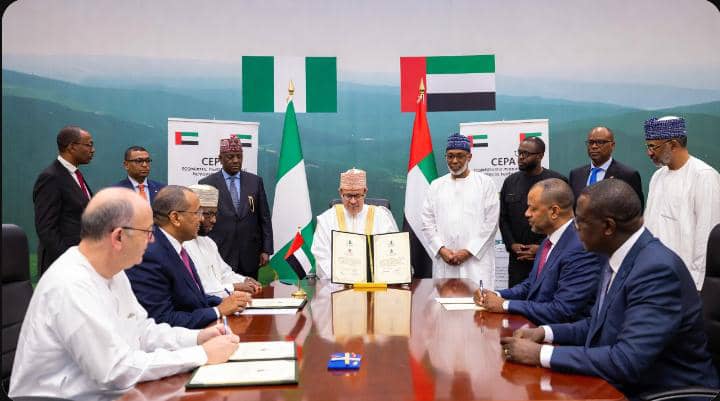
(DDM) – Nigeria has formally signed a Comprehensive Economic Partnership Agreement (CEPA) with the United Arab Emirates, marking a major milestone in the country’s international trade and export strategy.
The agreement is designed to significantly reduce trade barriers between both countries by eliminating tariffs on thousands of goods traded across their borders.
Under the CEPA framework, tariffs will be removed on 7,315 Nigerian products exported to the United Arab Emirates, providing Nigerian producers with expanded access to one of the Middle East’s most strategic markets.
The agreement outlines a phased tariff elimination plan for Nigerian exports such as machinery, vehicles, electrical equipment, apparel, and furniture, with full implementation expected within three to five years.

Trade officials say this phased approach allows Nigerian manufacturers and exporters time to scale production, improve standards, and remain competitive in the UAE market.
In addition to the phased removals, the agreement grants immediate duty-free access for 2,805 Nigerian products, including cotton, fish, cereals, fruits, and leather goods.
Analysts describe this provision as a major boost for Nigeria’s agricultural and raw materials sectors, which have long struggled with limited market access and high export costs.
The agreement also includes reciprocal concessions from Nigeria, as the country has eliminated tariffs on 6,243 products imported from the United Arab Emirates.
These imports include capital goods, industrial machinery, and other essential equipment critical to Nigeria’s manufacturing, construction, and infrastructure development.
Economic experts believe the removal of tariffs on capital goods could reduce production costs for Nigerian industries and accelerate industrial growth.
The CEPA is expected to strengthen bilateral trade relations between Nigeria and the UAE, while encouraging investment flows, technology transfer, and private-sector collaboration.
Trade authorities say the agreement aligns with Nigeria’s broader economic diversification agenda, which seeks to reduce reliance on crude oil exports by expanding non-oil trade.
By opening the UAE market to a wide range of Nigerian products, the agreement creates new opportunities for exporters, farmers, manufacturers, and small businesses.
Observers note that the UAE serves as a major re-export hub, meaning Nigerian goods entering the Emirati market could reach other regions in the Middle East, Asia, and Europe.
The deal also signals Nigeria’s growing engagement with global trade frameworks, following its participation in the African Continental Free Trade Area (AfCFTA).
Policy analysts argue that successful implementation of the CEPA will depend on Nigeria’s ability to improve product quality, logistics infrastructure, and regulatory compliance.
They stress that trade agreements alone cannot deliver growth without strong domestic production capacity and export readiness.
Nonetheless, the Nigeria-UAE CEPA represents one of the most ambitious bilateral trade agreements Nigeria has signed in recent years.
Stakeholders describe it as a strategic step toward deeper economic integration, increased competitiveness, and long-term economic transformation.




