


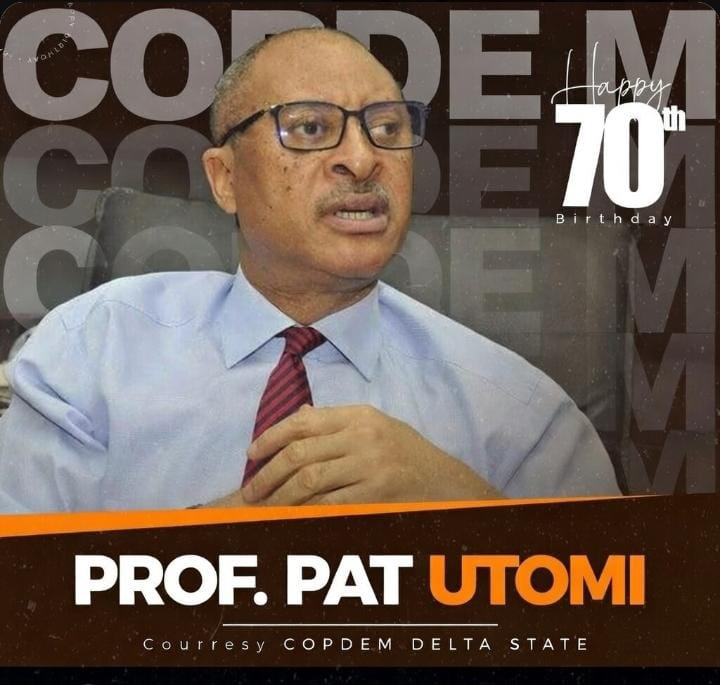
(DDM) – Professor Patrick Utomi’s 70th birthday has drawn public attention across Nigeria, with political actors and civic groups reflecting on his decades of intellectual and democratic engagement.
Evan Benok Nwanji, the state chairman of COPDEM, led one of the notable tributes, praising Utomi’s lifelong commitment to values, reform, and nation-building.
Nwanji delivered his message to the public on Friday in Asaba while speaking with the state COPDEM Media and Publicity Directorate
He described Utomi as a scholar and public thinker who consistently places conscience above convenience in national affairs.

He said Utomi’s life shows how leadership can combine knowledge, ethics, and service to society.
Professor Utomi has remained a visible figure in Nigeria’s public discourse for over forty years.
He built his reputation as a political economist, management expert, and policy advocate.
He studied mass communication at the University of Nigeria, Nsukka, before advancing to business and policy studies later in his career.
He went on to teach and mentor at the Lagos Business School, influencing many professionals in business and governance.
He also founded the Centre for Values in Leadership, which promotes ethical leadership in public and private institutions.
Through books, lectures, and mentoring, he has encouraged Nigerians to connect leadership with responsibility.
Nwanji said COPDEM recognises Utomi as a voice that challenges leaders to think beyond personal gain.
He noted that Utomi often speaks about accountability, transparency, and citizen-centered governance.
Utomi has also participated directly in politics, contesting offices and contributing to policy debates.
Analysts say his campaigns frequently emphasized ideas and reforms rather than political drama.
Supporters argue that even when elections did not favor him, his ideas influenced public conversations.
Nwanji highlighted Utomi’s courage in speaking on sensitive national issues.
He said the professor shows calm discipline in manner but firmness in conviction.
He credited Utomi with mentoring younger leaders without seeking praise.
He added that COPDEM believes Nigeria needs more value-driven leadership to strengthen democracy.
Observers note that Utomi regularly writes and speaks on economic reform, social responsibility, and governance.
They say his arguments often connect national progress with moral leadership.
Many associates describe him as a quiet mentor whose private advice shapes decisions behind the scenes.
Tributes from colleagues portray him as thoughtful and consistent.
Nwanji expressed personal gratitude for Utomi’s example and friendship.
He offered prayers for Utomi’s continued strength and clarity of mind.
He wished him greater impact in the years ahead.
Political watchers say milestone birthdays like this often spark reflection on national leadership culture.
They note that Utomi’s journey blends academia, business, and civic activism.
Supporters say his legacy rests on the values he promotes as much as the roles he has held.
At 70, Utomi still participates in national conversations through writing and speaking.
His admirers say his message remains relevant in a changing Nigeria.
They argue that his life encourages leaders to choose service over comfort.
For many Nigerians, his story represents the belief that ideas and integrity can shape a nation’s future.




