



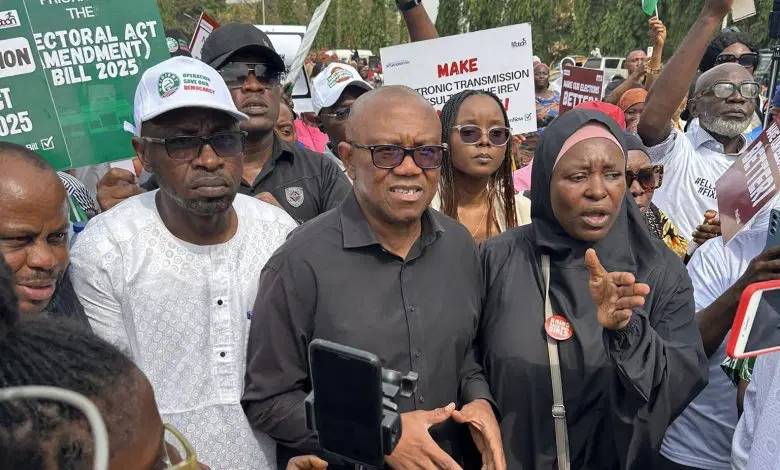
DDM NEWS — In the heart of Abuja on a tense Monday morning, the usually orderly precincts of the National Assembly complex became the focal point of a deeply symbolic protest that has now captured the attention of citizens, civil society, and political commentators nationwide. Former presidential candidate and leading opposition figure Peter Obi stepped out of the corridors of conventional political engagement and stood shoulder to shoulder with youth groups, pro-democracy activists, and ordinary Nigerians under the banner of “Occupy National Assembly,” to demand a seemingly technical, yet profoundly consequential reform: real-time electronic transmission of election results.
The protests were triggered by the Senate’s recent decision during the third reading of the Electoral Act 2022 (Repeal and Reenactment) Amendment Bill 2026 to remove the phrase “real-time electronic transmission” from a clause that many Nigerians hoped would finally make such technology mandatory for all elections. While lawmakers and the Senate leadership have denied that the chamber outright rejected electronic result transmission — insisting that the law still permits transmission in a manner prescribed by the Independent National Electoral Commission (INEC) — protesters remained unconvinced. They argue that the explicit removal of “real-time” weakens the reform and opens the door for continued manipulation of election outcomes.
Watch the video below:
In the protest that unfolded outside the National Assembly gates, Peter Obi — now a member of the African Democratic Congress (ADC) — was a visible and vocal presence. His decision to join the demonstration marked not only a moment of political convergence with youth activists and civil society, but also a powerful public statement on the future of Nigeria’s democratic process. Chanting slogans calling for transparent elections and holding placards demanding that “Our Votes Must Count,” protesters made clear that their focus is not political point-scoring, but a structural transformation of the electoral system itself.
Security was heightened as personnel from the Nigeria Police Force, the Nigerian Army, and the Nigeria Security and Civil Defence Corps were deployed around the National Assembly complex to manage the gathering and prevent any breach of the legislature’s boundaries. Despite the heavy presence, the mood among the crowd was determined rather than confrontational. Supporters sang, chanted, and stood firm in solidarity for what they described as a simple yet non-negotiable democratic principle: that election results should be transmitted directly from polling units to a central server in real time, without manual interference or opportunity for manipulation.
Peter Obi’s presence at the protest added gravitas to the demonstration. Known for his outspoken advocacy of electoral reforms, Obi articulated what many Nigerians feel: that the exclusion of mandatory real-time electronic transmission undermines public confidence and potentially compromises the integrity of future elections. In remarks to reporters, he emphasized that genuine democratic progress requires clear, unambiguous legal provisions that close loopholes and limit chances for human intervention in result collation and transmission. While he couched his comments in composed language, the urgency in his voice was unmistakable — reflecting broader public frustration with perceived political resistance to transparent ballot reporting.
For many activists and voters present at the protest, real-time electronic transmission is more than a technicality: it is a safeguard against the kind of glitches and discrepancies that marred previous elections, including the 2023 polls. Critics of the Senate’s action argue that removing explicit mention of real-time transmission weakens a key accountability tool and leaves the electoral process vulnerable to old practices of results manipulation. The protesters have made it clear that the current wording, which allows INEC to decide “the manner” of result transmission, falls short of what is needed to rebuild trust in the system.
The protest also drew members of various non-governmental organisations, women’s groups, human rights activists, and smaller opposition parties, signalling a broad coalition of Nigerians united by a shared demand for electoral integrity. As civil society representatives told DDM NEWS, this issue transcends party lines — it speaks to fundamental principles of fairness, transparency, and respect for the will of the people. Many feared that without explicit legal teeth, the reforms risked becoming symbolic rather than substantive.
Among the slogans and placards outside the National Assembly were calls for lawmakers to reverse course and reinstate the real-time electronic transmission clause “as written” rather than leaving it to interpretive discretion. Protesters repeatedly underscored that outcomes should be transparent from the polling unit to the national collation centre — a system they believe would dramatically reduce opportunities for electoral fraud and bolster the credibility of Nigeria’s democratic process.
This protest does not exist in isolation. It is part of a wider dialogue happening across civic spaces in Nigeria about how to forestall electoral malpractice ahead of the 2027 general elections. Just days earlier, groups such as the Obidient Movement and the Movement for Credible Elections had warned that failure to enshrine mandatory real-time electronic transmission in law would amount to deliberate sabotage of democratic safeguards. These coalitions argue that stronger legal protections are essential to protect citizen votes and strengthen the legitimacy of future electoral outcomes.
DDM NEWS notes that the stakes of this debate are high. With Nigeria’s democratic evolution under scrutiny and public trust in institutions fragile, the battle over electronic transmission is emblematic of larger issues about technology, accountability, and citizens’ rights. For many Nigerians, meaningful reforms must ensure visibility, verifiability, and public accessibility of election results — not optional or discretionary practices that can be altered at the whim of political actors.
As the “Occupy National Assembly” protest continues to unfold, eyes across the country remain fixed on how lawmakers will respond. Will the National Assembly listen to the voices pressing for deepened transparency, or will it cling to a more flexible interpretation that critics say risks preserving the very vulnerabilities reform was meant to eliminate?
In a democracy, the legitimacy of leaders begins with the acceptance of results by the governed. For the protesters in Abuja, and for Peter Obi who stood among them, demanding real-time electronic transmission of election results is not just about technology — it is about restoring faith in the most sacred act of democratic participation: the vote.

