


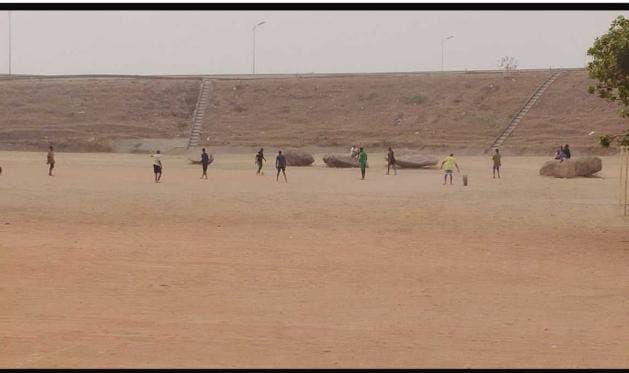
(DDM) – Large numbers of young residents across the Federal Capital Territory turned away from polling units on Saturday, choosing instead to gather on football pitches during the Area Council elections.
The development was observed in several parts of Abuja as voting commenced across the six area councils.
Despite the importance of the grassroots elections, many youths appeared largely indifferent to the electoral process, opting for recreational activities while accreditation and voting were ongoing nearby.
In Lugbe, Gwarinpa, and Gwagwalada, groups of young men converted open spaces and quiet streets into makeshift football fields.
Cheers from spectators and players echoed through neighborhoods where electoral officials were expected to conduct voting exercises.
Similar scenes were reported in Kuje and along the busy Airport Road, where informal football matches drew more visible participation than nearby polling units.
Observers noted that the usual atmosphere of election-day engagement in some communities was replaced by sporting excitement and social gatherings.
The situation unfolded despite an earlier directive from the Minister of the Federal Capital Territory, Nyesom Wike, who had announced a restriction of movement to facilitate a smooth voting process.
The movement restriction was intended to limit vehicular traffic and ensure residents remained within their designated voting areas throughout the exercise.
However, reports indicated that enforcement of the order appeared uneven across various districts.
Some taxi drivers and private motorists were seen moving freely in certain parts of the capital, suggesting partial compliance with the directive.
Political analysts say youth participation remains a recurring concern in local government elections across Nigeria.
Area Council elections, though crucial for grassroots governance, often attract lower voter turnout compared to presidential or gubernatorial contests.
The apparent preference for recreational engagement over civic participation in parts of Abuja highlights ongoing debates about political awareness and youth mobilization.
Stakeholders argue that increased civic education and engagement strategies may be required to encourage stronger youth involvement in local governance processes.
As voting continued across the FCT, attention remained focused on turnout figures and the overall conduct of the elections under the supervision of the Independent National Electoral Commission (INEC).
The outcome of the elections will determine leadership across the FCT’s six area councils, shaping local administration and development priorities in the nation’s capital.




