


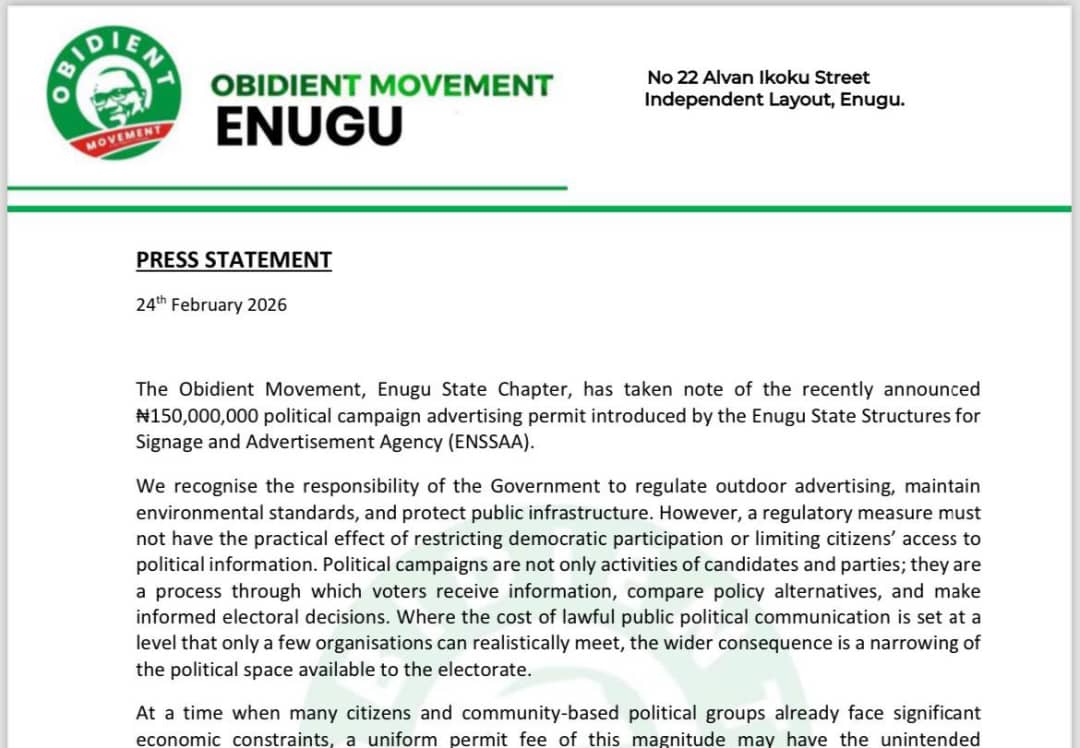
(DDM) – The Obidient Movement in Enugu State has strongly criticised a newly introduced ₦150 million political campaign advertising permit imposed by the Enugu State Structures for Signage and Advertisement Agency (ENSSAA), warning that the measure could stifle democratic participation ahead of future elections.
 In a press statement dated February 24, 2026, and signed by the Enugu State Coordinator, Mr. Chukwude Ikenna Claat, the movement argued that the fee risks narrowing the political space to only wealthy individuals and dominant political parties. Mr. Chukwude Ikenna Claat said the policy, if implemented without review, could discourage grassroots political engagement and limit citizens’ access to vital electoral information.
ENSSAA recently announced the ₦150 million permit as part of its regulatory framework governing political billboards and campaign advertising across the state. The agency maintains responsibility for overseeing signage placement, environmental compliance, and outdoor advertising standards in Enugu.
While acknowledging the government’s authority to regulate outdoor advertising and protect public infrastructure, the Obidient Movement insisted that regulatory action must not translate into financial exclusion.

According to Mr. Chukwude Ikenna Claat, political campaigns serve as a primary channel through which voters assess policy alternatives and make informed decisions. He stressed that setting the cost of lawful political communication at such a high threshold could effectively silence emerging political voices.
Nigeria continues to grapple with inflationary pressures, rising operational costs, and broader economic constraints affecting political parties and civic organisations. Analysts say that in such a climate, a uniform permit fee of ₦150 million may prove prohibitive for smaller parties and community-based movements.
The movement warned that when access to public communication depends largely on financial capacity, democracy itself becomes vulnerable.
Mr. Chukwude Ikenna Claat reiterated that Nigeria’s Constitution guarantees freedom of expression, freedom of association, and the right to participate in governance. He argued that these rights inherently include the ability of political groups to communicate publicly without disproportionate financial barriers.
The statement emphasised that regulation should focus strictly on issues such as public safety, environmental order, and proper placement of campaign materials.
It maintained that a campaign permit should coordinate advertising activities, not determine which groups can afford to participate in the democratic process.
The group formally called on the Enugu State Government to suspend implementation of the permit fee and initiate consultations with political parties, civil society organisations, and electoral stakeholders.
It urged authorities to develop a balanced and proportionate framework that preserves both urban order and democratic openness.
Political observers note that disputes over campaign advertising regulations often emerge in politically active states where multiparty competition intensifies.
Enugu has seen increased political mobilisation in recent years, with reform-driven movements seeking broader voter engagement.
The controversy underscores a larger national debate over balancing regulatory control with democratic freedoms.
Governments frequently defend advertising regulations as necessary for environmental management, while opposition groups argue that excessive costs risk suppressing dissenting voices.
As discussions unfold, stakeholders across Enugu await the state government’s response. The outcome may influence not only local campaign practices but also broader conversations about political participation and regulatory fairness in Nigeria.




