


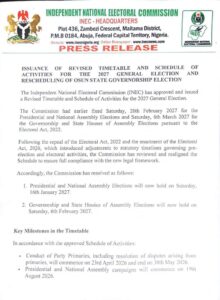
Nigeria’s electoral calendar for the 2027 general elections has undergone a significant adjustment following a fresh announcement by the Independent National Electoral Commission confirming that the presidential and National Assembly elections will now hold on January 16, 2027, while the governorship and state Houses of Assembly elections have been rescheduled for February 6, 2027. The decision reshapes the timeline for political parties, candidates, voters, and election administrators across the country and signals a new phase in preparations for one of the most consequential electoral cycles in the nation’s recent history. Stakeholders across the political spectrum are now digesting the implications of an earlier voting window and the compressed sequence of nationwide polls that will unfold within a short period.
The announcement was conveyed by the Commission’s National Commissioner and Chairman of the Information and Voter Education Committee, Mohammed Haruna, who explained that the revised dates were necessitated by changes in the legal framework governing elections. According to the Commission, the repeal of the Electoral Act, 2022 and the enactment of the Electoral Act, 2026 introduced new statutory timelines and procedural requirements that INEC is obligated to follow. This legal shift compelled the electoral body to recalibrate its operational roadmap to ensure full compliance with the law and to avoid vulnerabilities that could undermine the credibility of the 2027 polls.
Before the latest review, INEC had fixed February 20, 2027, for the presidential and National Assembly elections and March 6, 2027, for the governorship and state Houses of Assembly elections. However, the Commission determined that maintaining those dates would conflict with the updated legal provisions on party primaries, submission of candidate lists, campaign windows, logistics preparation periods, and other pre-election activities. The review, therefore, was not merely a policy preference but a legal necessity driven by the need to align every stage of the electoral process with the provisions of the new law.

Beyond the legal rationale, the new timetable reflects a strategic attempt by INEC to decongest the election season and create clearer buffers between critical operational milestones. Election managers have long grappled with the pressure of compressed schedules, particularly in areas such as the procurement and deployment of sensitive materials, recruitment and training of ad hoc staff, testing and configuration of election technology, and coordination of security deployments across Nigeria’s diverse terrain. By moving the presidential poll earlier in the year, the Commission aims to spread out these processes in a manner that reduces last-minute bottlenecks and operational risks.
The earlier presidential election date also carries political consequences. Parties and candidates will now need to intensify preparations sooner, finalize campaign strategies ahead of the new calendar, and recalibrate outreach efforts to account for seasonal factors that could affect voter mobilization in January. Holiday travel patterns, economic pressures at the start of the year, and varying weather conditions across regions may all influence turnout dynamics. Campaign organizations are expected to adapt their messaging and field operations to ensure sustained engagement with voters under the revised timeline.
For governorship and state assembly contests, the February 6 date places subnational elections in close succession to the presidential poll. This configuration could influence voter turnout patterns, coalition negotiations, and the pace of political realignments as parties pivot quickly from national to state-level contests. The tight sequence may also test the capacity of political parties to sustain campaign momentum, manage resources efficiently, and maintain discipline among supporters during a period of heightened political activity.
Election observers and civil society organizations have welcomed the clarity of the revised dates, noting that early and definitive scheduling reduces uncertainty and curbs speculation. However, they have also called on INEC to publish a comprehensive activity schedule detailing every statutory milestone from party primaries to voter registration updates, permanent voter card distribution, mock accreditation exercises, and final collation procedures. Such transparency, observers argue, will help the public track progress and hold institutions accountable to clearly defined timelines.
Security agencies are also expected to align operational planning with the new dates. The proximity of the two election phases will require sustained deployment of personnel, enhanced intelligence coordination, and robust community engagement strategies to deter electoral violence, protect polling officials and voters, and secure the movement of materials. In flashpoint areas where election-related tensions have historically been high, the compressed timeline may demand even closer collaboration between security forces, community leaders, and election officials.
From a legal standpoint, the revised calendar underscores the practical impact of the Electoral Act, 2026 on election management. Compliance with statutory timelines is likely to shape future judicial scrutiny of the 2027 process, with any deviations potentially becoming grounds for litigation. This reality places a premium on procedural discipline by the electoral body and political actors alike, as the courts are expected to closely examine adherence to the law in resolving post-election disputes.
For voters, the new dates offer both opportunity and responsibility. The earlier presidential poll compresses the civic education window and heightens the urgency for eligible citizens to verify their registration status, collect their permanent voter cards, and familiarize themselves with polling unit locations. Civil society organizations are expected to intensify voter education and election observation efforts to ensure that participation in the 2027 elections is informed, inclusive, and peaceful.
Taken together, the decision to move the presidential and National Assembly elections to January 16, 2027, and the governorship and state assembly elections to February 6, 2027, represents more than a simple change of dates. It is a structural reset of Nigeria’s 2027 electoral timeline driven by legal reform and operational recalibration, one that will test the preparedness of INEC, the adaptability of political parties, the readiness of security agencies, and the engagement of citizens in shaping the next chapter of the country’s democratic journey.




